Introduction
Every time I talk to farmers about irrigation, one problem comes up repeatedly they either water too much, too little, or at the wrong intervals. And in most cases, the issue is not the water supply itself. The issue is the sprinkler system design. Spacing is too wide, runtime is guessed, and the application rate is never calculated. Over time, this leads to waterlogged patches, dry corners, wasted energy, and lower yields.
Design your sprinkler irrigation system with our free calculator. Enter field size, crop water requirement, and sprinkler specs to get optimal sprinkler spacing, application rate in mm/hr, and recommended daily runtime in hours. Works for all crops and sprinkler types.
That is exactly why we built the Universal Sprinkler Spacing, Rate & Runtime Calculator on Precision Agriculture Calculators. It is designed for any farmer, agronomist, or irrigation planner anywhere in the world whether you are growing wheat in Canada, tomatoes in Spain, tea in Kenya, or citrus in Brazil. The tool supports both metric and imperial units, covers 35+ crops, and gives you a complete irrigation design in seconds.
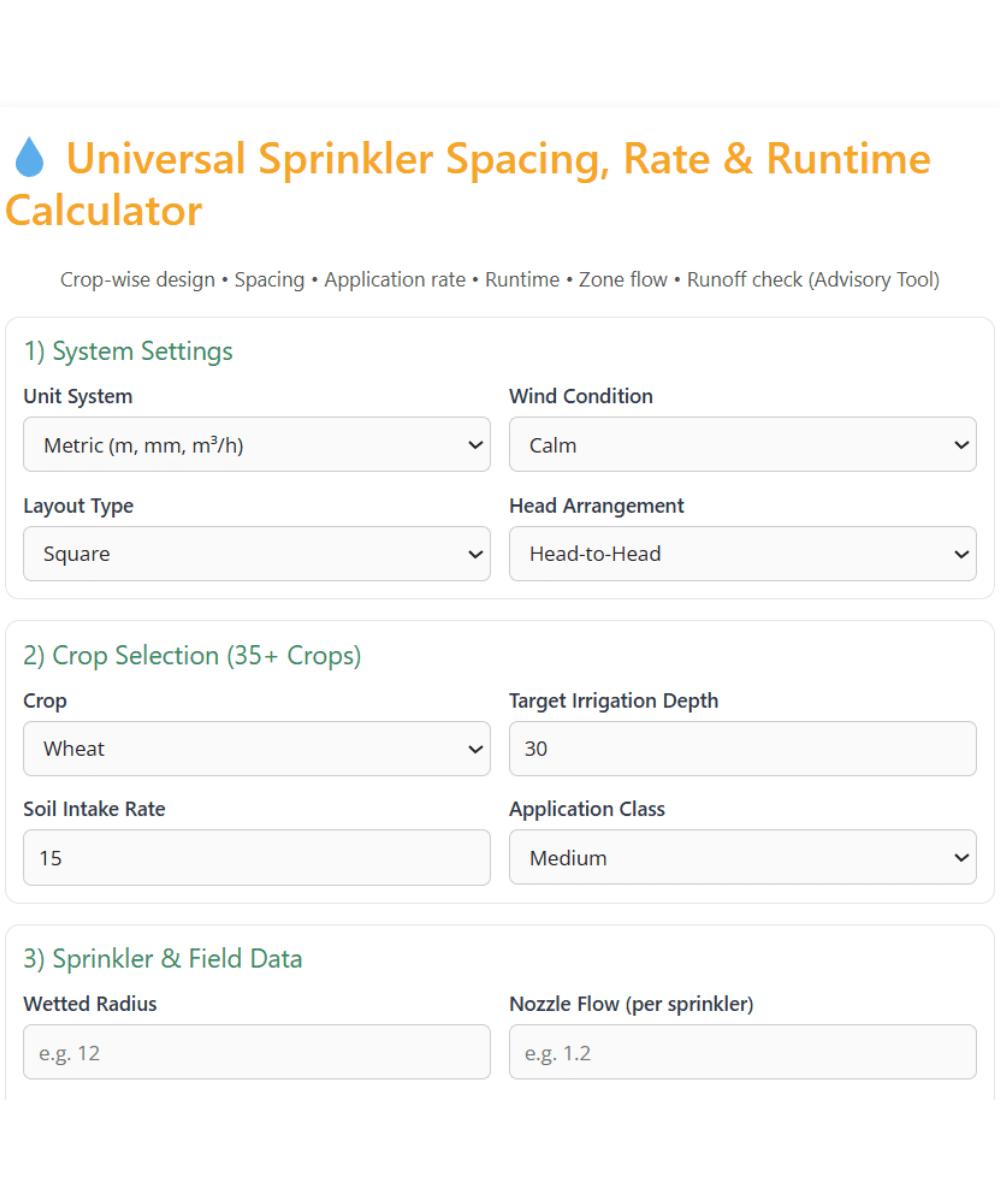
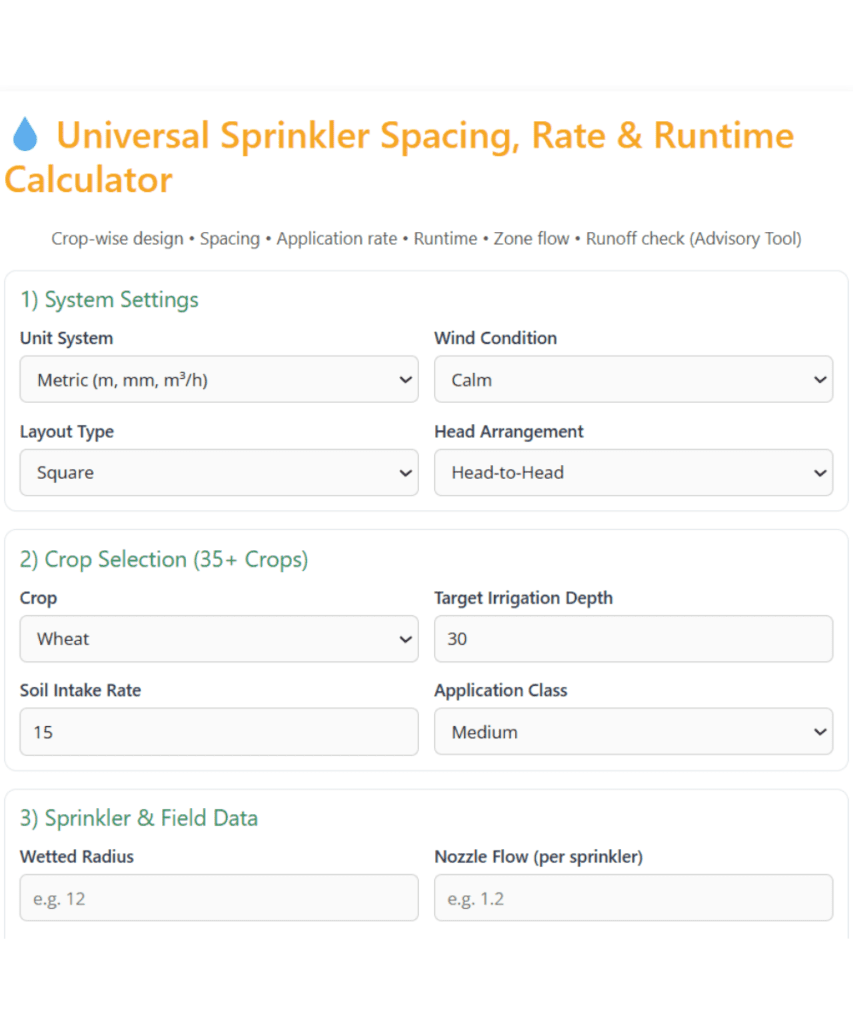
💧 Universal Sprinkler Spacing, Rate & Runtime Calculator
Crop-wise design • Spacing • Application rate • Runtime • Zone flow • Runoff check (Advisory Tool)
1) System Settings
2) Crop Selection (35+ Crops)
3) Sprinkler & Field Data
Why Sprinkler System Design Matters More Than You Think
Sprinkler irrigation is one of the most widely used irrigation methods in the world. According to the Food and Agriculture Organization of the United Nations (FAO), sprinkler irrigation accounts for a significant portion of irrigated agriculture globally, particularly in field crops, horticulture, and orchard production. Yet despite its widespread use, poor system design remains one of the leading causes of water waste and crop stress in irrigated farming.
The consequences of a poorly designed sprinkler system are well documented. Research published through the FAO Irrigation and Drainage Paper 45 highlights that uneven water distribution in sprinkler systems can reduce crop yield by 10 to 30 percent, even when the total volume of water applied appears sufficient. The problem is not quantity it is distribution uniformity.
When sprinklers are spaced too far apart, the overlap between wetted areas is insufficient, leaving dry zones in the field. When spaced too close, you waste water, increase runoff risk, and raise operating costs. Wind conditions, soil intake rates, nozzle flow rates, and operating pressure all interact to determine whether your system actually delivers water where it is needed. This calculator accounts for all of these variables in a single, streamlined interface.
What Inputs Does the Calculator Use?
The tool is organized into three clear sections. Here is a detailed breakdown of every input and why it matters:
Section 1: System Settings
- Unit System: Choose between Metric (metres, millimetres, m3/h) or Imperial (feet, inches, gpm). The tool fully adapts all calculations and output labels to your chosen system, making it usable for farmers and engineers worldwide.
- Wind Condition: Select Calm, Moderate, or Strong. Wind is one of the most underestimated factors in sprinkler design. Strong winds distort the water distribution pattern, reduce throw distance, and create dry pockets. The calculator applies a wind correction factor 1.0 for calm, 0.9 for moderate, and 0.8 for strong conditions directly into the spacing calculation.
- Layout Type: Choose Square or Triangular layout. A triangular layout positions sprinklers in a staggered grid, which typically improves distribution uniformity by up to 10 percent compared to a square layout for the same spacing.
- Head Arrangement: Head-to-Head means each sprinkler throws water to the next sprinkler head ideal for maximum uniformity. Head-to-Row reduces spacing slightly and is used in certain field configurations.
Section 2: Crop Selection
- Crop (35+ options): When you select a crop, the tool automatically fills in the recommended target irrigation depth and soil intake rate for that crop. It covers cereals, millets, pulses, oilseeds, vegetables, fruits, orchards, plantation crops, and turf making it truly universal.
- Target Irrigation Depth: This is the depth of water you want to deliver to the root zone in a single irrigation event, measured in mm or inches. For example, wheat typically needs 30 mm, while banana and mango may need up to 40 mm per irrigation.
- Soil Intake Rate: This is the rate at which your soil can absorb water, measured in mm/hr or in/hr. Sandy soils have high intake rates (25+ mm/hr), while clay soils are much lower (8-12 mm/hr). If your application rate exceeds the soil intake rate, runoff occurs and the calculator warns you about this.
- Application Class: Light, Medium, or Heavy. This adjusts the spacing factor light application suits shallow-rooted vegetables, while heavy application suits deep-rooted orchard trees.
Section 3: Sprinkler & Field Data
- Wetted Radius: The radius of the circle wetted by each sprinkler head under ideal conditions (metres or feet). This is available from the manufacturer’s specification sheet.
- Nozzle Flow Per Sprinkler: The water output of a single sprinkler head (m3/h or gpm). Again, this comes from the manufacturer’s datasheet.
- Operating Pressure: The working pressure at the sprinkler head (kPa or psi). Too low a pressure reduces the throw distance and creates poor distribution. The calculator warns you if pressure falls below recommended minimums.
- Field Length and Width: The actual dimensions of your field in metres or feet. The tool uses these to calculate the total number of sprinklers needed.
- Manufacturer Spacing Factor: This is the recommended spacing as a percentage of the wetted diameter. The default is 60%, which is a widely accepted standard for most sprinkler systems. Your sprinkler manufacturer’s chart may specify a different value.
- System Efficiency (%): Accounts for losses due to wind drift, evaporation, and system imperfections. The default is 80%, which is a reasonable assumption for well-maintained sprinkler systems under normal conditions.
Understanding the Design Results
Once you click Calculate Design, the tool generates a complete Design Results table. Here is what each output means:
- Sprinkler Diameter: The full wetted diameter (twice the radius). This is the foundation of all spacing calculations.
- Spacing X and Spacing Y: The recommended distance between sprinklers along the field length (X) and width (Y). For triangular layouts, Spacing Y is automatically reduced by a factor of 0.866 to maintain proper overlap.
- Sprinklers (L x W) and Total Sprinklers: The number of sprinkler heads needed along the length and width of the field, and the total count. This directly informs your procurement and installation planning.
- Application Rate (mm/hr or in/hr): How much water the system applies per hour. This must be lower than the soil intake rate to prevent runoff. If the application rate exceeds the soil intake rate, the tool immediately flags a warning.
- Zone Flow (m3/h or gpm): The total water flow required to run all sprinklers in the zone simultaneously. This is critical for pump sizing and pipeline design.
- Net Runtime (hours): How long the system needs to run to deliver the target irrigation depth under ideal conditions.
- Gross Runtime (hours): The actual runtime needed after accounting for system efficiency losses. This is the number you use when programming your irrigation timer or scheduling your irrigation events.
Key Features and Smart Logic of This Calculator
What makes this tool stand out from a basic sprinkler calculator is the intelligence built into its calculation logic. Here are the key smart features:
- Wind Correction Factor: Automatically adjusts spacing based on wind conditions. This aligns with the guidelines published by the Irrigation Association (IA) and FAO, which both recommend tightening spacing by 10-20% under windy conditions to maintain distribution uniformity.
- Crop-Specific Defaults: The built-in crop database pre-fills the target irrigation depth, soil intake rate, and application class for each of the 35+ crops. This saves time and reduces the risk of input errors.
- Triangular Layout Adjustment: Automatically applies the 0.866 geometric factor for triangular layouts, which is the mathematically correct spacing for equilateral triangle arrangements.
- Runoff Warning: If the calculated application rate exceeds the soil intake rate, the tool warns you immediately. This is a critical check runoff not only wastes water but also causes soil erosion and nutrient loss.
- Low Pressure Warning: Operating below minimum pressure degrades distribution uniformity. The calculator flags this so you can address pump sizing or pressure regulator settings before installation.
- Wide Spacing Warning: If the calculated spacing exceeds 70% of the wetted diameter, the tool alerts you to the risk of poor overlap and dry zones between sprinkler heads.
- Print Report Feature: The built-in print button lets you generate a physical or PDF copy of your design report useful for sharing with contractors, suppliers, or agronomists.
Which Crops and Users Benefit Most from This Tool?
The calculator is designed for a global audience across diverse farming systems. Here is a breakdown of who benefits most:
- Field Crop Farmers (Wheat, Maize, Sorghum, Rice): These crops are typically grown over large areas and require uniform water distribution across the entire field. Proper sprinkler spacing and runtime calculation directly impacts grain filling, yield stability, and water use efficiency.
- Vegetable Growers (Tomato, Potato, Onion, Capsicum): Vegetables have shallow root zones and are highly sensitive to both overwatering and underwatering. The light application class and lower target depth defaults for vegetables ensure gentle, precise irrigation that supports consistent quality and reduces disease risk from waterlogged soils.
- Orchard and Fruit Farmers (Mango, Citrus, Apple, Grapes): Fruit trees require deep irrigation events that penetrate the full root zone. The heavy application class and higher target depth defaults for orchard crops reflect this need. Proper zone flow calculation is especially important for large orchards with hundreds of sprinkler heads.
- Plantation Crop Managers (Tea, Coffee, Sugarcane): Plantation crops often span undulating terrain and large areas. Uniform water distribution across the plantation is critical for consistent crop quality and productivity.
- Irrigation Engineers and Agronomists: The tool’s zone flow output, pressure checks, and layout optimization features make it a quick desktop design aid for professionals validating sprinkler layouts before full hydraulic analysis.
- Turf and Landscape Managers: The Turf/Lawn option with its default of 15 mm depth and 25 mm/hr intake rate is calibrated for fine-turf applications such as sports fields, golf courses, and landscaped areas.
Step-by-Step: How to Use the Universal Sprinkler Calculator
Let me walk you through a complete example. Suppose you are a tomato farmer in a semi-arid region with a 100m x 50m field, using a Knapsack-style portable sprinkler system, and you want to design your sprinkler layout before the season begins.
- Open the tool on Precision Agriculture Calculators.
- Set Unit System to Metric since your field measurements are in metres.
- Set Wind Condition to Moderate your region typically has afternoon wind. The tool will apply a 0.9 correction factor to your spacing automatically.
- Set Layout to Triangular and Head Arrangement to Head-to-Head for maximum distribution uniformity across the tomato beds.
- Select Tomato from the crop dropdown. The tool will automatically set Target Depth to 25 mm, Soil Intake Rate to 20 mm/hr, and Application Class to Light.
- Enter your sprinkler’s Wetted Radius say 12 metres (from the manufacturer’s datasheet).
- Enter Nozzle Flow as 1.2 m3/h and Operating Pressure as 300 kPa (from the same datasheet).
- Enter Field Length as 100 m and Field Width as 50 m.
- Keep Manufacturer Spacing Factor at 60% (the standard default) and System Efficiency at 80%.
- Click Calculate Design. The tool will instantly return your spacing values (X and Y), the number of sprinklers needed, application rate, zone flow, and both net and gross runtimes along with any warnings if the design has a risk of runoff or poor uniformity.
With these inputs, you would see that your application rate is well within the tomato soil intake rate, your gross runtime for a 25 mm irrigation event is approximately 0.39 hours (about 23 minutes), and your total sprinkler count gives you clear procurement guidance. If the wind warning appeared, you would know to schedule irrigation in early morning calm hours which also reduces evaporation losses.
For deeper understanding of sprinkler system design principles, the FAO Irrigation and Drainage Paper 45 and the Irrigation Association’s Center Pivot and Lateral Move Irrigation Design and Installation standards are excellent global references.
Explore More Irrigation and Farming Tools on Precision Agriculture Calculators
If you found this sprinkler calculator useful, you will benefit from these related tools, that work alongside your irrigation planning:
- Rainwater Harvesting Calculator — Estimate how much rainwater you can collect and store to supplement your sprinkler irrigation supply.
- Soil Moisture Depletion Calculator — Know exactly when your soil needs water again after an irrigation event, reducing unnecessary sprinkler runs.
Frequently Asked Questions
What is the ideal spacing for sprinkler irrigation?
The ideal spacing depends on the sprinkler’s wetted diameter, wind conditions, and crop type. As a general rule, spacing should not exceed 60-65% of the wetted diameter under calm conditions. Under moderate wind, reduce this to 50-55%. This calculator determines the optimal spacing automatically based on your specific inputs.
What does gross runtime mean and why is it different from net runtime?
Net runtime is the theoretical time needed to deliver the target irrigation depth assuming 100% efficiency. Gross runtime accounts for system losses water lost to wind drift, evaporation off leaves, and system inefficiencies. If your system efficiency is 80%, you need to run the system 25% longer than the net time to actually deliver the intended depth to the root zone.
Why does the tool warn about runoff?
Runoff occurs when water is applied faster than the soil can absorb it. This wastes water, causes soil erosion, and can leach nutrients away from the root zone. The application rate calculated by this tool should always be compared against your soil’s intake rate. If they are close, consider switching to a lighter application class, reducing nozzle flow, or irrigating in shorter cycles with rest periods.
Can I use this tool for large commercial farms?
Yes. The tool calculates zone flow (total water demand for all sprinklers running simultaneously), which is a key input for pump sizing and mainline pipeline design on large farms. However, for large commercial installations, the results of this tool should be used as a preliminary design guide.
Final hydraulic design including pressure loss calculations across the mainline and laterals should be completed by a qualified irrigation engineer. Refer to the ASABE (American Society of Agricultural and Biological Engineers) S436 standard for detailed sprinkler system design guidelines.
Does the calculator work for both portable and permanent sprinkler systems?
Yes. Whether you are using a portable Knapsack-style sprinkler setup, a semi-permanent lateral move system, or a fixed permanent overhead system, the core spacing, rate, and runtime calculations apply equally. The layout type and head arrangement options accommodate different installation configurations.
Conclusion
Sprinkler irrigation, when properly designed, is one of the most effective and water-efficient methods of delivering moisture to crops across a wide range of climates and farming systems. But the gap between a well-designed system and a poorly designed one can mean the difference between a profitable harvest and a season of crop stress, water waste, and high energy costs.
The Universal Sprinkler Spacing, Rate & Runtime Calculator on Precision Agriculture Calculators bridges that gap putting professional-level irrigation design within reach of every farmer, agronomist, and irrigation planner in the world, completely free of charge. Whether you are planning a new system from scratch, optimizing an existing layout, or simply verifying that your current sprinkler spacing and runtime are correct, this tool gives you the numbers you need to make confident, evidence-based decisions for your farm.
Disclaimer
The Universal Sprinkler Spacing, Rate & Runtime Calculator available on Precision Agriculture Calculators is intended for general educational, planning, and advisory purposes only. The results generated are based on standard agronomic and engineering formulas and commonly accepted irrigation design parameters.
Actual system performance may vary based on local topography, soil variability, water quality, pipeline pressure losses, pump characteristics, and other site-specific conditions. Users are strongly advised to verify all design outputs against manufacturer specifications, local irrigation standards, and professional engineering guidance before proceeding with system installation or modification.