Every season, farmers across the world make the same two irrigation mistakes and the frustrating part is that both mistakes look identical from the outside. They are standing in their field, running water through their system, watching their crops grow. But one farmer is over-irrigating. The other is under-irrigating. And neither one knows it until harvest time, when the damage is already done.
Over-irrigation does not just waste water. It leaches away the nutrients you just applied, promotes root diseases, creates waterlogged conditions that suffocate the crop, and in heavy clay soils can cause yield losses of 20 to 30 percent all while your water bill climbs higher every week. Under-irrigation, on the other hand, creates water stress at the crop’s most critical growth stages. A cotton plant stressed for water during boll formation. A wheat plant short on water during grain filling. A tomato plant wilting during fruit set. These are losses that never recover, no matter how well you manage the rest of the season.
The root cause of both problems is the same: most farmers irrigate on a fixed schedule based on habit or guesswork rather than on what the crop actually needs on that specific day, in that specific soil, at that specific growth stage.
Calculate the total water requirement for any crop across its full growing season. Free online crop water requirement calculator based on FAO Penman-Monteith method. Enter crop type, growth stage, and climate zone to get irrigation needs in mm, litres per acre, and cubic metres per hectare.
We built the Crop Water Requirement Calculator on Precision Agriculture Calculators to change that completely. It calculates your crop’s actual water need accounting for the crop type, its growth stage, your soil’s water holding capacity, your local evapotranspiration rate, effective rainfall, and your irrigation system’s efficiency and gives you a precise daily, weekly, and full-season irrigation figure in litres, cubic metres, gallons, or millimetres, for any field size in any area unit.
Crop Water Requirement Calculator
Calculate daily, weekly & full-season irrigation needs — with soil/land type adjustment, FAO Penman-Monteith method, 32 crops, and all area units including Acre, Hectare, Guntha & Bigha.
| Crop | Season (days) | Kc Initial | Kc Mid | Kc Late | ET₀ range | Total Water (mm) |
|---|
| Soil Type | Water Holding Capacity | Drainage | Irrigation Frequency | Water Adjustment | Common Regions (India) |
|---|---|---|---|---|---|
| 🏜️ Sandy / Light | Very Low | Very Fast | Every 2–3 days | +25% | Rajasthan, coastal areas |
| 🌱 Sandy Loam | Low–Medium | Fast | Every 3–4 days | +12% | Punjab, Haryana, UP |
| 🌍 Loam | Medium | Moderate | Every 5–7 days | Baseline | Most agricultural zones |
| 🧱 Clay Loam | Medium–High | Slow | Every 7–10 days | −8% | MP, Chhattisgarh |
| 🏔️ Heavy Clay | High | Very Slow | Every 10–14 days | −15% | Andhra Pradesh, Telangana |
| ⬛ Black Cotton | Very High | Very Slow | Every 12–15 days | −20% | Maharashtra, MP, Gujarat |
| 🟥 Red / Laterite | Low | Fast | Every 3–4 days | +15% | Karnataka, Goa, Kerala |
| 🌊 Alluvial | Medium–High | Moderate | Every 5–8 days | −5% | Gangetic plains, river deltas |
| 🪨 Sandy Clay / Gravelly | Very Low | Fast | Every 1–2 days | +30% | Hillside farms, rocky terrain |
Why Accurate Crop Water Calculation Is One of the Most Important Skills in Modern Farming
Water is agriculture’s most critical and most threatened resource. The Food and Agriculture Organization of the United Nations reports that irrigation accounts for approximately 70 percent of all freshwater withdrawals globally, and that globally, irrigation water use efficiency averages only 40 to 50 percent meaning more than half of all water applied to crops is lost to evaporation, runoff, or deep percolation before the crop can use it. Their comprehensive resource on crop water requirements and the FAO-56 methodology is available at https://www.fao.org/3/x0490e/x0490e00.htm.
The FAO’s landmark publication Irrigation and Drainage Paper No. 56, which is the scientific foundation for this calculator established the globally accepted framework for calculating crop water requirements using the reference evapotranspiration approach. This methodology, developed and refined over decades of agronomic research, is now the standard used by irrigation engineers, agronomists, and agricultural planners in every country in the world.
The World Health Organisation and FAO jointly estimate that closing the gap between current irrigation efficiency and what is achievable with science-based scheduling could reduce agricultural water use by 25 to 40 percent globally without any loss of yield. In water-scarce regions including large parts of India, Sub-Saharan Africa, the Middle East, and Central Asia this improvement is not optional. It is existential.
The USDA’s Natural Resources Conservation Service documents that properly scheduled irrigation based on evapotranspiration data consistently produces yield improvements of 5 to 20 percent compared to calendar-based irrigation, while simultaneously reducing water use by 15 to 30 percent. Their irrigation scheduling resources are available at https://www.nrcs.usda.gov/resources/education-and-teaching-materials/irrigation-water-management.
The cost of continuing to irrigate by habit rather than by calculation is enormous. A sugarcane farmer on 5 hectares of black cotton soil who over-irrigates by just 20 percent is wasting the equivalent of 5 to 8 lakh litres of water per season and the energy cost of pumping that water. A wheat farmer on sandy loam who under-irrigates by 15 percent during the grain-filling stage is leaving 8 to 12 percent of their potential yield on the ground. This calculator eliminates both risks by giving you a precise, scientifically calculated irrigation requirement before you even open your gate valve.
What the Crop Water Requirement Calculator Calculates
This is the most comprehensive free irrigation calculator available combining crop science, soil physics, and climate data into a single, instantly usable result. Here is every output and why it matters.
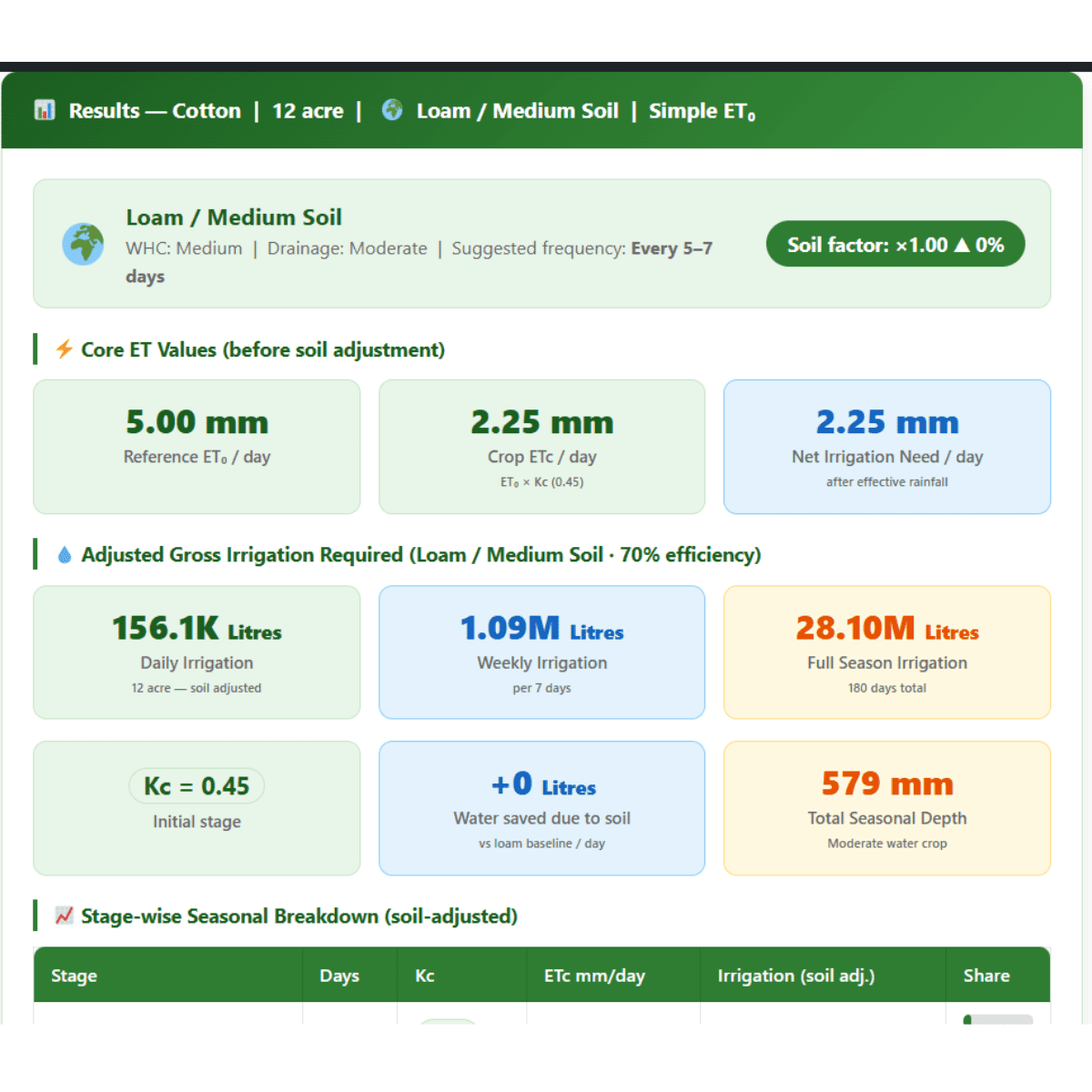
Reference ET₀ (mm/day): This is the amount of water a reference grass surface would lose to the atmosphere on a given day under your local climate conditions. It is the foundation of the entire calculation. Higher temperatures, lower humidity, stronger winds, and more sunshine all increase ET₀. The calculator accepts ET₀ as a direct input in Simple mode, or calculates it from your climate data using the FAO Penman-Monteith or Hargreaves-Samani methods.
Crop ETc (mm/day): This is the actual water consumption of your specific crop on a specific day, calculated as ET₀ multiplied by the Kc value for your crop at its current growth stage. A mature sugarcane crop in mid-season (Kc = 1.25) needs 25 percent more water than the reference surface. A late-season wheat crop (Kc = 0.25) needs only one quarter of the reference amount because it is drying down toward harvest.
Net Irrigation Requirement (mm/day): ETc minus effective rainfall. This is how much irrigation water the crop actually needs from you the portion of its water demand that rainfall is not covering. In the dry season, this equals ETc. During the monsoon, it may be zero.
Daily Gross Irrigation Requirement (litres/m³/gallons): The net requirement divided by your irrigation system’s efficiency, then adjusted for your soil type. This is the physical volume of water you need to apply to your field every day. Your irrigation system does not deliver water with 100 percent efficiency flood irrigation loses 30 percent or more; even drip loses 5 percent. And your soil’s water holding capacity either amplifies or reduces how much you need to apply per session. This output gives you the real number to work with.
Weekly Irrigation Volume: Daily requirement multiplied by seven. This is the planning number for weekly water purchasing, pump scheduling, and canal rotation booking.
Full Season Irrigation Volume: The total water your field needs from sowing to harvest. This is the number you use for water budgeting, borewell feasibility assessment, and farm-level water planning at the start of every season.
Soil Adjustment Factor and Delta: The calculator shows you exactly how your soil type is changing your water requirement compared to the standard loam baseline both as a multiplier and as an absolute daily volume difference. If you are farming on black cotton soil, you are saving 20 percent compared to loam. If you are on sandy or gravelly soil, you are spending 25 to 30 percent more.
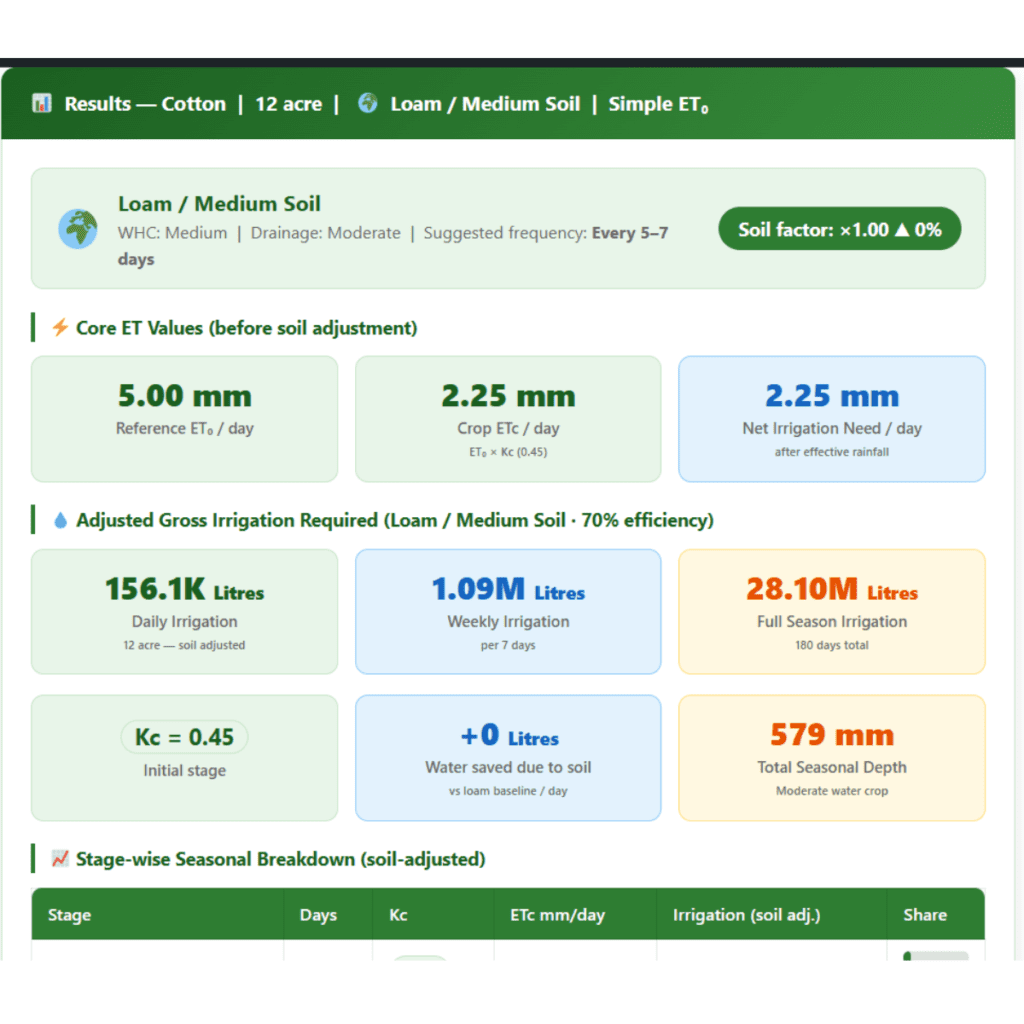
Stage-wise Seasonal Breakdown: A complete table showing how much water each growth stage (Initial, Development, Mid Season, Late Season) requires, the proportion of total seasonal water each stage uses, and a visual bar showing relative water demand across the season. This is the roadmap for your entire irrigation season.
Irrigation Scheduling Tip: Based on your soil type, the calculator tells you exactly how often to irrigate and approximately how much to apply per session turning a volumetric calculation into a practical, actionable irrigation schedule.
What Does the Calculator Ask You to Enter?
The calculator is organised into three clear sections. Here is what each input means.
Crop Selection: Choose from 32 crops across vegetables, fruits, field crops, and pulses. The Kc value and season duration are auto-filled when you select a crop. The 32 crops include tomato, onion, potato, chili, cabbage, carrot, spinach, cucumber, brinjal, okra, mango, grape, banana, pomegranate, watermelon, citrus, papaya, strawberry, guava, wheat, rice, maize, cotton, sugarcane, soybean, sunflower, groundnut, sorghum, bajra, chickpea, lentil, and black gram.
Growth Stage: Select Initial (germination and early establishment), Crop Development, Mid Season (full canopy cover), or Late Season (maturity and senescence). The Kc value changes automatically because crops use water very differently at each stage mid-season is typically peak water demand, while late season demand drops sharply as the crop matures.
Kc Value: The crop coefficient, auto-filled from the FAO-56 database for your selected crop and stage. You can override this with a locally calibrated value if you have one from your state agricultural university or extension service.
Season Duration: Total days from sowing to harvest. Auto-filled when you select a crop, but adjustable for your specific variety and local conditions.
Soil Type 9 Options: This is one of the most important and unique inputs in this calculator most irrigation calculators ignore soil type entirely. Choose from Sandy/Light Soil, Sandy Loam, Loam/Medium (the standard baseline), Clay Loam, Heavy Clay, Black Cotton Soil (Vertisol), Red/Laterite Soil, Alluvial Soil, and Sandy Clay/Gravelly. Each soil type carries a water adjustment factor based on its water holding capacity and drainage characteristics, ranging from +30 percent for gravelly soil to -20 percent for black cotton soil.
Field Area and Unit: Enter your field size in Acres, Hectares, Square Metres, Guntha, or Bigha. The calculator converts all units internally.
Water Volume Output Unit: Choose Litres, Cubic Metres, US Gallons, or mm (depth only). Farmers who work with drip systems often prefer litres. Irrigation engineers prefer mm or m³. The calculator accommodates all preferences.
Calculation Method: Three options for calculating ET₀. Simple ET₀ Input is the most practical enter the ET₀ value directly from your local agro-meteorological station, IMD data, or the NASA POWER web tool. FAO Penman-Monteith is the gold standard method requiring temperature (max and min), relative humidity, wind speed, sunshine hours, altitude, latitude, and day of year produces the most accurate results. Hargreaves-Samani requires only temperature data and is reliable when detailed climate data is unavailable.
Irrigation System Efficiency: Choose from Drip (95%), Sprinkler (85%), Furrow/Flood (70%), or Border Strip (60%). This factor accounts for distribution and conveyance losses in your irrigation system.
Effective Rainfall: The portion of rainfall that actually contributes to crop water needs typically 70 to 80 percent of total rainfall for moderate intensities. Enter zero during dry seasons.
What Makes This Calculator Practically Useful
Most irrigation calculators available online give a single number total water per hectare without accounting for soil type, growth stage, system efficiency, or rainfall. This calculator combines all four simultaneously, which is what irrigation actually requires.
The nine-soil-type adjustment system is the feature that sets this calculator apart from everything else available for free. A farmer on black cotton soil in Maharashtra and a farmer on red laterite soil in Karnataka growing the same crop in the same climate need completely different irrigation amounts. The black cotton farmer needs 20 percent less water because the soil holds it longer. The red laterite farmer needs 15 percent more because the soil drains it quickly. Without this adjustment, both farmers are getting the wrong number.
The three-method ET₀ calculation system makes this tool useful for both field farmers and technical users. A smallholder farmer with no climate station data uses the Simple method enter 5 mm/day as a reasonable default for most of India in summer and refine from there. An agronomist or irrigation engineer preparing a detailed water budget uses the full FAO Penman-Monteith method with actual weather station data for the most accurate results possible.
The stage-wise breakdown table is a practical season planning tool. Seeing that 35 percent of your seasonal water falls in the mid-season stage tells you when to have your pump serviced, when to negotiate your canal rotation slot, and when your water bill will peak. Planning for these pressure points in advance prevents the mid-season water crises that force farmers into panic irrigation at the wrong intervals.
The area unit flexibility acres, hectares, square metres, Guntha, and Bigha means farmers across different Indian states and international regions can use their own familiar units without any conversion. Guntha and Bigha are units used by millions of farmers in Maharashtra and North India respectively that most international agricultural calculators simply do not support.
Who Benefits Most from This Calculator?
Drip irrigation farmers across India: Farmers who have invested in drip systems and want to programme their irrigation timers scientifically not by feel. The calculator gives a precise daily volume in litres that maps directly onto dripper discharge rates and timer settings.
Sugarcane and cotton farmers in Maharashtra and Gujarat: These are among the highest water-consuming crops grown predominantly on black cotton soil a combination that dramatically affects irrigation scheduling. The soil type adjustment in this calculator is specifically designed to give accurate results for these farmers who are typically over-irrigating compared to what their soil and crop actually require.
Rice farmers converting to AWD (Alternate Wetting and Drying): Rice has one of the highest Kc values of any cereal (1.20 in mid-season). Farmers transitioning from continuous flooding to the water-saving AWD method need precise daily water demand calculations to manage their irrigation intervals correctly. This calculator supports that transition.
Fruit orchard farmers: Mango, pomegranate, citrus, grape, and banana farmers with permanent crops need seasonal water budgets to manage their drip or basin irrigation across the full year. The full-season volume output is directly usable for annual farm water planning.
Farmers with limited water supply: Borewell farmers with constrained pumping hours, canal farmers with allocated water quotas, and farmers in water-scarce regions need to know exactly how much water their crop needs to plan rational deficit irrigation strategies. This calculator gives them the baseline from which to make those decisions.
Agricultural engineering students and irrigation consultants: The FAO Penman-Monteith implementation in this calculator shows all intermediate calculations and is consistent with the FAO-56 standard making it directly useful for coursework, irrigation system design, and professional water auditing.
Home gardeners and kitchen farmers: The sqm area unit and litre volume output make this calculator equally useful for a 20 square metre kitchen garden as for a 20-hectare commercial farm. A home gardener wanting to know exactly how much to water their tomato plot in summer gets the same scientifically accurate answer as a commercial farmer.
Step-by-Step: How to Use the Crop Water Requirement Calculator
Let me walk through two complete examples one simple and one using the full Penman-Monteith method.
Example 1 Simple Method: Cotton Farmer in Maharashtra
Scenario: Pradeep grows Bt cotton on 5 acres of black cotton soil in Vidarbha, Maharashtra. It is mid-July his crop is in the development stage. Local ET₀ from the agro-met station is 5.5 mm/day. He uses flood furrow irrigation (70% efficiency). Effective rainfall from recent rain is 2 mm/day.
Step 1 Tab 1, Select Crop: Cotton. Season auto-fills to 180 days. Kc auto-fills to 0.75 for Development stage.
Step 2 Select Growth Stage: Crop Development.
Step 3 Select Soil Type: Black Cotton Soil. Soil factor = 0.80 (−20% water vs loam).
Step 4 Enter Field Area: 5 Acres.
Step 5 Select Water Volume Unit: Litres.
Step 6 Tab 2, Select Method: Simple ET₀ Input.
Step 7 Enter ET₀: 5.5 mm/day.
Step 8 Enter Effective Rainfall: 2 mm/day.
Step 9 Select Irrigation Efficiency: Furrow/Flood 70%.
Step 10 Click Calculate Now.
Results Pradeep sees:
- ETc: 5.5 × 0.75 = 4.13 mm/day
- Net irrigation need: 4.13 − 2.0 = 2.13 mm/day
- Gross requirement (before soil): 2.13 ÷ 0.70 = 3.04 mm/day
- After Black Cotton Soil adjustment (×0.80): 2.43 mm/day
- Field area: 5 acres = 20,234 m²
- Daily irrigation: approximately 49,200 litres
- Weekly irrigation: approximately 344,000 litres
- Full season total: approximately 8.8 million litres
Irrigation scheduling tip shown: “For Black Cotton Soil irrigate every 12–15 days with approximately 590,000 litres per irrigation session.”
Pradeep now knows he needs to schedule his canal rotation for approximately 590,000 litres every 12 to 15 days. Before using this calculator, he was irrigating every 7 days, applying nearly double what his black cotton soil required a significant waste of water and pump energy.
Example 2 FAO Penman-Monteith Method: Tomato Farmer in Karnataka
Scenario: Kavitha grows tomatoes on 1 hectare of red laterite soil in Dharwad, Karnataka. Her crop is in mid-season. She has a drip system (95% efficiency). She wants maximum accuracy and has her local weather station data.
Inputs: Tmax 33°C, Tmin 20°C, RH 55%, Wind 2.5 m/s, Sunshine 9 hours, Altitude 680m, Latitude 15.5°N, Day of Year 285, Effective Rainfall 0 mm.
Results:
- FAO Penman-Monteith ET₀ calculated: approximately 5.8 mm/day
- Kc for Tomato mid-season: 1.15
- ETc: 5.8 × 1.15 = 6.67 mm/day
- Gross (÷ 0.95 drip efficiency): 7.02 mm/day
- After Red Laterite Soil adjustment (×1.15): 8.07 mm/day
- Daily: approximately 80,700 litres (80.7 m³)
- Full season (125 days): approximately 10.1 million litres
Soil scheduling tip: “Irrigate every 3–4 days” because red laterite drains fast and cannot hold water long enough for weekly intervals.
Kavitha’s drip system controller can now be programmed to run for the exact number of hours needed to deliver 80,700 litres per day calculated from her dripper count and discharge rate.
Related Tools
These tools on Precision Agriculture Calculators work directly alongside the Crop Water Requirement Calculator:
- Soil Moisture Depletion Calculator– Know exactly when your soil has reached the depletion threshold and irrigation is needed the perfect companion to this calculator.
- Borewell Yield Estimator– Compare your full-season water requirement (from this calculator) against your borewell’s yield to assess whether your water supply is adequate.
- Irrigation & Fertigation Calculator– Combine your irrigation schedule with fertigation planning to deliver nutrients through your drip system precisely when and how much the crop needs.
Frequently Asked Questions
FAQ’s asking by people’s:
Q1: Where do I find my local ET₀ value for the Simple method?
The best sources for local ET₀ data are your state’s agro-meteorological observatory, the India Meteorological Department (IMD) Agromet Advisory Service, or the NASA POWER web tool (power.larc.nasa.gov) which gives free daily ET₀ data for any location on earth by entering your GPS coordinates. For most of India in summer months, ET₀ ranges from 5 to 8 mm/day. In winter it drops to 2 to 4 mm/day. In coastal and humid areas it is lower; in arid inland areas it is higher. If you have no data source at all, starting with 5 mm/day is a reasonable default for most tropical and subtropical locations.
Q2: My crops are on black cotton soil in Maharashtra. Why does the calculator give me less water than what my neighbour uses on sandy soil?
Because black cotton soil (Vertisol) has a very high water holding capacity it can store 200 to 300 mm of water per metre of soil depth, compared to only 50 to 80 mm for sandy soil. Once black cotton soil is wetted to field capacity, it releases water to roots very slowly and steadily for 12 to 15 days. Applying water again before that reservoir is depleted wastes irrigation and risks waterlogging. Your neighbour’s sandy soil drains in 2 to 3 days and genuinely needs more frequent, heavier irrigation. The calculator’s soil adjustment factor correctly accounts for this physics not just crop needs but soil storage capacity.
Q3: The calculator shows my full-season water requirement is 10 million litres. How do I know if my borewell can supply this?
Use the Borewell Yield Estimator on Precision Agriculture Calculators to calculate your borewell’s daily yield in litres. Multiply by the number of days in your season. If the borewell yield exceeds the seasonal requirement, you are water-secure. If it falls short, you need to consider supplemental sources, deficit irrigation strategies for lower-demand growth stages, or switching to a more water-efficient crop. Knowing your seasonal water requirement before sowing is exactly the kind of information that prevents mid-season irrigation crises.
Q4: What is the difference between the three calculation methods and which should I use?
Simple ET₀ Input is best for most farmers practical, fast, and accurate enough when your ET₀ value comes from a reliable local source. FAO Penman-Monteith is the international gold standard and gives the most accurate results when you have full weather station data use it for irrigation system design, water auditing, or any situation where precision is critical. Hargreaves-Samani is the best choice when you have temperature data but not the full suite of weather parameters reliable for day-to-day field decisions when only a thermometer is available. For AdSense and decision-making purposes, the Simple method produces results within 5 to 10 percent of the full Penman-Monteith method for most practical conditions.
Q5: Can I use this calculator for drip-irrigated polyhouse or greenhouse crops?
Yes, with one adjustment. Greenhouse crops typically have ET₀ values 20 to 30 percent lower than open-field crops because wind speed and solar radiation are reduced inside the structure. When using the Simple method for greenhouse crops, reduce your ET₀ input by 20 to 25 percent compared to outdoor values. The Kc values remain the same since the crop physiology does not change only the atmospheric demand is reduced. Alternatively, use the Hargreaves-Samani method with indoor temperature readings for a more direct calculation.
Conclusion
Your crop’s water needs change every day, every week, and every growth stage. The only way to irrigate correctly is to calculate correctly accounting for your specific crop, your growth stage, your soil’s water holding capacity, your local evapotranspiration rate, and your irrigation system’s efficiency.
The Crop Water Requirement Calculator gives you that calculation precise, scientifically grounded, and ready in seconds for any crop, any soil, any field size, and any location on earth.
Stop guessing how much water your crop needs. Start knowing.
Use the calculator now at Precision Agriculture Calculators and irrigate with the confidence that comes from science rather than habit.
Disclaimer
The irrigation requirements and water volumes produced by the Crop Water Requirement Calculator are approximate estimates based on the FAO-56 methodology and the soil texture classification system. Results are intended for planning and educational purposes and should be used as a starting point for irrigation scheduling, not as a rigid prescription.
Actual crop water requirements vary with local microclimate conditions, specific crop variety, canopy cover, mulching practices, actual soil moisture status, and irrigation system performance in the field. The Kc values used are from FAO Irrigation and Drainage Paper No. 56 and represent standard conditions locally calibrated Kc values from your state agricultural university will improve accuracy.
Soil type adjustments are based on generalised soil texture classes and water holding capacity ranges. Actual soil behaviour varies with organic matter content, soil structure, slope, and management history. Farmers are encouraged to validate calculator results against soil moisture observations in their own fields.
Precision Agriculture Calculators does not accept liability for crop yield outcomes or water management decisions made solely on the basis of this calculator. Always supplement calculator results with field observations, local agronomy advice, and soil testing.