Introduction
Many fruit farmers know their trees need pruning but aren’t sure when to do it, how much to remove, or which branches to cut.
Cut too little and the canopy stays dense. Light and air don’t reach the inner branches. Diseases establish in the shaded interior. Fruit quality stays mediocre despite good irrigation and nutrition.
Cut too much at the wrong time and you remove the wood that would have carried next season’s flowers. The tree spends the next year growing back what you cut instead of setting fruit.
Pruning is not the same for every fruit or every age of tree. A mango tree in its third year needs a completely different approach from a 15-year-old mango that has become too dense to manage. A grape vine needs two separate pruning events per year. Apple and cherry trees should only be pruned during winter dormancy. Citrus trees need almost no pruning at all compared to stone fruits.
Learn how to prune fruit trees step by step with our Fruit Tree Pruning Guide calculator. Complete pruning guide and Improve tree health, growth, and fruit yield easily.
We built the Fruit Tree Pruning Guide Calculator on Precision Agriculture Calculators to give farmers crop-specific, age-based pruning recommendations for 20 fruit types.
Enter your fruit type, tree age, current season, tree height, and spread. The calculator identifies your tree’s growth stage, recommends the pruning type, tells you what percentage of branches to remove, gives you the best timing for your specific crop, writes out an action plan, provides technical guidance on cutting angle and tool hygiene, and predicts the yield improvement you can expect.
It’s a complete pruning decision guide for any farmer managing a fruit orchard.
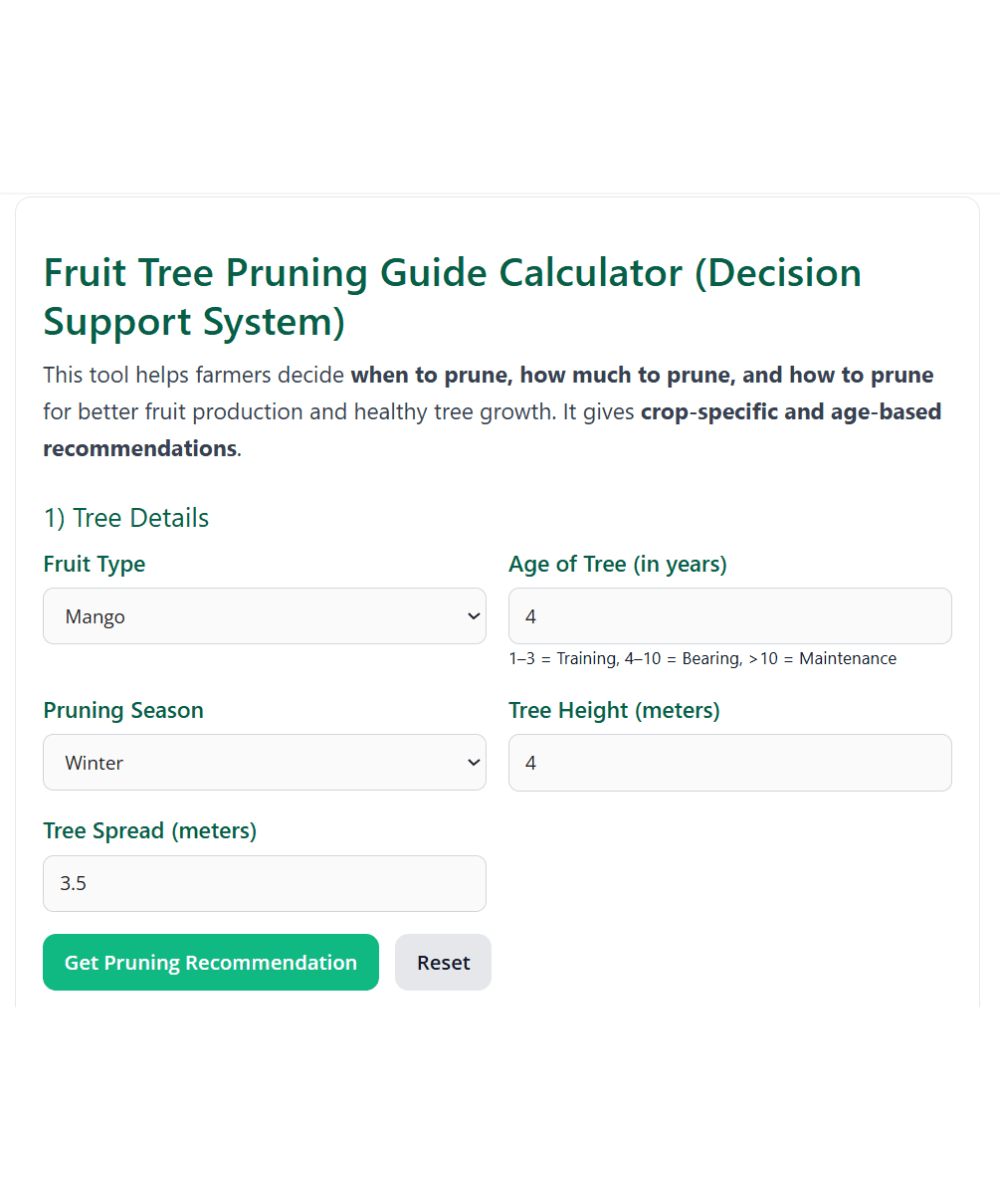
Fruit Tree Pruning Guide Calculator (Decision Support System)
This tool helps farmers decide when to prune, how much to prune, and how to prune for better fruit production and healthy tree growth. It gives crop-specific and age-based recommendations.
1) Tree Details
Why Pruning Is One of the Highest-Return Investments in Fruit Farming
Most farmers think of pruning as removing unwanted growth. That’s only half of it.
The deeper purpose of pruning is to redirect the tree’s energy from producing wood and leaves into producing flowers and fruit.
Research reviewed through the Food and Agriculture Organization of the United Nations (FAO) Horticulture resources and published horticultural science consistently shows that properly pruned orchards produce 20 to 35 percent higher fruit yield with significantly better fruit size, colour, and marketable quality compared to unpruned trees of the same variety on the same soil.
Here’s what good pruning achieves:
- Light penetration into the canopy. Fruit colour, sugar development, and size are all directly driven by light reaching the fruit and the wood that carries it. In a dense, unpruned canopy, 60 to 80 percent of the inner canopy is in permanent shade. The fruit produced there is small, pale, and low in sugar. Opening the canopy distributes light through all fruit-bearing positions.
- Air circulation reduces disease. Fungal diseases like powdery mildew, anthracnose, and botrytis thrive in the still, humid microclimate of a dense canopy. Good air movement dries leaf surfaces faster after rain or dew, dramatically reducing disease pressure and the number of fungicide applications needed.
- Directing energy to fewer, better fruit. An unpruned tree spreads its photosynthetic energy across thousands of shoots and fruit. A pruned tree concentrates that energy into fewer, better-positioned shoots and fruit. The result is larger, higher-quality fruit that commands better market prices.
- Controlling tree size for practical management. Trees that are never pruned grow taller each year. At 6 or 8 metres, harvest requires ladders, picking is slow and dangerous, and spray coverage of the upper canopy becomes difficult. Regular pruning keeps trees at a manageable height for efficient picking and spraying.
- Removing disease and pest reservoirs. Dead wood, crossing branches, and dense interior growth are the primary sites where pests overwinter and diseases carry over from one season to the next. Removing this wood at pruning time is one of the most effective sanitation practices in an orchard.
The International Society for Horticultural Science (ISHS) publishes extensive research on variety-specific pruning effects across all major temperate and tropical fruit crops. The evidence consistently confirms that regular correct pruning is among the most cost-effective production practices in fruit farming.
The Three Tree Growth Stages and Why They Need Different Pruning
The single most important variable in pruning is the age and developmental stage of the tree. The same tree at age 2, age 6, and age 15 needs completely different pruning approaches.
Training Phase: Years 1 to 3
Young trees in their first three years are building their permanent framework. This is the most important pruning period in the tree’s entire life because you are shaping the structure it will carry for decades.
The goal is not to maximize growth or yield. The goal is to develop 3 to 5 strong scaffold branches radiating outward from the trunk at the right angles and heights to support heavy fruit loads for years to come.
Pruning in this stage is light: approximately 15 percent of growth. You remove weak, crossing, and inward-growing shoots. You select the scaffold branches and remove everything that competes with them. You train the canopy shape: open vase for most fruit trees, central leader for apple and pear, or the specific training system for grapes and pomegranates.
Mistakes made in the training phase are extremely difficult to correct later. A poorly structured young tree becomes a management problem for its entire productive life.
Fruit Bearing Stage: Years 4 to 10
The tree is now productive. This is the stage most farmers are managing most of the time.
Pruning intensity is moderate: approximately 20 percent of branches. The focus shifts from building structure to maintaining productivity and fruit quality.
You remove suckers coming from the base and root zone. You take out dead, diseased, and overcrowded branches. You open the canopy centre to improve light and air penetration. You remove any crossing branches that are rubbing and creating entry points for disease.
The key principle at this stage is that fruit is borne on certain types of wood that varies by species. Mango fruits on the current season’s terminal shoots. Grapes fruit on the current season’s canes from the previous year’s wood. Knowing this determines which wood you keep and which you remove.
Maintenance Stage: Trees Older Than 10 Years
Old trees often have dense canopies from years of inadequate pruning, dead wood accumulating in the interior, and declining productivity as the productive outer canopy has grown too far from the trunk to manage easily.
Pruning intensity is the highest at 25 percent or more. This may include rejuvenation pruning where major scaffold branches are cut back heavily to stimulate completely new growth from lower on the tree.
Rejuvenation pruning looks dramatic. Farmers often hesitate because it temporarily reduces the tree’s appearance. But the productivity recovery after rejuvenation pruning is consistently striking: trees that had declined to 30 to 40 percent of their peak yield often recover to full production within 2 to 3 seasons after correct rejuvenation pruning.
Crop-Specific Pruning Timing for the 20 Fruits Covered
Timing is as important as technique. Pruning at the wrong time removes the wood that carries the next crop.
Mango
Prune immediately after harvest in June to July. Mango flowers on terminal shoots of the current season’s growth. Pruning after harvest removes the old fruiting wood and stimulates a new flush of growth that will carry next season’s flowers.
Pomegranate
Prune after harvest and before the next flowering flush. Pomegranate is a multi-stemmed shrub managed as a tree. Remove suckers aggressively throughout the season. Annual pruning opens the canopy and stimulates new fruiting wood.
Grape
Grapes require two pruning events per year. Rough pruning in April removes heavy old wood. Sweet pruning in October is the precision operation that selects the canes for the next season’s fruiting. Grape pruning is a skilled operation with significant variety-specific variation. Incorrect pruning is one of the primary causes of poor grape production.
Banana
Banana is not a tree but is treated like one in orchards. After the bunch is harvested, remove the old pseudostem at ground level. The management pruning involves selecting one primary sucker as the next generation ratoon and removing all other suckers.
Apple and Cherry
Both must be pruned during the winter dormancy period when the tree has no leaves and is fully dormant. Pruning during the growing season or at blossom time causes serious stress and gummosis in stone fruits. The dormancy period gives clear visibility of branch structure and allows the pruning wounds to seal before new growth begins.
Guava
Light pruning after harvest or before the flowering season. Guava is relatively tolerant of pruning timing but benefits from canopy thinning after each crop cycle to control size and stimulate new growth.
Citrus: Orange, Lemon, Mosambi
Citrus requires minimal pruning compared to most fruit trees. Prune after harvest and avoid heavy pruning during peak flowering. Remove dead wood, water shoots, and inward-growing branches. Over-pruning of citrus reduces yield.
Other Fruit Types
Avocado, fig, ber, jamun, jackfruit, tamarind, custard apple, and other tropical fruits each have specific pruning requirements that the calculator addresses based on age stage and canopy density. The general rule for all tropical fruits: prune after harvest and avoid pruning during active flowering or fruit set.
How the Canopy Density Check Works
The calculator uses a simple canopy index: tree height multiplied by tree spread in metres.
A tree 3 metres tall with a 3-metre spread has a canopy index of 9. A tree 4 metres tall with 4 metres spread has an index of 16.
When the canopy index exceeds 12, the calculator adds 5 percent to the pruning recommendation and flags extra thinning in the action plan. This threshold represents a canopy that has grown large enough relative to typical orchard spacing to cause significant shading and disease pressure.
This is a simple planning indicator, not a precise measurement. It helps farmers recognize when a tree has outgrown manageable size and needs extra attention beyond the standard age-based pruning.
The Technical Guidance in Every Result
Cutting Angle: 45 Degrees Above a Healthy Bud
Every pruning cut should be made at a 45-degree angle, slanting away from the bud, with the base of the cut level with the top of the bud.
This angle serves two purposes. It sheds water away from the cut surface, reducing the risk of fungal entry at the wound. And the angle directs the new growth outward in the direction of the retained bud.
Cuts made straight across (perpendicular to the branch) collect water and invite disease. Cuts made too far above a bud leave a stub that dies back and becomes a disease entry point.
Tools Required
Three tools cover most orchard pruning needs: pruning shears for small branches up to 1.5 cm diameter, a pruning saw for larger branches, and a grafting knife for clean-up cuts.
Tool quality matters. Sharp blades make clean cuts. Blunt tools tear wood, leaving ragged wound surfaces that take far longer to seal and are far more susceptible to disease entry.
Sharpen your pruning shears before every major pruning session and after every few hours of use. A sharp pruning shear is safer and more efficient than a blunt one.
Tool Sterilization
This is the most important hygiene practice in orchard management and the most commonly ignored one.
Disease-causing fungi and bacteria can be transferred from an infected tree or branch to a healthy one on contaminated cutting tools. In a commercial orchard with dozens or hundreds of trees, one infected tree can spread a pathogen to the entire block through unsterilized tools.
Sterilize tools between trees using a dilute bleach solution (1 part bleach to 10 parts water) or 70 percent alcohol spray. Dip or spray blades and wipe clean. This takes 30 seconds per tree and prevents losses that can take years to recover from.
What Does the Calculator Ask You to Enter?
Fruit Type
Select from 20 fruit options. The selection determines the fruit-specific best pruning timing shown in your results.
Tree Age in Years
The single most important input. Age determines the growth stage: Training (1 to 3 years), Fruit Bearing (4 to 10 years), or Maintenance (above 10 years). Each stage has a different pruning intensity, different objectives, and different action plan.
Pruning Season
Summer, winter, or monsoon. The calculator adjusts the action plan for monsoon season, adding a warning to avoid heavy pruning during the monsoon to reduce disease risk from wet wound surfaces.
Tree Height and Spread in Metres
Used to calculate the canopy index. Enter the current measured height and canopy spread of your tree. For spreading trees like mango and guava, spread is measured as the widest diameter of the canopy from one side to the other.
What Do Your Results Show You?
Tree Stage
Confirms which growth stage the calculator has placed your tree in based on age. Training Phase, Fruit Bearing Stage, or Maintenance Stage.
Recommended Pruning Type
Light Training Pruning for young trees. Medium Pruning for bearing trees. Heavy or Rejuvenation Pruning for old trees.
Suggested Canopy Reduction Percentage
The percentage of branches to remove in this pruning session. Note that this refers specifically to dry, diseased, and overcrowded branches, not a random 20 percent of all branches. The percentage guides intensity: light training is 15 percent, standard maintenance is 20 percent, and rejuvenation is 25 percent or more for dense canopies.
Best Time for Pruning
Crop-specific timing advice. For mango: immediately after harvest in June to July. For grape: rough pruning April, sweet pruning October. For apple and cherry: winter dormancy only.
Action Plan
A written sequence of what to do during the pruning session: which types of branches to remove, how to approach canopy opening, and any season-specific precautions.
Growth and Yield Prediction
The expected productivity improvement after correct pruning. Young trees: better shape and strong structure for future fruiting. Bearing trees: 20 to 30 percent improvement in fruit quality and yield. Old trees: 15 to 25 percent improvement after recovery period.
What Makes This Tool More Than a Generic Pruning Guide
Age-Based Stage Classification
Most pruning guides say prune lightly when young and more heavily as trees mature. This calculator converts that principle into specific stage classifications with specific percentages and action plans.
The transition from Training to Bearing stage at year 4 is particularly important. Many farmers continue light training pruning past year 3 out of caution, missing the opportunity to shift to yield-focused pruning that opens the canopy for fruit production.
20 Crop-Specific Timing Recommendations
Every fruit crop has its own phenology: its own annual cycle of dormancy, flush, flower, and fruit. Pruning timing must align with this cycle or it removes the wood that carries the coming season’s crop.
The grape two-step pruning (April rough pruning, October sweet pruning) is completely different from the single post-harvest mango pruning. The winter dormancy requirement for apple and cherry is non-negotiable in a way that monsoon avoidance for tropical fruits is not.
Having all 20 crops with their specific timing in one tool means a mixed orchard farmer can plan the pruning calendar for the entire farm from a single reference.
Canopy Density Adjustment
Adding the physical dimensions of the tree captures the real-world reality that a 10-year-old tree that has been well-managed is very different from a 10-year-old tree that has never been pruned and has a canopy index of 18.
The automatic 5-percent increase and extra thinning recommendation for dense canopies ensures that neglected trees get the more intensive treatment they need, not just the standard age-based recommendation.
Tool Hygiene in Every Result
Including tool sterilization as a fixed element in every result means it’s visible and reinforced every time the calculator is used.
This is not a minor detail. Disease transmission through unsterilized pruning tools is a major pathway for orchard diseases like bacterial canker in stone fruits, anthracnose in mango, and fungal wood diseases in grapes. Including it in every result ensures farmers see it every time they plan a pruning session.
Who Benefits Most from This Tool?
- Fruit Orchard Farmers Starting a New Plantation: The training phase recommendation is the most critical use of this tool. Getting the scaffold structure right in years 1 to 3 pays dividends for the entire productive life of the orchard. Use the calculator every year in the first three years to verify the right pruning intensity for each crop.
- Farmers with Mixed Orchards: A farm with mango, pomegranate, and grapes has three completely different pruning calendars and three different pruning approaches. Use the tool for each crop to plan a coordinated annual pruning calendar across the entire farm.
- Farmers Inheriting or Taking Over Neglected Orchards: Old, dense, overgrown orchards are one of the most common challenges in fruit farming. The maintenance stage recommendation with its rejuvenation focus directly addresses this situation, giving the farmer a clear plan for recovering productivity from neglected trees.
- New Fruit Farmers Learning Pruning Basics: The 45-degree cut guidance, tool list, and sterilization recommendation provide the foundational technical knowledge that a new farmer needs alongside the strategic pruning plan.
- Agricultural Extension Workers and Horticulturists: A quick field reference for generating pruning recommendations during farm visits for any of the 20 crops covered, without needing to carry or recall crop-specific pruning calendars for each species.
- Farmers After a Disease Outbreak: After a fungal or bacterial disease episode in the orchard, the pruning action plan and tool hygiene guidance provide the framework for the sanitation pruning needed to remove the disease reservoir and prevent recurrence.
Step-by-Step: How to Use the Fruit Tree Pruning Guide Calculator
Here’s a complete example. You have a mango orchard. Your trees are 6 years old, currently 4 metres tall with a 5-metre spread. It is now summer after harvest. You want a complete pruning plan.
- Open the Fruit Tree Pruning Guide Calculator.
- Select Mango as Fruit Type.
- Enter Age as 6 years.
- Select Summer as Pruning Season.
- Enter Height as 4 metres.
- Enter Spread as 5 metres.
- Click Get Pruning Recommendation.
Here’s what the results show:
- Tree Stage: Fruit Bearing Stage (age 6 falls in the 4 to 10 year bearing range).
- Pruning Type: Medium Pruning.
- Canopy index = 4 x 5 = 20. This exceeds the threshold of 12, so extra thinning is added and the percentage increases from 20 to 25 percent.
- Suggested Canopy Reduction: 25 percent of dry, diseased, and overcrowded branches.
- Best Time: Immediately after harvest (June-July). Since it is summer and post-harvest, this is the correct timing.
- Action Plan: Remove suckers, dry, diseased, and overcrowded branches. Open canopy centre for light and air. Extra thinning recommended because canopy is dense.
- Technical Guidance: 45-degree cut above a healthy bud. Tools: pruning shear, saw, knife. Sterilize before and after.
- Expected Benefit: 20 to 30 percent improvement in fruit quality and yield.
With this plan, you know to work through the mango block removing roughly one in four of the internal dry, diseased, and crossing branches. Focus on opening the canopy centre. Use a saw for the larger scaffold branches that need to come out and shears for smaller wood. Sterilize between trees.
For fruit-crop-specific pruning standards and horticultural management practices, the FAO Horticulture resources and the International Society for Horticultural Science (ISHS) research publications cover pruning science for all major tropical and temperate fruit crops. For country-specific variety recommendations and pruning calendars, contact your national horticulture research station or agricultural university.
Related Tools
Use the Fruit Tree Pruning Guide alongside these tools for a complete orchard management program:
- Advanced Spray Calculator — After pruning, a protective fungicide spray on fresh pruning wounds is essential for disease prevention. Use the spray calculator to plan the spray session.
- Liquid Fertilizer Dilution Calculator — Post-pruning fertilization encourages rapid new growth from pruned trees. Plan your liquid fertigation or foliar spray alongside the pruning calendar.
- Crop Growing Season Planner — Plan your complete orchard management calendar including pruning timing relative to flowering, harvest, and other key phenological events.
- Farm Machinery Valuation Depreciation Guide: Estimate Equipment Market Value Easily.
Frequently Asked Questions
My trees are old and very dense. Will rejuvenation pruning really work?
Yes, in almost all cases. Rejuvenation pruning is one of the most powerful interventions available to fruit farmers with neglected or declining orchards.
The reason it works is that fruit tree root systems are often much more intact and vigorous than the above-ground canopy suggests. When the heavy, shaded, unproductive upper canopy is removed, the roots support a vigorous flush of new growth from lower on the tree. This new wood is vigorous, well-lit, and highly productive.
The recovery takes 1 to 3 seasons depending on the crop and the extent of rejuvenation. Many farmers see dramatic improvement in their third post-pruning season. The temporary yield reduction during recovery is recovered and exceeded by the improved productivity that follows.
I pruned at the wrong time of year. What happens?
The consequences depend on the crop and how far off the timing was.
For most tropical fruits like mango, guava, and custard apple, pruning at the wrong time typically delays the next flowering flush by one season. The tree is not permanently damaged but you miss one production cycle.
For grapes, incorrect timing is more serious. Pruning after bud break removes the current season’s production entirely. This is why the two-step grape pruning calendar (April rough pruning, October sweet pruning) is so important to follow.
For apple and cherry in temperate climates, pruning during the growing season can cause gummosis, bacterial canker entry, and significant tree stress. These should only be pruned in dormancy.
Should I paint or seal pruning cuts?
Research on pruning wound sealants has produced mixed results. For most fruit trees, the tree’s natural wound-sealing response is adequate when cuts are made correctly at the right angle and with sharp, sterile tools.
For large diameter cuts on susceptible trees, particularly apple and pear in high disease pressure environments, a fungicidal wound sealant or pruning paste can provide additional protection. Apply the sealant immediately after cutting while the wound is fresh.
The more important protection is tool sterilization between trees, which prevents disease introduction at the wound site in the first place.
How do I identify which branches to remove?
Start with the 4 Ds: Dead, Diseased, Damaged, and Duplicate (crossing or rubbing). These are the non-negotiable removals regardless of age or crop.
Then look for water shoots: extremely vigorous vertical shoots growing straight up from scaffold branches. These rarely produce fruit and shade the productive wood below them. Remove all water shoots.
Then look for suckers growing from below the graft union or from the root zone. These are from the rootstock variety and must be removed before they dominate the fruiting variety above.
Finally, for the canopy opening objective, identify the branches growing toward the canopy centre and remove the weakest of these to create light wells into the inner canopy.
Can I prune during monsoon season?
Light pruning in monsoon is acceptable. Heavy pruning during the monsoon season should be avoided because wet wound surfaces are significantly more susceptible to fungal infection.
If heavy pruning must be done during monsoon, apply a fungicidal wound treatment to all major cuts immediately after pruning and follow with a protective fungicide spray over the whole canopy. Sterilize tools meticulously between trees.
The best practice for most fruit crops is to schedule major pruning during the dry season or post-harvest period and limit monsoon pruning to removing obviously diseased or damaged wood only.
Conclusion
Every fruit tree needs pruning. The question is always: which pruning, when, and how much?
The Fruit Tree Pruning Guide Calculator on Precision Agriculture Calculators answers all three questions for 20 fruit crops across three tree growth stages. Enter your fruit type, tree age, season, height, and spread. Get your tree’s growth stage classification, pruning intensity recommendation, crop-specific best timing, a written action plan, technical cutting guidance, and yield improvement prediction.
Whether you’re training a young orchard, maintaining a productive bearing block, or restoring a neglected old orchard, this tool gives you the specific plan your trees need this season.
Disclaimer
The Fruit Tree Pruning Guide Calculator on Precision Agriculture Calculators provides pruning recommendations based on general horticultural principles for age-based growth stages and crop-specific phenology. Results are general guidance only and should not be taken as the sole basis for pruning decisions in commercial orchards.
Actual pruning requirements vary significantly with fruit crop variety, rootstock, climate, soil fertility, irrigation management, previous pruning history, and current tree health status. Canopy reduction percentages are approximate guides, not precise targets. The yield improvement predictions shown are based on published research averages and individual results may differ. Pruning at the wrong time can cause yield loss or disease entry.
Always consult a qualified horticulturist or your local agricultural extension officer before undertaking major pruning operations on high-value or commercially critical orchards. The author accept no liability for yield losses or tree damage arising from pruning decisions made based on this calculator.