Every farmer’s first question at the beginning of a season is the same: what should I plant right now? It sounds simple. But behind that question is a web of decisions. What grows in my climate zone? Which crop suits my water supply? Is this the right month to sow? What can I plant next to it? What should I grow after it? And is this crop too difficult for my level of experience?
Most farmers answer these questions the way they always have: from memory, from what their neighbours are growing, or from a single seasonal recommendation they received years ago from an extension officer.
Find out which crops to plant this month in your region with our free Crop Growing Season Planner. Enter your location, soil type, and farming goal to get a personalized sowing calendar with variety comparisons, expected harvest dates, and yield estimates.
We built the Crop Growing Season Planner on Precision Agriculture Calculators to give every farmer a better answer. A complete, searchable, filterable crop planning tool that covers 54 crops across 9 categories, shows you exactly what to plant and harvest each month, helps you compare crops side by side, and even recommends the best crops for your specific farm conditions.
It works for farmers anywhere in the world. Northern hemisphere or southern hemisphere. Tropical, temperate, arid, or Mediterranean climate. Home garden or commercial farm.
Everything in one place, free, and designed to work from your phone in the field.
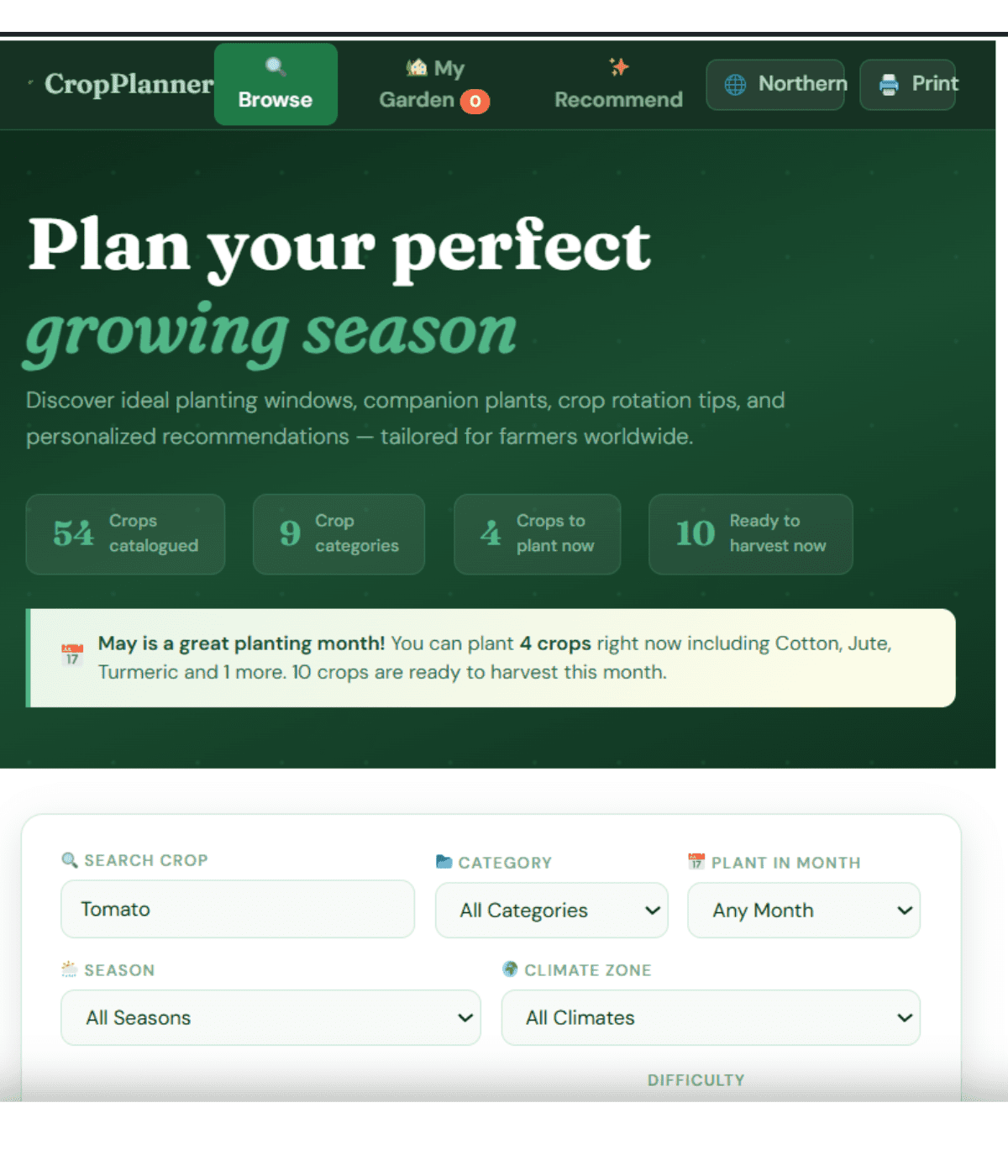
Plan your perfect
growing season
Discover ideal planting windows, companion plants, crop rotation tips, and personalized recommendations — tailored for farmers worldwide.
catalogued
categories
plant now
harvest now
🏡 My Garden
✨ Smart Crop Recommender
Tell us about your farm — we’ll match the best crops for you right now.
⚖️ Crop Comparison
Why Crop Planning Is the Foundation of Farm Profitability
Most farm losses are not caused by bad weather or pest attacks alone. They start earlier, with poor planning decisions that put the wrong crop in the wrong place at the wrong time.
According to the Food and Agriculture Organization of the United Nations (FAO) Crop Calendar and Agricultural Planning resources, sowing date and crop selection relative to the local growing season are among the most significant determinants of final yield for smallholder farmers globally.
Here is what systematic crop planning gives you:
- The right crop at the right time. Every crop has an optimal planting window in every climate. Plant tomato too early in the cold season and it fails to germinate. Plant mustard too late and it runs into warm temperatures during grain fill, collapsing yield. The planner shows you the optimal planting and harvest months for every crop in your climate zone.
- Better companion planting decisions. Companion planting is one of the most underutilized tools in integrated pest management. Basil next to tomato reduces aphid pressure. Marigold in a vegetable plot deters nematodes. Legumes interplanted with cereals fix nitrogen. The planner gives companion plant recommendations for all 54 crops.
- Smarter crop rotation. Planting the same crop in the same field year after year builds specific pest populations, depletes specific nutrients, and reduces yield over time. Knowing what to plant after your current crop, and what to avoid, is the foundation of sustainable soil management. Every crop card in the planner includes a rotation recommendation.
- Matching crop difficulty to your experience level. Cotton, cardamom, and cauliflower are Hard difficulty crops requiring experienced management. Cowpea, radish, and fenugreek are Easy crops that establish well under basic management. Beginners who start with easy crops succeed and build confidence. Beginners who attempt hard crops without support often fail and abandon farming.
- Personalizing crop choice to your farm conditions. A farmer with a borewell and medium water availability should not be growing rice. A farmer with only rainfed water should be looking at sorghum, chickpea, and sesame rather than banana or sugarcane. The Smart Recommender matches crop options to your specific water source, climate zone, and income goals.
The CGIAR Research Program on Climate Change, Agriculture and Food Security (CCAFS) consistently identifies improved crop planning and seasonal calendar adherence as among the highest-return interventions available to smallholder farmers worldwide, particularly in the face of climate variability.
The 54 Crops Covered Across 9 Categories
The planner covers the broadest crop database of any free online planning tool I am aware of. Here is what is included.
Grains and Cereals
Rice (Paddy), Wheat, Maize (Corn), Sorghum (Jowar), Bajra (Pearl Millet), and Amaranth (Rajgira). These six cereal crops cover the staple food and fodder grain needs of farmers across tropical, subtropical, temperate, and arid regions globally.
Vegetables
Tomato, Potato, Onion, Garlic, Chilli, Brinjal (Eggplant), Cabbage, Cauliflower, Cucumber, Pumpkin, Bitter Gourd, Ladies Finger (Okra), Spinach, Carrot, Radish, and Drumstick (Moringa). Sixteen vegetables spanning cool-season and warm-season types with season bars showing exactly which months to plant and harvest each one.
Legumes and Pulses
Peas, Chickpea (Gram), Pigeon Pea (Arhar/Tur), Black Gram (Urad), Soybean, Cowpea, and Green Gram (Moong). All seven are nitrogen-fixing crops that improve soil fertility. Rotation recommendations explain which cereal or vegetable should follow each pulse for maximum soil benefit.
Fruits
Banana, Mango, Papaya, Guava, Watermelon, Lemon and Lime, Pomegranate, and Coconut. Both annual fruit crops with 75 to 120 day seasons and perennial orchards with multi-year production timelines.
Root and Tuber Crops
Sweet Potato, Tapioca (Cassava), Carrot, and Radish. These root crops span tropical and temperate conditions with a range of water requirements from very low to moderate.
Oilseeds
Groundnut (Peanut), Soybean, Sunflower, Mustard (Rapeseed), Sesame, and Linseed (Flaxseed). The complete range of tropical and temperate oilseed crops with their specific soil, water, and temperature requirements.
Spices
Turmeric, Ginger, Cardamom, and Black Pepper. High-value cash crops with specific companion plant and rotation requirements. Cardamom and Black Pepper are marked Hard difficulty reflecting the specialized management they require.
Herbs
Fenugreek (Methi) and Coriander. Both are short-duration cool-season herbs suitable as gap crops in any rotation. Both are Easy difficulty and nitrogen-fixing.
Fiber Crops
Cotton, Sugarcane, and Jute. Three major commercial fiber crops with their complete planting, growing, and harvest windows and rotation requirements.
The Three Sections of the Planner and What Each Does
The following:
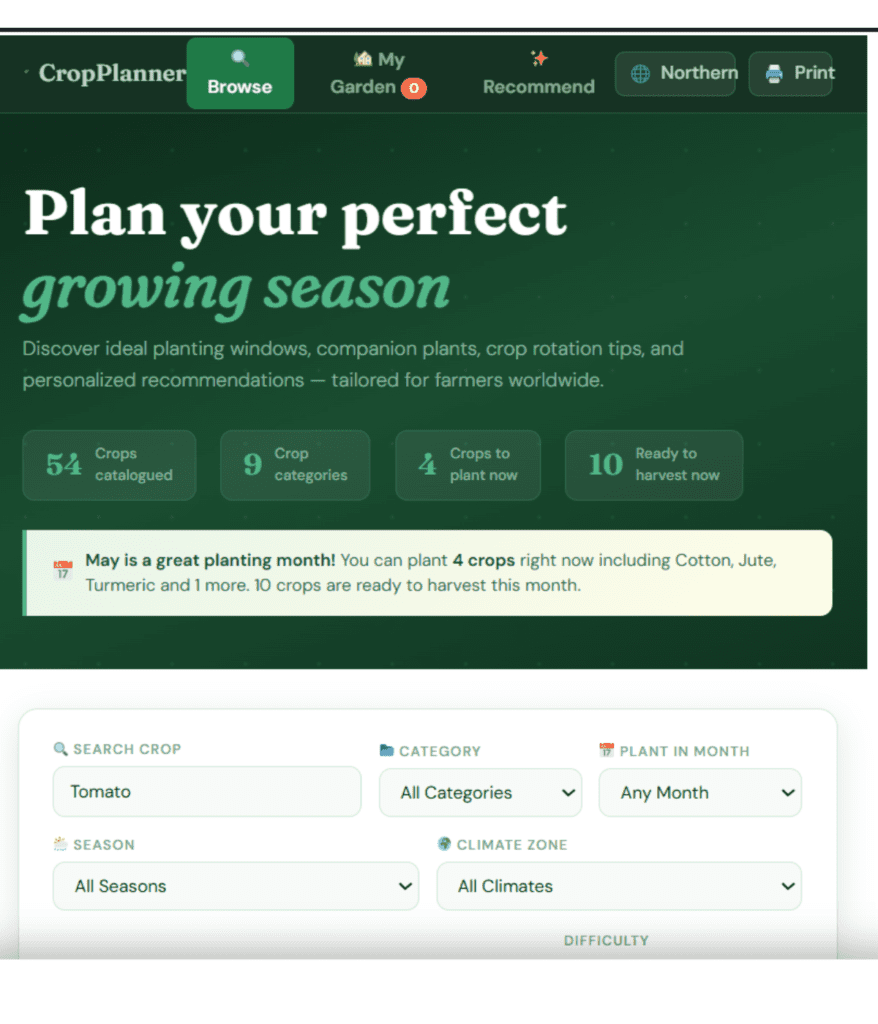
Browse: Search and Filter All 54 Crops
The main section. Seven filters work together or independently to narrow down the crop list to exactly what you need.
Search by crop name or scientific name. Filter by category (vegetable, fruit, grain, legume, and more). Filter by the month you want to plant. Filter by season type: Kharif, Rabi, Zaid, or Perennial. Filter by climate zone: Tropical, Subtropical, Temperate, Arid, or Mediterranean. Filter by water needs: Low for drought-tolerant crops, Moderate, or High. Filter by the month you want to harvest.
Difficulty pills let you select Easy, Medium, Hard, or any combination. Sort results by A to Z, fastest growing, highest yield, or by season. Switch between grid view (crop cards in columns) and list view (full-width rows) depending on what’s easier to read on your screen.
Every result shows you exactly how many crops matched your filters and lets you save any crop to My Garden by clicking the star icon.
My Garden: Your Personal Crop List
Every crop you bookmark with the star icon saves to My Garden. This is your personal planning list for the season.
My Garden shows all your bookmarked crops in a clean summary grid. When your season is planned, you can export the entire list as a text file that includes each crop’s planting months, harvest months, yield, duration, companion plants, and rotation recommendation.
The export creates a file called my-garden-plan.txt that you can save on your phone, print, share with your farm worker, or send to your agronomist.
Smart Recommender: What Should I Grow?
This is the section I am most proud of. It answers the question that farmers ask most: given my specific farm situation, what are the best crops for me right now?
You enter four inputs: your climate zone, your water source, your land size, and your farming goal. The tool scores all 54 crops against those inputs and returns the 8 best matches with a compatibility score, yield, duration, and a note if the crop is plantable right now in the current month.
Climate match, water requirement fit, and goal alignment all contribute to the score. Crops that are plantable in the current month get a bonus. Easy crops get a bonus for beginner-friendliness.
Click any recommended crop and the Browse section opens with that crop highlighted so you can read all the details.
What Every Crop Card Shows You
This tool shows you:
The 12-Month Season Bar
The most visually useful feature of each crop card. A horizontal bar spanning all 12 months, colour-coded in three shades: green for planting months, yellow-orange for growing months, and orange-red for harvest months. Grey means off-season.
The current month is outlined so you can immediately see where you are in the season for any crop. At a glance, you know whether you are in the planting window, mid-season, approaching harvest, or completely off-season for any crop.
The bar flips automatically for southern hemisphere farmers when you toggle the hemisphere switch. All month windows shift by six months so Australian, South African, South American, and New Zealand farmers see accurate planting and harvest windows for their seasons.
Plant Now and Harvest Now Badges
Crop cards where the current month falls within the optimal planting window show a green Plant Now badge at the top. Cards where the current month falls within the harvest window show an orange Harvest Now badge.
These badges make it instantly obvious which crops are actionable right now without reading a single number. During peak planting season, dozens of cards will show the Plant Now badge. During harvest months, the Harvest Now badges help you prioritize immediate action.
The Detailed Expand Panel
Every crop card has a View Full Details button that opens an expanded panel with eight data fields: planting months, harvest months, soil type, water needs, temperature range, spacing, expected yield, and climate zone.
Below the data fields, three colour-coded boxes give practical farm guidance. The Farmer Tip box gives a single most important management insight for that crop. The Companion Plants box names the specific crops that grow well alongside this one. The Crop Rotation box names what to plant next and what to avoid.
The Crop Comparison Tool
Add any two or three crops to the comparison by clicking the scales icon on each card. A comparison panel appears at the bottom of the screen showing the selected crops.
Click Compare to open a full comparison table with all eight attributes across all selected crops side by side. This is the fastest way to decide between two similar crops: wheat vs mustard for a rabi season, or tomato vs chilli for a kharif vegetable plot.
Features That Make This Planner Different from Any Other
Features are given as:
Hemisphere Toggle for Southern Hemisphere Farmers
This is a feature that almost no crop planning tool includes.
In the northern hemisphere, wheat sows in October and harvests in March. In Australia or Argentina, wheat sows in April or May and harvests in October or November. The months are completely different because the seasons are reversed.
The hemisphere toggle on the Crop Planner switches all planting and harvest windows by 6 months automatically. Every season bar, every filter result, every Smart Recommender output, and every Plant Now and Harvest Now badge adjusts instantly for southern hemisphere growing calendars.
Farmers in Australia, South Africa, New Zealand, Brazil, Argentina, and southern Chile can use this tool with accurate seasonal information from the moment they flip the toggle.
Smart Recommender Algorithm
The recommender evaluates each of the 54 crops against your inputs using a points system covering climate match, water availability fit, goal alignment, current planting window, and ease of management.
Scoring from 4 to 11 points, only crops with 4 points or above appear in results. The top 8 crops by score are recommended. A crop that matches your climate, suits your water source, aligns with your cash crop goal, is plantable right now, and is easy to grow would score near the maximum.
Four goal options cover the main farming objectives globally: Home and Food Security for subsistence farmers, Cash Crop and Income for commercial smallholders, Export Quality for farmers targeting premium or international buyers, and Organic Farming for farmers avoiding synthetic inputs.
Export My Garden Plan
The export function creates a complete text file containing every crop in your garden list with all planning information needed for the season.
For a farm advisor, this export is a complete recommended crop list they can hand to a farmer. For the farmer, it is a reference they can read offline when they are in the field without internet access. For a farmer planning a presentation to a bank or cooperative, it is a structured crop plan document they can attach to a loan application.
54 Crops with Individual Scientific Names
Every crop includes its scientific (Latin) name. This seems like a minor detail but it matters enormously for farmers dealing with export buyers, research institutions, government scheme applications, or international seed suppliers.
A buyer in Europe asking for Gossypium hirsutum gets the right type of cotton. A scheme application for Cajanus cajan gets the right pigeon pea subsidy. A seed supplier searching for Elettaria cardamomum provides the true cardamom, not a substitute species. Scientific names prevent confusion that costs money.
Who Benefits Most from the Crop Growing Season Planner?
- Farmers Starting a New Season and Unsure What to Grow: Open the Smart Recommender, enter your climate zone, water source, and goal, and get an immediate ranked list of the best crops for your situation right now. No agricultural knowledge required to get a useful starting point.
- Farmers Planning a Mixed Cropping System: Use the comparison tool to evaluate two or three crops for the same plot. Compare duration, water needs, yield, and rotation requirements side by side to make an informed decision about which combination maximizes income while managing resources.
- Farmers in the Southern Hemisphere: Toggle the hemisphere switch and get accurate planting and harvest windows for your seasons in Australia, South Africa, New Zealand, Brazil, Argentina, or anywhere south of the equator. A rare feature in free crop planning tools.
- Beginning Farmers Building Experience: Filter by Easy difficulty to find crops that establish well without expert management. Start with cowpea, radish, moong, fenugreek, or coriander. Build confidence. Progress to medium-difficulty crops the following season.
- Agricultural Extension Workers and Farm Advisors: Use the tool during field visits to build a My Garden list for a farmer, check companion plants and rotation recommendations, and export the complete plan as a text file to leave with the farmer.
- Organic and Low-Input Farmers: Filter the Smart Recommender by Organic Farming goal and find crops suited to minimal-input production systems. All companion plant and rotation information supports reduced chemical management. Nitrogen-fixing legumes are highlighted with specific rotation guidance.
- Students and Agricultural Researchers: The complete crop database with scientific names, soil requirements, temperature ranges, climate zones, and companion plant data makes this a useful field reference for agronomy studies and farm surveys.
Step-by-Step: How to Use the Crop Growing Season Planner
Use this guide:
Finding What to Plant This Month
- Open the Crop Growing Season Planner.
- Look at the hero section at the top. It shows how many crops are plantable and harvestable this month.
- In the Browse tab, find the Plant in Month filter and select the current month.
- Select your climate zone.
- Click Apply.
All crops with their planting window open in this month and your climate zone appear with their Plant Now badges. Browse them. Click View Full Details on any crop to read the complete guidance before deciding.
Using the Smart Recommender
- Click the Recommend tab in the top navigation.
- Select your Climate Zone from Tropical, Subtropical, Temperate, Arid, Mediterranean, or Highland.
- Select your Water Source: River or Canal (High), Borewell (Medium), or Rainfed (Low).
- Enter your land size in acres.
- Select your Goal: Home or Food Security, Cash Crop or Income, Export Quality, or Organic Farming.
- Click Get Recommendations.
Up to 8 crops appear ranked by compatibility score. Crops plantable right now show a Plant Now note. Click any crop card to jump to Browse and read the full details.
Comparing Two Crops
- In the Browse tab, find the first crop you want to compare.
- Click the scales icon on its card. A comparison bar appears at the bottom of the screen.
- Find the second crop and click its scales icon.
- Click Compare in the comparison bar.
A full comparison table opens showing both crops across 14 attributes: category, season, difficulty, planting months, harvest months, duration, yield, water needs, temperature, soil type, spacing, climate zone, companion plants, and crop rotation.
For global crop production data, planting calendar references, and climate zone definitions used in this tool, the FAO FAOSTAT crop production database and the CGIAR Research Program on Climate Change, Agriculture and Food Security provide the underlying agronomic references. For southern hemisphere seasonal calendars, national agricultural departments in Australia (DAFF), South Africa (DALRRD), and Argentina (SENASA) maintain region-specific planting calendars.
Related Tools
Use the Crop Growing Season Planner alongside these tools for a complete farm planning and management program:
- Irrigation Scheduling Calendar — Convert the planting date you choose for each crop into a complete day-by-day irrigation schedule.
- Farmer Profit and Loss Calculator — Use the yield and season duration data from this planner to project income and profit from your planned crop mix before the season begins.
- Seed Calculator for Farmers — Calculate the exact seed quantity needed for each crop in your garden plan based on your plot area and the spacing shown in each crop’s details.
Frequently Asked Questions
Peoples are asking this faq’s:
How does the Plant Now badge work?
The Plant Now badge appears on a crop card when the current calendar month falls within that crop’s optimal planting window. The planner checks today’s date automatically and updates the badges accordingly.
If you open the tool in October and October is within the planting window for onion, the onion card shows a Plant Now badge. If you open the tool in April when it is outside the onion planting window, no badge appears on the onion card.
The Harvest Now badge works the same way for crops where the current month falls in the harvest window. Both badges update in real time with no manual input required.
How do I use this tool if I am in Australia, South Africa, or another southern hemisphere country?
Click the Northern hemisphere toggle button in the top right corner of the tool. It will switch to Southern and all planting and harvest windows immediately shift by six months to reflect southern hemisphere seasons.
Every feature of the tool works correctly after this toggle: the season bars, the Plant Now and Harvest Now badges, the Plant in Month filter, the Harvest in Month filter, and the Smart Recommender’s current planting window bonus all use the corrected southern hemisphere month windows.
What is the difference between Kharif, Rabi, and Zaid seasons?
These are the three main cropping seasons of South Asian agriculture, widely referenced in crop planning across India, Pakistan, Bangladesh, and Sri Lanka.
Kharif is the monsoon or summer season. Crops are sown with the onset of monsoon rains in June to July and harvested in September to November. Rice, maize, cotton, soybean, sorghum, groundnut, and most vegetables are Kharif crops.
Rabi is the winter season. Crops are sown in October to December when temperatures are cooler and harvested in February to April. Wheat, mustard, chickpea, lentil, onion, garlic, potato, and most cool-season vegetables are Rabi crops.
Zaid is the short summer season between Rabi harvest and Kharif sowing, typically March to May. Short-duration crops like watermelon, cucumber, sunflower, and moong bean are grown in this window.
The Crop Planner uses these season labels as searchable filters. Farmers in other regions who do not use these names can still find the same information by filtering on the planting and harvest month directly.
Can I use the companion plant recommendations for organic farming?
Yes. Companion planting is one of the most important tools in organic and low-input farming systems because it replaces or reduces the need for synthetic pesticides and fertilizers.
The companion plant recommendations in this planner are based on well-established agro-ecological relationships. Legumes fix nitrogen that benefits their companion cereals. Marigold root secretions reduce nematode populations. Basil compounds deter aphids from adjacent tomato plants. Garlic acts as a natural insect repellent for neighbouring crops.
Use the Smart Recommender with Organic Farming as your goal to prioritize crops that work well in low-input systems. Then build companion planting pairs from each crop’s expanded details.
What does the compatibility score in the Smart Recommender mean?
The compatibility score shows how well a crop matches your entered farm conditions on a scale of 0 to 11. A score of 4 is the minimum threshold to appear in results. A score of 9 or above means the crop is an excellent match across most criteria.
Three points for climate match. Two points for water availability fit. Three points for goal alignment. Two points for being plantable in the current month. One point for easy difficulty rating. A crop that scores 11 is a perfect match: right climate, right water availability, right goal, plantable this month, and easy to grow.
Use the score as a starting point, not an absolute rule. A crop scoring 7 may still be a very good choice depending on your specific field conditions and market access.
Conclusion
Good farming starts with good planning. And good planning starts with knowing your options.
The Crop Growing Season Planner on Precision Agriculture Calculators gives every farmer a complete, searchable, and personalized crop planning database covering 54 crops across 9 categories. Browse and filter by climate, water, season, difficulty, and planting month. Check what is plantable and harvestable right now. Compare crops side by side before committing to a decision. Get personalized recommendations for your specific farm conditions, water source, and income goal. Save your selected crops to My Garden and export a complete written plan. Whether you farm in the northern hemisphere or the southern hemisphere, on a half-acre plot or a 20-acre farm, this tool helps you choose the right crops and plan the right season from the very first step.
Disclaimer
The Crop Growing Season Planner on Precision Agriculture Calculators provides crop planning information based on published average planting and harvest windows, general agronomic guidance, and broad climate zone classifications. This information is for planning and educational purposes only.
Actual optimal planting dates vary significantly by specific location, local microclimate, crop variety, soil type, and current weather conditions. Companion planting recommendations are based on generally recognized agro-ecological relationships and may not be effective under all local conditions. Smart Recommender scores are estimates based on general crop-climate-water matching logic and should not be the sole basis for major farm investment or planting decisions.
Always consult your local agricultural extension officer, Krishi Vigyan Kendra (KVK), or certified agronomist for location-specific and variety-specific planting recommendations. The author accept no liability for farm losses or decisions made based on this planning tool.