Introduction
Crops don’t tell you they’re thirsty until it’s too late.
By the time a plant wilts, shows leaf roll, or shows tip burn, it has already experienced water stress for days. That stress has already cost you yield. You can’t undo it by irrigating after the fact.
The only way to protect your crop from water stress is to irrigate before the plant feels it.
That means understanding your soil’s water balance: how much water your soil can hold, how much is available to your crop roots at any given moment, how fast the crop is using it, and how many days you have before stress begins.
Calculate soil moisture depletion and find out exactly when your crop needs the next irrigation before stress symptoms appear. Free online soil moisture calculator for all soil types and crops. Enter soil type, field capacity, wilting point, and crop ET to get days to next irrigation and water deficit in mm.
That’s exactly what the Advanced Soil Moisture Depletion and Irrigation Planner on Precision Agriculture Calculators calculates.
You enter your soil type, crop, root zone depth, daily ET, and irrigation efficiency. The tool calculates your soil’s total water storage, readily available water, current depletion status, net and gross irrigation requirement, and days remaining until your next irrigation is needed.
It’s a planning tool, not a soil sensor. But it gives you the framework to understand your soil water balance and schedule irrigations proactively rather than reactively.
Soil Moisture Depletion & Irrigation Planner
AWC-based Soil Water • Crop Root Zone • Depletion • Irrigation Need • Scheduling (Advisory Tool)
1) System Settings
2) Root Zone & Moisture Status
3) Environment & System Efficiency
Why Soil Moisture Management Is the Foundation of Efficient Irrigation
Most farmers water by observation or by a fixed weekly schedule. Both approaches fail for the same reason: they ignore what the soil actually holds and what the crop actually needs at any given moment.
According to the Food and Agriculture Organization of the United Nations (FAO) Irrigation and Drainage Paper 56, soil water balance management using the AWC (Available Water Capacity) method is the most widely recommended approach for scheduling irrigation across all climate zones and crop types.
Here’s why the soil water balance approach is superior to observation or schedule-based irrigation:
- It accounts for soil type. A sandy soil can only hold a fraction of the water that a clay loam holds. Two fields with the same crop, same rainfall, same ET need completely different irrigation frequencies. Only soil-type-specific AWC calculations capture this difference.
- It prevents both over-watering and under-watering. Schedule-based irrigation applies water on fixed days regardless of soil moisture status. After a rainy week, this waterlogged soil and wasted water. During a hot dry spell, the fixed schedule may stretch too long and stress the crop. AWC-based scheduling adapts to conditions.
- It quantifies the depletion buffer. The concept of Readily Available Water (RAW) defines a safe depletion zone within which the crop experiences no stress. Staying within this zone is the goal of scientific irrigation management. Without calculating RAW, you can’t know whether you’re inside or outside the safe zone.
- It gives you days in advance. Knowing how many days you have until the next irrigation is needed lets you plan labour, pump scheduling, and energy use without scrambling at the last minute.
Research reviewed by the USDA Agricultural Research Service confirms that AWC-based irrigation scheduling consistently reduces water use by 15 to 30 percent compared to calendar-based methods with equal or better crop yields.
The AWC Method: How Soil Water Balance Works
Three numbers build the entire soil water balance calculation.
AWC: Available Water Capacity
AWC is the fraction of water stored per unit depth of soil that is available for plant uptake. It’s expressed as millimetres of water per millimetre of soil depth (mm/mm).
Sandy soils have an AWC of 0.07. That means 1 mm of sandy soil holds 0.07 mm of plant-available water. Silty loam soils have an AWC of 0.22. The same depth of silty loam holds more than three times as much plant-available water as sandy soil.
AWC is the most important soil physical parameter for irrigation planning. Everything else in the calculation depends on it.
TAW: Total Available Water
TAW is the total plant-available water stored in the crop’s root zone.
TAW (mm) = AWC x Root Zone Depth (mm).
For a loam soil (AWC 0.17) with wheat roots at 600 mm depth: TAW = 0.17 x 600 = 102 mm.
That 102 mm is the reservoir of water available to the wheat crop from field capacity down to permanent wilting point. But crops don’t deplete the full TAW before showing stress. They start showing stress well before TAW is exhausted.
RAW: Readily Available Water
RAW is the fraction of TAW that can be depleted before the crop begins to experience water stress.
RAW (mm) = TAW x MAD fraction.
MAD is Management Allowable Depletion, expressed as a percentage. At 50 percent MAD, the crop can deplete half of TAW before any stress occurs.
For the same wheat example: RAW = 102 x 0.50 = 51 mm.
This 51 mm is your working irrigation buffer. When this buffer is consumed, your next irrigation is due. If you wait until after RAW is depleted, your crop is already in stress.
Depletion and Days to Irrigation
The current soil moisture depletion tells you where you are within the RAW buffer. The tool uses a planning-mode assumption of 60 percent of RAW depleted as a starting point when no field measurement is available.
Days until next irrigation = remaining water in RAW buffer divided by daily ET.
If 20 mm remains in your buffer and your crop is using 5 mm per day, you have 4 days until you need to irrigate.
What Does the Calculator Ask You to Enter?
Unit System
Metric (centimetres and millimetres) or Imperial (inches). Root depth auto-fills in your chosen unit when you select a crop. All calculations happen internally in millimetres.
Soil Type
Six soil types with their published AWC values:
- Sandy Soil (AWC 0.07): Very low water holding capacity. Needs frequent light irrigation. Poor buffering against missed irrigations.
- Sandy Loam (AWC 0.12): Moderate water holding. Better drainage than heavier soils. Common on alluvial plains and riverbeds.
- Loam (AWC 0.17): Balanced water holding and drainage. The most agriculturally productive soil texture. Most crops perform best on loam.
- Clay Loam (AWC 0.20): High water holding capacity. Needs careful irrigation management to avoid waterlogging. Good buffer against missed irrigations.
- Silty Loam (AWC 0.22): Highest AWC in the list. Excellent water storage but prone to surface sealing and compaction. Dominant in flood plains and river deltas.
- Clay (AWC 0.18): High storage but very slow drainage. Avoid over-irrigation. Clay soils can accumulate waterlogging damage quickly.
Crop Type
Seven crops with typical root depths that auto-fill when selected:
- Wheat: 60 cm. Moderate root depth. Sensitive to stress at heading and grain fill.
- Rice: 50 cm. Shallow roots. Normally grown flooded but increasingly managed with Alternate Wetting and Drying (AWD) method where this calculator applies.
- Maize: 75 cm. Deep roots give good water buffering in medium-textured soils.
- Cotton: 100 cm. Deep root system. Most sensitive to stress at boll development.
- Sugarcane: 120 cm. Very deep root system. High seasonal water demand.
- Vegetables: 45 cm. Shallow roots. Highly sensitive to both water stress and waterlogging. Need most careful monitoring.
- Orchard and Fruit Trees: 150 cm. Very deep roots. Long-term perennial crops where root zone depth develops over years.
Root Zone Depth
Auto-filled from crop selection but fully editable. Adjust to match your crop’s actual development stage. Early-season roots are much shallower than mature roots. A 30-day-old maize crop has roots of perhaps 30 to 40 cm, not the full 75 cm depth used for mature plants.
Using stage-appropriate root depth gives a more accurate TAW and irrigation interval at each point in the season.
MAD Percentage
Management Allowable Depletion. Default 50 percent. This is the internationally recommended starting value for most field crops.
Use lower MAD (40 to 45 percent) for shallow-rooted sensitive crops like vegetables and seedlings. Use higher MAD (55 to 60 percent) for deep-rooted field crops and orchards in their established years.
Daily ET
Crop evapotranspiration in millimetres per day. Enter your local ETo from a weather station or agro-meteorological service, multiplied by the crop’s Kc coefficient for the current growth stage.
If you don’t have a local weather station, use the NASA POWER portal to get historical daily ETo for your location. For a quick estimate, common ranges are 3 to 4 mm per day in cool or humid conditions, 5 to 7 mm per day in warm temperate conditions, and 7 to 10 mm per day in hot arid conditions during summer.
Irrigation Efficiency
The percentage of water applied that actually reaches the root zone and becomes available to the crop. Default 80 percent.
Typical values: Drip irrigation 85 to 95 percent. Sprinkler 70 to 80 percent. Furrow irrigation 55 to 65 percent. Flood irrigation 40 to 55 percent.
This determines the gross irrigation depth, meaning how much water you actually need to pump or deliver to achieve the net root zone requirement.
What Do Your Results Show You?
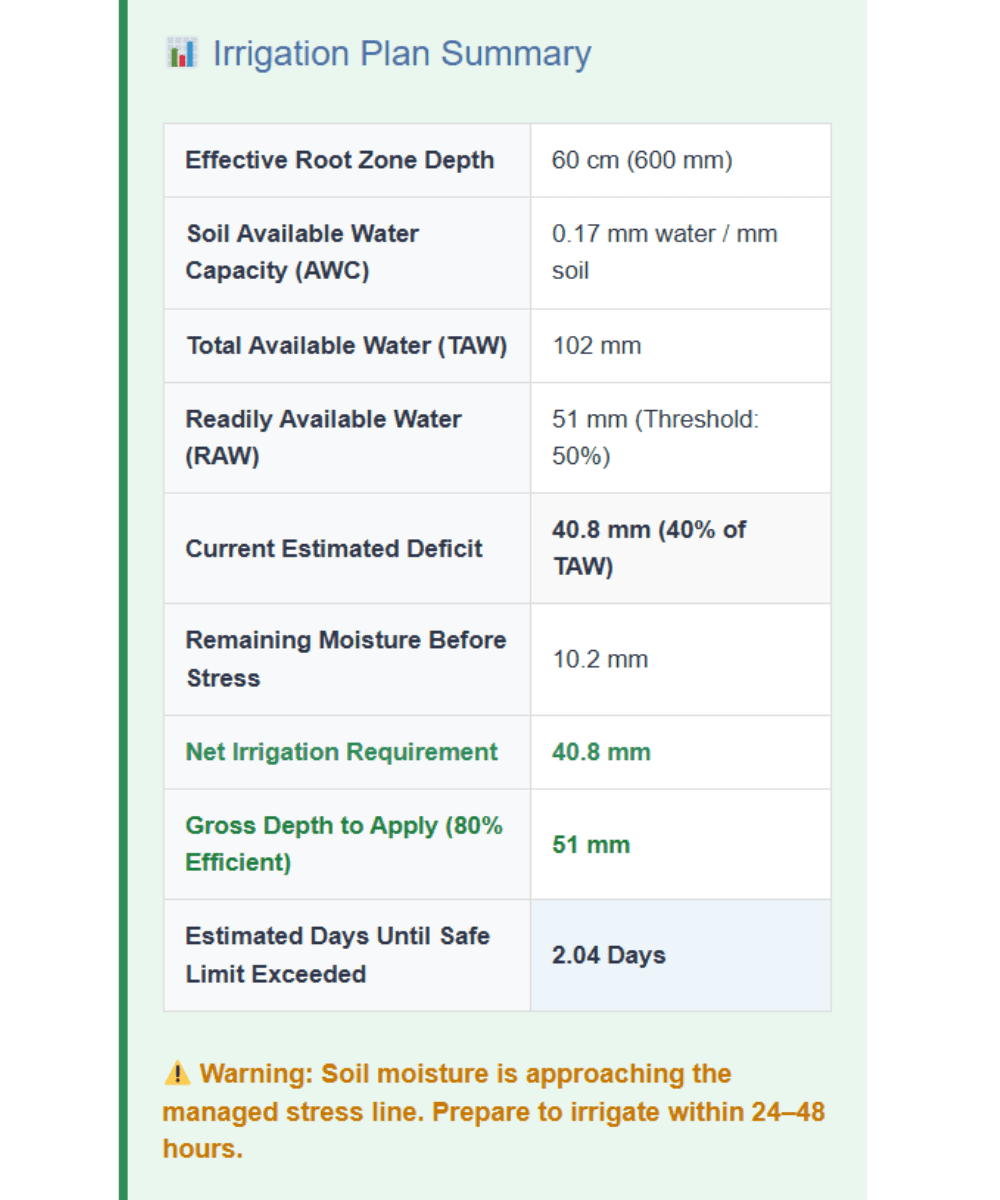
Root Zone Depth in Millimetres
Your entered root depth converted to millimetres, the base unit for all water depth calculations. This confirms the conversion is correct before you read the water depth results.
Soil AWC
The AWC value being used for your selected soil type. Confirming this helps you verify you selected the right soil texture.
TAW: Total Available Water
The total millimetres of plant-available water stored in your crop’s root zone from field capacity to permanent wilting point.
This is the maximum theoretical irrigation reservoir in your soil. No crop can extract water below permanent wilting point. No practical irrigation management should deplete the full TAW without severely stressing the crop.
RAW: Readily Available Water
The practical irrigation threshold. This is how many millimetres of water you can allow the soil to lose before your crop begins to experience any stress.
This is the number that drives your irrigation schedule. When cumulative depletion reaches RAW, it’s time to irrigate.
Estimated Current Depletion and Remaining Water
In planning mode, the tool assumes 60 percent of RAW has been depleted. Remaining water is RAW minus current depletion.
In practice, replace this estimate with your actual tensiometer reading or gravimetric soil moisture measurement if you have field monitoring equipment.
Net and Gross Irrigation Requirement
Net irrigation is the millimetres of water your soil needs to bring it back to field capacity. Gross irrigation is that net requirement divided by your irrigation efficiency, representing the actual water you need to pump or deliver.
For example: if net requirement is 30 mm and efficiency is 80 percent, gross requirement is 37.5 mm. The difference is lost to evaporation, runoff, and deep percolation in your irrigation system.
Days Until Next Irrigation
Remaining water in the buffer divided by daily ET. This is your planning horizon.
If days remaining is 1 or less, irrigation is urgent. If it’s 5 or more, you have time to plan your next irrigation window without risking crop stress.
Moisture Status Badge
Three status levels: Safe (comfortable moisture range), Warning (approaching stress, plan irrigation soon), and Critical (below safe level, irrigate urgently).
The warning triggers at 70 percent of RAW depleted. Critical triggers when depletion equals RAW. Never let the field reach Critical status during sensitive growth stages.
Soil-Specific Advice
A brief management note specific to your selected soil type. Sandy soil advice focuses on frequent light irrigation. Clay soil advice warns against over-irrigation and slow drainage. Loam soil advice confirms balanced management.
What Makes This Tool Useful for Farm Planning
Crop-Specific Root Depth Auto-Fill
Entering the correct root zone depth is the most common error in soil water balance calculations. Using a single flat depth for all crops ignores the enormous variation from 45 cm for vegetables to 150 cm for orchards.
The auto-fill from crop selection ensures you start with an agronomically appropriate root depth. Override it at any time as your crop matures and roots deepen through the season.
Soil-Type-Specific AWC Values
Six soil types with published AWC values replace the guesswork of entering an arbitrary number. The difference between sandy soil (AWC 0.07) and silty loam (AWC 0.22) is a factor of more than three in water storage capacity.
Getting this right is the difference between a realistic and a completely misleading irrigation plan.
Gross Irrigation with Efficiency Adjustment
Net irrigation depth tells you what the crop needs. Gross irrigation tells you what to pump. The gap between these two numbers is what your irrigation system wastes.
For a farmer paying for pumping electricity, this distinction matters financially. A 55 percent efficient flood irrigation system needs nearly twice the pumping energy of a 90 percent efficient drip system to deliver the same net root zone water.
Status Alert System
The three-level Safe, Warning, and Critical status system gives you an immediate at-a-glance read on urgency.
You don’t need to interpret millimetre numbers to know whether you need to act today, plan for the coming days, or relax. The status badge does that interpretation for you.
Metric and Imperial Support
Root depth auto-fills in inches for Imperial users and in centimetres for Metric users. The internal calculation converts everything to millimetres. Output results display in millimetres regardless of input unit, which is standard practice in irrigation science.
Who Benefits Most from This Tool?
- Farmers Transitioning from Fixed-Schedule to Demand-Based Irrigation: If you currently irrigate every 5 days regardless of weather or soil status, this tool shows you exactly why that approach wastes water in wet periods and stresses crops in hot dry spells.
- Vegetable and High-Value Crop Farmers: Vegetables have shallow roots, high sensitivity to water stress, and tight yield-quality windows. Even a single day of unnecessary stress at flowering or fruit set causes quality loss that can’t be recovered. This tool’s precise depletion tracking is essential for these crops.
- Farmers with Sandy or Light Soils: Light soils have very low water storage and very short irrigation intervals. Without calculating RAW for their specific soil, farmers routinely either over-water (because they think more water is needed to compensate for low storage) or under-water (because they use intervals designed for medium soils). The AWC calculation makes the correct interval clear.
- Farmers Installing or Evaluating Irrigation Systems: Before investing in a drip or sprinkler system, use this tool to calculate gross irrigation requirement at different efficiency levels. The difference in pumping cost between a 55 percent and 90 percent efficient system over a 120-day season is often larger than the capital cost difference between the systems.
- Agricultural Students and Extension Workers: TAW, RAW, MAD, and the AWC method are the core concepts of FAO Paper 56 irrigation science. This calculator makes those concepts immediately practical rather than remaining abstract equations.
- Farm Irrigation Managers and Consultants: A rapid desk calculation tool for generating irrigation depth and interval recommendations during farm advisory visits without needing specialized software.
Step-by-Step: How to Use the Soil Moisture Depletion Calculator
Here’s a complete example. You’re growing vegetables on a sandy loam soil. Your root zone is 45 cm. Your daily ET is 5 mm. Your MAD is 45 percent (appropriate for sensitive vegetables). You use drip irrigation at 90 percent efficiency.
- Open the Advanced Soil Moisture Depletion and Irrigation Planner on Precision Agriculture Calculators.
- Select Metric as Unit System.
- Select Sandy Loam as Soil Type.
- Select Vegetables as Crop Type. Root depth auto-fills to 45 cm.
- Confirm Root Zone Depth shows 45 cm.
- Change MAD to 45 percent.
- Enter Daily ET as 5 mm/day.
- Enter Irrigation Efficiency as 90 percent.
- Click Calculate Plan.
Here’s what the results show:
- Root zone depth = 45 cm = 450 mm.
- Soil AWC for Sandy Loam = 0.12.
- TAW = 0.12 x 450 = 54 mm.
- RAW = 54 x 0.45 = 24.3 mm.
- Current depletion (planning mode 60% of RAW) = 24.3 x 0.60 = 14.6 mm.
- Remaining before stress = 24.3 minus 14.6 = 9.7 mm.
- Net irrigation requirement = 14.6 mm.
- Gross irrigation at 90% efficiency = 14.6 / 0.90 = 16.2 mm.
- Days until next irrigation = 9.7 / 5 = approximately 2 days.
- Status: Safe but approaching Warning. Plan irrigation within 2 days.
This result tells you to irrigate within 2 days and to apply approximately 16 mm of water (gross) at that irrigation. For a 1-hectare field, that’s 160 cubic metres of water (160,000 litres).
The soil advice for Sandy Loam reminds you that this soil has moderate storage and good drainage, and you should expect to irrigate every 2 to 3 days throughout a warm growing period.
For the complete scientific framework behind AWC-based irrigation scheduling, refer to FAO Irrigation and Drainage Paper 56: Crop Evapotranspiration, the definitive global reference for this methodology. For soil texture classification and AWC values by soil type, the USDA Natural Resources Conservation Service Soil Survey Manual is the primary international reference. Local ETo data can be accessed freely from the NASA POWER climate portal for any location worldwide.
Related Tools
Use the Soil Moisture Depletion Calculator alongside these tools for a complete water management program:
- Crop Water Requirement Calculator — Calculate your crop’s seasonal water demand and compare it to what your soil can store per irrigation cycle.
- Soil pH Corrector Calculator — Soil pH affects root depth development and nutrient availability. Correct pH issues alongside your irrigation management for best results.
- Mulching Sheet Calculator — Mulching reduces soil surface evaporation by 20 to 30 percent, directly reducing daily ET and extending the days between irrigations.
Frequently Asked Questions
What is the difference between TAW and RAW?
TAW (Total Available Water) is the total water stored in the root zone between field capacity and permanent wilting point. RAW (Readily Available Water) is the portion of TAW that can be depleted without the crop experiencing any stress.
Most crops start experiencing mild stress when about 50 percent of TAW is depleted. This is why RAW at 50 percent MAD represents the practical irrigation threshold for most crops.
You irrigate when you’ve consumed RAW, not TAW. Waiting until TAW is depleted means your crop has been under stress for days.
How do I get my actual daily ET value?
The most accurate method is to use your local agro-meteorological station’s published ETo (reference evapotranspiration) and multiply by the crop coefficient (Kc) for your crop’s current growth stage. Kc values for all major crops are published in FAO Paper 56.
If no local station is available, use the NASA POWER portal at power.larc.nasa.gov. Enter your latitude and longitude to get historical daily ETo averages for any month.
A practical field estimate: ET is approximately equal to pan evaporation multiplied by 0.75 to 0.85. If your Class A evaporation pan reads 8 mm/day, your ETo is approximately 6 to 7 mm/day. Multiply by the crop Kc to get ETc.
Why does my root zone depth matter so much?
Root zone depth determines the volume of soil your crop can access for water. Doubling the root depth doubles the TAW and RAW, which roughly doubles the irrigation interval.
Early in the season, roots are shallow and intervals are short. As the crop matures and roots deepen, intervals extend naturally. This is why irrigation frequency should decrease as the season progresses, not remain constant.
Updating your root depth input as the crop grows through the season gives you more accurate interval predictions at each growth stage.
What MAD percentage should I use for my crop?
Use 40 to 50 percent MAD for sensitive, shallow-rooted crops: vegetables, seedlings, strawberries, young orchards. Any water stress in these crops causes immediate quality loss.
Use 50 percent MAD for most field crops at vegetative and reproductive stages: wheat, maize, cotton, sugarcane.
Use 55 to 60 percent MAD for deep-rooted field crops during less sensitive stages: maize at vegetative growth, cotton at early boll development, established orchards.
Never use MAD above 60 percent for any crop except drought-tolerant varieties under deliberate deficit irrigation research programs.
Can I use this calculator without any soil moisture measurements?
Yes. The calculator runs in planning mode using a 60 percent of RAW depletion assumption when no field measurement is available. This represents a mid-cycle planning condition.
For better accuracy, calibrate the tool against actual field measurements. If you have a tensiometer, read it and estimate your current depletion from the tensiometer reading, then adjust the net irrigation figure accordingly.
Even without measurements, the tool gives you the correct interval and gross irrigation depth for planning pump schedules, labour, and water procurement.
Conclusion
Crop water stress is silent and invisible until it shows in yield. By then the damage is done.
The Advanced Soil Moisture Depletion and Irrigation Planner on Precision Agriculture Calculators gives you the numbers to stay ahead of stress rather than reacting to it. Enter your soil type, crop, root depth, ET, and efficiency, and get your TAW, RAW, current status, irrigation requirement, and days remaining until the next irrigation is needed. Use it at the start of each irrigation cycle to verify your schedule is based on your soil’s actual water balance rather than a guess or a calendar. Your soil holds the answer. This calculator helps you read it.
Disclaimer
The Advanced Soil Moisture Depletion and Irrigation Planner on Precision Agriculture Calculators provides soil water balance estimates based on standard AWC-based calculation methods from FAO Irrigation and Drainage Paper 56. Results are advisory estimates for planning purposes only. Actual soil moisture status depends on recent rainfall, irrigation history, evapotranspiration variability, spatial soil variability within the field, crop root distribution, and other factors not accounted for in this calculator.
The current depletion estimate uses a fixed planning-mode assumption of 60 percent of RAW depleted and does not reflect actual field moisture conditions unless calibrated with field measurements. AWC values used are standard published averages for each soil texture class and may differ from your specific soil. Daily ET values entered by the user determine the accuracy of irrigation interval calculations.
Always supplement calculated irrigation schedules with actual soil moisture monitoring using tensiometers, capacitance probes, or gravimetric sampling for precise irrigation management. The author and Precision Agriculture Calculators accept no liability for crop yield losses or water waste arising from irrigation decisions made based on this calculator.