Introduction:
Clogged drip emitters. Silted sprinkler heads. Murky water in the livestock trough.
These are symptoms of the same root problem: water that hasn’t been filtered correctly before use.
On most farms, the filtration system is an afterthought. Farmers buy a pump, install pipes, and add whatever filter the supplier recommends or whatever was cheapest at the hardware shop. A few weeks into the season, emitters block, pressure drops, or the system fails.
The right filtration system starts with three questions. What is my water source and how dirty is the water? What am I using the water for? How much flow do I need?
The answers determine your filter size, filter type, micron ratings for each stage, and the complete system configuration you need.
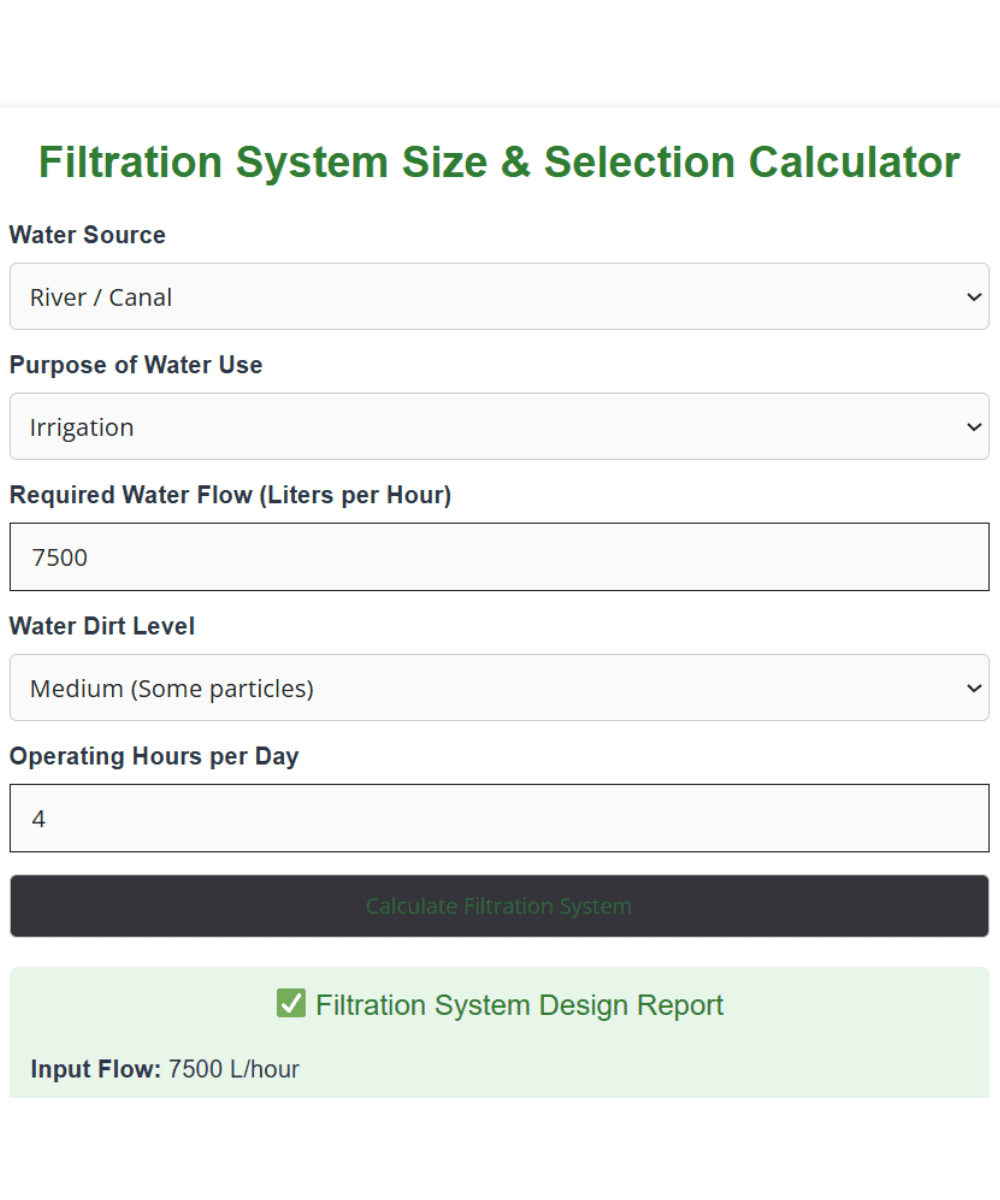
Filtration System Size Calculator: Select the correct water filter size and type for your drip or sprinkler irrigation system. Free online farm filtration calculator covering disc filters, sand media filters, and screen filters. Enter flow rate and water quality to get recommended filter size, mesh rating, and flushing frequency.
That’s exactly what the Advanced Filtration System Size and Selection Calculator on Precision Agriculture Calculators works out for you.
You enter your water source, purpose, required flow rate, water dirt level, and daily operating hours. The tool calculates your design flow with a 20 percent safety factor, recommends the correct system type, specifies the micron rating for each filter stage, selects the right physical filter size, and gives you installation and maintenance tips.
Print the report and take it to your supplier. You’ll know exactly what to ask for.
Filtration System Size & Selection Calculator
Why Getting Filtration Right Matters for Every Water Use on the Farm
Water quality problems are responsible for a large proportion of irrigation system failures, livestock health issues, and processing equipment damage on farms worldwide.
The Food and Agriculture Organization of the United Nations (FAO) identifies water quality and filtration as critical factors in the performance and lifespan of micro-irrigation systems, particularly drip irrigation. Emitter blockage from unfiltered particles is one of the most common causes of drip system failure and reduced water distribution uniformity.
Here’s what happens on farms without the right filtration:
- Drip emitters block. Drip emitters have openings of 0.2 to 0.5 mm. River water, pond water, or even borewell water often carries sand particles, organic debris, and algae that are large enough to block these tiny openings within days. Without correct pre-filtration, the entire investment in a drip system is at risk.
- Sprinkler heads wear and fail early. Sand and grit in unfiltered water act as abrasives inside sprinkler nozzles and rotors. Nozzle wear changes the distribution pattern and ultimately destroys the nozzle. Correct filtration dramatically extends sprinkler service life.
- Livestock drink contaminated water. Muddy or particulate-laden water from rivers, ponds, or open canals is not suitable for dairy cattle or poultry without filtration. Contaminated drinking water increases disease incidence, reduces milk production, and affects livestock weight gain.
- Processing equipment corrodes and blocks. Produce washing, equipment cleaning, and agri-processing operations require clean water. Silt and particles damage pump seals, block spray nozzles, and contaminate products.
- Over-sized or under-sized filters create their own problems. An over-sized filter wastes capital. An under-sized filter clogs rapidly, drops system pressure, and requires frequent cleaning that costs labour time. Getting the size right from the start eliminates both problems.
The USDA Natural Resources Conservation Service (NRCS) recommends that all pressurized irrigation systems include a minimum of one inline filtration stage, with multi-stage filtration for systems using surface water sources.
Understanding Microns: What the Numbers Actually Mean
Micron is the unit of measurement for filter mesh size. One micron is one-thousandth of a millimetre.
The micron rating of a filter tells you the smallest particle it will capture. A 100-micron filter stops particles larger than 0.1 mm. A 10-micron filter stops particles larger than 0.01 mm.
To put this in context: a human hair is about 70 microns in diameter. A grain of fine sand is about 100 microns. A drip emitter opening is about 200 to 500 microns.
Why does this matter for filter selection? Because the micron rating must be matched to both your water’s particle size distribution and your system’s minimum opening size.
For drip irrigation, the general rule is that your filter should remove all particles larger than one-tenth of the smallest emitter opening. A 200-micron emitter needs filtration to at least 20 microns.
For drinking water, you want to get down to 5 microns or lower to remove bacteria-sized particles and turbidity.
The Three-Stage Filtration Approach
The most reliable farm water treatment systems use three stages: pre-filtration, main filtration, and polishing filtration.
Each stage does a different job. Together they protect your system from the widest range of particles and contaminants.
Stage 1: Pre-Filter (Coarse)
Removes the large particles first: sand, gravel, organic debris, leaves, insects.
For muddy or high-turbidity water, the pre-filter is typically a sand filter or a 120 to 150 micron screen. For cleaner water sources, 50 to 100 microns is sufficient.
The pre-filter protects the main filter from overloading. Without it, the main filter would clog within hours when dealing with turbid water.
Stage 2: Main Filter (Medium)
Removes the mid-range particles that passed the pre-filter: fine sand, silt, algae, small organic particles.
This is typically a disc filter or cartridge filter at 25 to 50 microns for most irrigation purposes, or 10 to 25 microns for drip systems and sensitive applications.
The main filter does the primary protection work for your irrigation emitters, sprinkler heads, or distribution system.
Stage 3: Polishing Filter (Fine)
Removes the finest remaining particles for applications that require very clean water.
For drinking water and food processing, a 5-micron polishing filter removes turbidity and many bacteria-sized particles. For standard drip irrigation, a 10 to 20 micron polishing filter catches anything the main filter missed.
For low-turbidity borewell water used in standard irrigation, the polishing stage may be optional. For drinking water and agri-processing, it’s essential.
What Does the Calculator Ask You to Enter?
Water Source
Four options, each with different typical contamination characteristics:
- River or Canal: Surface water with high and variable turbidity, seasonal suspended solids, algae, and organic matter. Requires the most robust pre-filtration.
- Borewell or Groundwater: Generally clearer than surface water but may carry fine sand, iron particles, and dissolved minerals. Usually lower turbidity but requires consistent fine filtration.
- Pond or Open Storage: Stagnant surface water with algae, organic sediment, and biological load. Turbidity varies with season and weather.
- Storage Tank: Water previously collected and stored. Usually lowest particle load but may have sediment accumulation at the bottom and biological growth if stored for long periods.
Purpose of Water Use
Five purposes, each with different filtration requirements:
- Irrigation (General): Basic sand or screen filter. Field crops can tolerate more particulate water than drip systems. A single-stage filter is often sufficient.
- Drip or Sprinkler System: Most demanding filtration requirement. Emitter blockage is costly and difficult to clear. A screen or disc filter plus a fine cartridge is the minimum standard recommendation.
- Dairy or Livestock: Requires visually clear water free of sediment and heavy organic load. A sand filter plus cartridge filter ensures clean drinking water for animals.
- Drinking or Domestic: Highest standard. Multi-stage system with sand filter, activated carbon filter for taste and odour, and fine cartridge filtration to 5 microns or below.
- Agri Processing or Washing: Produce washing, equipment cleaning, and packhouse operations need clean water to prevent product contamination. Multi-stage pre-filter, fine filter, and polishing filter recommended.
Required Water Flow (Litres per Hour)
Your system’s actual required flow rate in litres per hour. This is determined by your irrigation system design, livestock water demand, or processing equipment capacity.
For drip irrigation: calculate total emitter flow rate for your field. For sprinklers: check the system design specification. For livestock: allow 50 to 80 litres per large animal per day.
The calculator adds a 20 percent safety factor to your entered flow to determine design flow. This buffer ensures the filter is not running at its maximum capacity continuously, which reduces clogging frequency and extends filter life.
Water Dirt Level
Three levels that drive the micron selection:
- Low (Clear Water): Visually clear water with minimal suspended particles. Typical of good-quality borewell or clean storage tank water. 50-micron pre-filter is sufficient.
- Medium (Some Particles): Slightly turbid water with visible fine particles when a sample is held up to light. Typical of average borewell water, late-season canal water, or lightly turbid pond water.
- High (Muddy or Heavy Particles): Visibly turbid or brown water with heavy suspended sediment. Typical of river water after rainfall, monsoon canal water, or farm ponds after disturbance. Requires 120 to 150 micron pre-filtration plus a full multi-stage system.
Operating Hours per Day
How many hours per day the system runs. Used to calculate daily water volume: flow rate x operating hours / 1,000 = kilolitres per day.
This daily volume figure helps you understand the total water throughput your filter system must handle, which informs maintenance frequency planning.
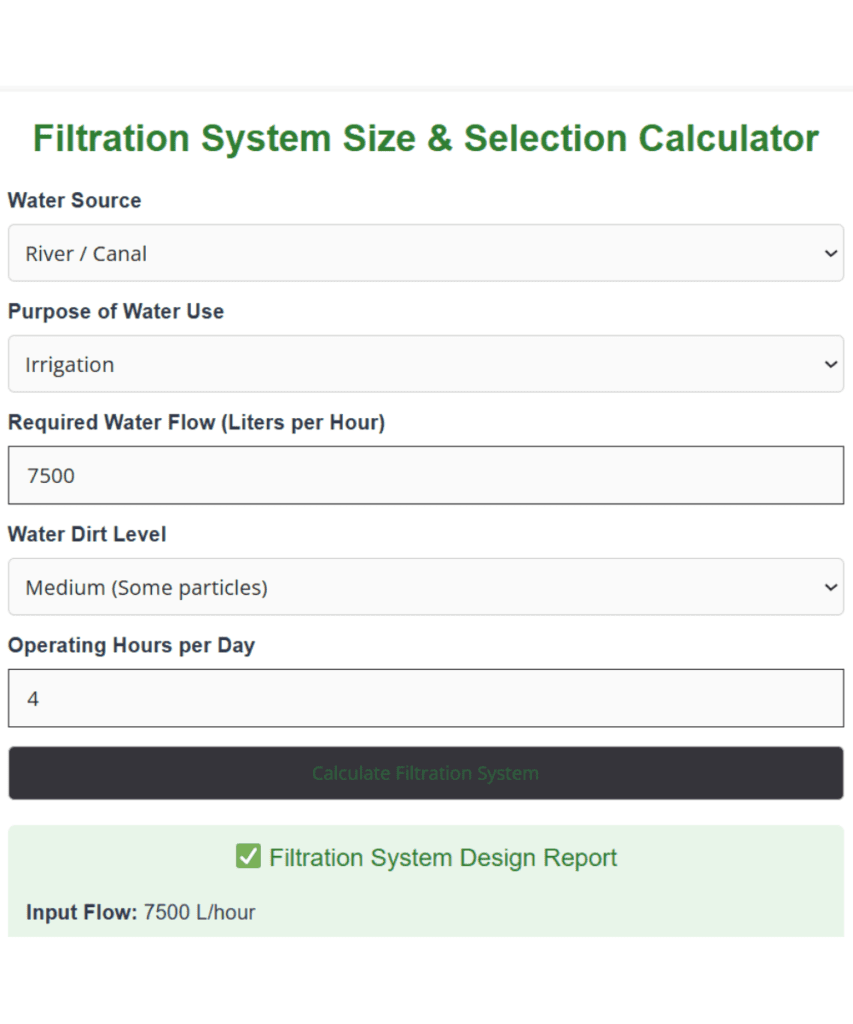
What Does Your Filtration System Report Show You?
Design Flow with Safety Factor
Your entered flow rate plus 20 percent. This is the capacity your filter must reliably handle.
Sizing to your exact required flow leaves no margin for increased demand, partial clogging, or flow variation. The 20 percent buffer ensures the system performs reliably under real conditions rather than only under ideal conditions.
Daily Water Volume
Total water processed per day in kilolitres (1 kilolitre = 1,000 litres). This tells you how intensively your filter system is working and how frequently backwashing or cartridge replacement will be needed.
Suggested Filter Size
Physical connection size matched to your design flow:
- Small (0.5 to 1 inch): Up to 1,200 L/hr design flow. Suitable for small drip systems, domestic water supply, small gardens.
- Medium (1 to 1.5 inch): 1,200 to 3,500 L/hr. Most common for smallholder irrigation systems and livestock water supply.
- Large (2 inch): 3,500 to 8,000 L/hr. For medium commercial farms, larger drip systems, and dairy operations.
- Extra Large (3 inch or more): Above 8,000 L/hr. Commercial-scale operations requiring high continuous flow.
System Type Recommendation
The complete system configuration recommended for your purpose:
Drip and sprinkler systems get a Screen or Disc Filter plus Fine Cartridge specification, optimized for emitter protection. Drinking water gets Multi-stage: Sand Filter, Carbon Filter, and Fine Cartridge. Dairy gets Sand Filter plus Cartridge. Agri-processing gets a Multi-stage Pre-filter, Fine, and Polishing system.
Three-Stage Micron Recommendations
Specific micron ratings for your pre-filter, main filter, and polishing filter based on your water dirt level.
High-turbidity water gets 120 to 150 micron pre-filter, 40 to 50 micron main filter, and 10 to 20 micron polishing. Clear water gets 50 micron pre-filter, 10 to 20 micron main filter, and 5 micron polishing for drinking or processing.
These specifications are what you take to your filtration supplier. You ask for each stage by its micron rating and filter type.
Installation and Maintenance Tips
Two practical tips appear in every report. Install a pressure gauge before and after each filter bank to monitor clogging. Clean or backwash when pressure drop increases or flow reduces. These are the two most important operating principles for any filter system.
What Makes This Calculator Practically Useful
Source and Purpose Combined Logic
The micron selection logic uses both water dirt level and purpose together. A farmer using muddy river water for a drip system gets a more aggressive multi-stage specification than a farmer using clear borewell water for general irrigation.
This combined logic ensures the filter system is matched to both the supply-side problem (dirty water) and the demand-side requirement (sensitive emitters).
20 Percent Safety Factor
Many farmers buy filters sized exactly to their current flow rate. When peak demand increases slightly, or when partial clogging reduces effective capacity, the system underperforms.
The 20 percent design flow buffer is a standard engineering practice for filter sizing. It gives the system headroom to handle peak demand and early-stage clogging without immediate pressure loss.
Four Filter Size Categories
Physical filter connection size must match your pipe system. An over-sized filter on a small-diameter pipe creates a mismatch that reduces pressure uniformity. An under-sized filter body on a high-flow system creates excessive pressure drop.
The four size categories from small to extra large match standard commercial filter product sizes available from most irrigation and water treatment suppliers globally.
Printable Report
The print button generates a clean filtration system design report you can take to your supplier.
Most farmers have difficulty specifying filter requirements to suppliers. They say ‘I need a filter for drip irrigation’ and get whatever the supplier has in stock. This report gives you the specific system type, connection size, and micron ratings for each stage, removing all ambiguity from the purchasing conversation.
Who Benefits Most from This Tool?
- Drip Irrigation Farmers: Blocked emitters are the most costly and time-consuming maintenance problem in drip systems. Getting the right filter specification before installation prevents the problem rather than fixing it repeatedly.
- Farmers Planning New Irrigation Systems: Before buying any pump, pipes, or drip tape, run this calculator to know what filtration system the design requires. Add the filter cost to your installation budget from the start.
- Farmers Troubleshooting Pressure and Flow Problems: If your existing system has frequent pressure drops or emitter blockages, use this calculator to check whether your current filter specification matches your water source and dirt level. An under-specified filter is often the root cause.
- Dairy and Livestock Farmers: Livestock water quality directly affects health, production, and feed conversion. A sand filter plus cartridge specification for dairy water is simple, affordable, and makes a measurable difference to animal health outcomes.
- Agri-Processing and Packhouse Operators: Produce washing and packhouse operations need clean water for hygiene compliance and product quality. The multi-stage system recommended for processing purposes meets food safety basic standards for water quality.
- Agricultural Engineers and Irrigation Consultants: A rapid desk tool for generating filter specifications during system design consultations, reducing the time spent on manual selection calculations.
Step-by-Step: How to Use the Filtration System Calculator
Here’s a complete example. You’re installing a drip irrigation system for a 2-acre tomato field. Your water source is a canal. Water is moderately turbid with visible particles. Your drip system requires 2,500 L/hr flow. You plan to run the system for 6 hours per day.
- Open the Advanced Filtration System Size and Selection Calculator on Precision Agriculture Calculators.
- Select River or Canal as Water Source.
- Select Drip or Sprinkler System as Purpose.
- Enter Required Flow as 2,500 L/hr.
- Select Medium (Some Particles) as Water Dirt Level.
- Enter Operating Hours as 6.
- Click Calculate Filtration System.
Here’s what the report shows:
- Input flow = 2,500 L/hr.
- Design flow with 20% safety = 3,000 L/hr.
- Daily water volume = 2,500 x 6 / 1,000 = 15 KL per day.
- Suggested filter size = Medium (1 to 1.5 inch).
- System type = Screen or Disc Filter plus Fine Cartridge (Clogging Protection).
- Pre-filter = 80 to 100 micron Screen or Disc Filter.
- Main filter = 25 to 40 micron Cartridge Filter.
- Polishing filter = 10 to 20 micron (Optional for this application).
You now have a complete filtration system specification. Take this to your drip irrigation supplier and ask for a 1 to 1.5 inch system with a 100-micron disc filter at the inlet and a 25 to 40 micron cartridge filter downstream.
Install a pressure gauge before and after each filter stage. When pressure drop across a stage increases by more than 20 percent, it’s time to clean or backwash.
For technical standards on irrigation water quality and filtration requirements, the FAO Irrigation Water Quality Guidelines provide internationally recognized benchmarks. For drip and micro-irrigation specific filtration standards, the USDA NRCS National Engineering Handbook Chapter 7: Micro-Irrigation covers emitter protection and filter sizing in detail.
Related Tools on Precision Agriculture Calculators.
Use the Filtration System Calculator alongside these tools for a complete water management and irrigation system design:
- Drip Irrigation Layout Calculator — Design your drip system layout, determine your total system flow rate, then bring that flow figure into this filtration calculator.
- Borewell Yield Estimator — Verify your borewell can supply the required flow rate before sizing your filtration system for that flow.
- Advanced Spray Calculator — Calculate spray volumes and flow rates for crop protection applications, then verify filtration needs for your spray water source.
- Dairy Feed Calculator — Plan your dairy herd management and water quality requirements alongside filtration system design for livestock operations.
Frequently Asked Questions
What is the difference between a screen filter, disc filter, and sand filter?
A screen filter uses a mesh screen stretched over a frame to physically intercept particles. It’s simple, inexpensive, and easy to clean. Best for light to moderate turbidity and medium-flow systems.
A disc filter uses a stack of grooved plastic discs compressed together. The grooves create a three-dimensional filtration path that catches particles from multiple angles. Better than screen filters for organic debris and algae because the tortuous path traps particles that a flat screen might let through. Recommended for drip systems using surface water.
A sand filter uses a bed of graded sand through which water percolates. The sand bed intercepts fine particles, algae, and biological material. Best for high-turbidity water as the first filtration stage. Requires backwashing when the pressure drop increases.
How often should I clean or backwash my filters?
Monitor the pressure gauge installed before and after each filter stage. When the pressure difference across a stage increases by 20 to 30 percent above the clean-filter baseline, it’s time to clean or backwash.
For high-turbidity water in active use, this might be daily. For clear borewell water, you might go weeks between cleanings.
Never wait for visible flow reduction to clean. By the time flow has reduced noticeably, the filter is heavily clogged and may have allowed bypassed particles to damage downstream emitters.
Can one filter handle all three stages?
For low-turbidity borewell water used in general irrigation, a single quality screen or disc filter at 50 to 80 microns can work adequately.
For surface water, drip systems, and any sensitive application, a single-stage filter is not recommended. Multi-stage filtration spreads the particle load across stages, extending the cleaning interval of each stage and providing redundancy if one stage is bypassed or fails.
For drinking water and food processing, a single filter is never appropriate regardless of source quality.
What does the 20 percent safety factor mean in practice?
If your system requires 2,500 L/hr, the design flow used for filter sizing is 3,000 L/hr.
This means you buy a filter rated for at least 3,000 L/hr rather than exactly 2,500 L/hr. When the filter develops partial clogging (which it always will between cleanings), it can still deliver 2,500 L/hr to your system without pressure loss.
Without this buffer, any level of clogging immediately reduces delivered flow below your system’s requirement.
Do I need different filtration for rainwater harvesting compared to borewell water?
Yes. Harvested rainwater from a roof is generally lower in mineral particles than borewell water, but it carries organic load including roof debris, bird droppings, pollen, and atmospheric dust.
For rainwater used in irrigation, a 50 to 80 micron screen or disc filter is appropriate. For rainwater used in drip irrigation, add a 20 to 25 micron cartridge filter downstream.
For rainwater used for drinking, a full multi-stage system with pre-filter, carbon filter for organic compounds and taste, and a fine 5-micron polishing filter is recommended.
Conclusion
A filtration system is not optional on a working farm. It’s the protection layer between your water source and your irrigation system, your livestock, and your processing operations.
Getting it wrong means blocked emitters, sick animals, damaged equipment, and repeated maintenance costs. Getting it right means a reliable system that performs consistently throughout the season with minimal intervention.
The Advanced Filtration System Size and Selection Calculator on Precision Agriculture Calculators takes your water source, purpose, flow rate, dirt level, and operating hours and turns them into a complete, printable filtration system specification. Use it before you buy a single filter component and walk into your supplier with the exact specification you need.
Disclaimer
The Advanced Filtration System Size and Selection Calculator on Precision Agriculture Calculators provides filtration system type, size, and micron recommendations based on general engineering guidelines for agricultural water applications. Results are advisory estimates for planning purposes only.
Actual filtration requirements depend on a full water quality analysis including suspended solids concentration, turbidity, iron content, biological load, pH, and dissolved minerals, none of which are captured in this calculator’s simplified inputs. The dirt level selection (Low, Medium, High) is a subjective user input and may not accurately represent actual water quality. Micron ratings recommended are typical ranges and may not match your specific emitter, sprinkler, or process equipment requirements.
Always obtain a certified water quality test report before designing filtration systems for drinking water, food processing, or high-value irrigation systems. Consult a qualified water treatment engineer or irrigation system designer for commercial-scale filtration system design. The author and Precision Agriculture Calculators accept no liability for system failures, crop losses, or health issues arising from filtration decisions made based on this calculator.