There is a moment every farmer knows well standing at the edge of a field, trying to decide how long to run the irrigation system today and whether to mix fertilizer into the water. Too little water and the crop falls short of its potential. Too much and you waterlog the roots, leach nutrients deep below the root zone, and waste energy running the pump for nothing. Add fertigation to the equation delivering dissolved fertilizer through the irrigation system and the decisions multiply quickly.
The Irrigation & Fertigation Calculator is built to take the guesswork out of both decisions at once. This dual-purpose tool calculates your crop’s daily water requirement using the internationally recognized ETc formula, estimates how long your irrigation system needs to run to meet that requirement, and calculates exactly how much fertilizer you need and at what injection rate to deliver it through your system.
It is designed for farmers, agronomists, and irrigation managers worldwide whether you are growing tomatoes in the Mediterranean, sugarcane in Brazil, wheat in Australia, or onions in sub-Saharan Africa.
Why Combining Irrigation and Fertigation Planning Matters
Water and nutrients are the two most critical inputs in crop production and they are deeply interconnected. Applying fertilizer without adequate water means nutrients remain unavailable to plant roots. Irrigating without accounting for nutrient delivery means your crop may be receiving water but still underperforming due to nutritional deficiencies.
Fertigation injecting water-soluble fertilizers directly into the irrigation system has been shown to improve nutrient use efficiency by 25 to 50 percent compared to conventional soil broadcasting, according to research documented by the Food and Agriculture Organization of the United Nations (FAO).
Despite these benefits, many farmers worldwide still rely on experience and habit rather than calculation when deciding how much water to apply and how much fertilizer to inject. The result is often either under-irrigation that stresses the crop or over-irrigation that wastes water, energy, and nutrients. In regions facing increasing water scarcity and rising fertilizer costs, this approach is no longer sustainable.
The ETc formula used in this calculator where ETc equals reference evapotranspiration (ET0) multiplied by the crop coefficient (Kc) is the global standard for crop water requirement estimation, as established in FAO Irrigation and Drainage Paper 56, the most widely cited reference in irrigation science worldwide.
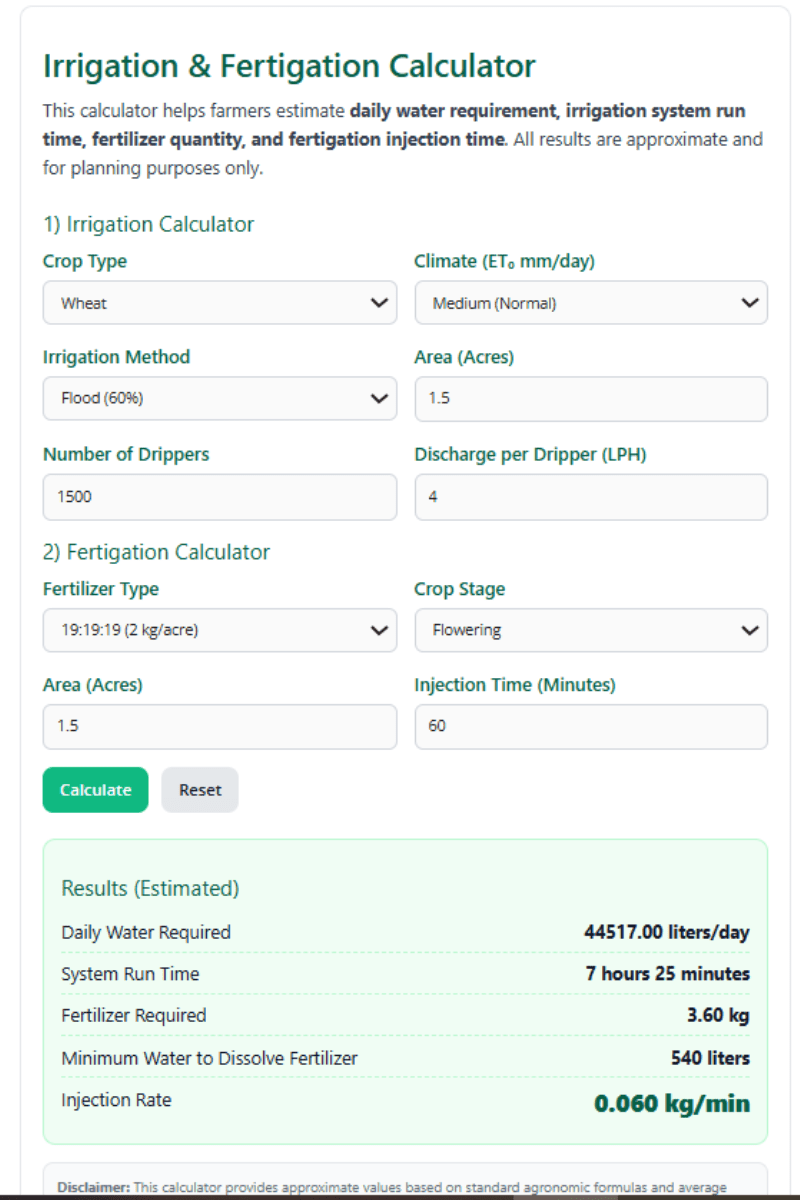
Irrigation & Fertigation Calculator
This calculator helps farmers estimate daily water requirement, irrigation system run time, fertilizer quantity, and fertigation injection time. All results are approximate and for planning purposes only.
1) Irrigation Calculator
2) Fertigation Calculator
What Inputs Does the Calculator Require?
The tool is organized into two sections: the Irrigation Calculator and the Fertigation Calculator.
Section 1 Irrigation Calculator Inputs
Crop Type (Kc value): The calculator includes six major crops with their assigned crop coefficients Wheat (0.8), Rice (1.1), Cotton (1.0), Tomato (1.05), Onion (1.0), and Sugarcane (1.2). Selecting the correct crop ensures your water requirement calculation reflects the actual physiological demand of what you are growing.
Climate / ET0 (mm/day): Reference evapotranspiration is the daily water loss from a reference grass surface under your local climate conditions. The tool offers three categories Low/Cool (4 mm/day), Medium/Normal (5.5 mm/day), and High/Hot (7 mm/day). In tropical and arid regions, the High setting is most appropriate during peak summer.
Irrigation Method: Choose from Drip (90% efficiency), Sprinkler (75% efficiency), or Flood (60% efficiency). The calculator uses your chosen efficiency to gross up the net water requirement telling you how much water you actually need to pump, not just what the crop theoretically needs.
Area (Acres): Enter your field area in acres. The calculator uses a conversion factor of 4,047 litres per mm per acre to translate the depth-based ETc value into total daily water volume in litres.
Number of Drippers and Discharge per Dripper (LPH): These two values give your system’s total flow capacity, which the tool uses to calculate the required runtime.
Section 2 Fertigation Calculator Inputs
Fertilizer Type: Choose from 19:19:19 NPK (2 kg/acre base dose), 0:52:34 (1.5 kg/acre base, for flowering and fruiting stages), or Urea (1 kg/acre base, nitrogen only).
Crop Stage: Vegetative (1.0x), Flowering (1.2x), or Fruiting (1.5x). The stage multiplier ensures your fertilizer application matches your crop’s actual nutritional demand at each phase of growth.
Area (Acres): Can differ from the irrigation area if you are only fertigating part of the field.
Injection Time (Minutes): How long you plan to run the fertigation injection. The tool divides the total fertilizer quantity by this time to calculate the injection rate in kg per minute.
Understanding the Calculator Results
Daily Water Required (litres/day): The total volume your irrigation system needs to deliver today to meet your crop’s evapotranspiration demand, adjusted for system efficiency.
System Run Time (hours and minutes): The exact time you need to run your drip system the most actionable output for the farmer. It tells you precisely when to start and stop your pump.
Fertilizer Required (kg): The total quantity of the selected fertilizer needed for your field at the current crop stage.
Minimum Water to Dissolve Fertilizer (litres): Each kilogram of fertilizer requires approximately 150 litres of water for safe dissolution preventing undissolved granules from blocking emitters.
Injection Rate (kg/min): The rate at which you need to inject fertilizer into the irrigation line to deliver the full dose within your specified injection time. Used to calibrate your venturi injector, dosatron, or fertigation pump.
Key Features and Smart Logic
ETc Formula (ET0 × Kc): Uses the globally accepted FAO-recommended calculation method your water requirement is a scientifically grounded estimate, not a rough guess.
Efficiency-Adjusted Water Volume: Gives you the gross pumping volume accounting for system losses the number you actually need to manage your pump and water source.
Stage-Based Fertilizer Scaling: The fertilizer dose automatically scales with crop stage. The 1.5x fruiting stage multiplier corrects the common mistake of applying the same dose throughout the season.
Injection Rate Calibration Output: Essential for setting up your injection equipment correctly a detail most basic fertigation calculators skip entirely.
Minimum Dissolution Volume: A practical safeguard that prevents emitter blockage one of the most common maintenance problems in drip fertigation systems.
Which Crops and Farming Systems Benefit Most?
Tomato, Onion, and Vegetable Growers: Vegetables under drip irrigation benefit enormously from combined irrigation and fertigation planning. Tomato at Kc 1.05 has moderately high water demand and is sensitive to both water stress and nutrient deficiency.
Sugarcane Farmers: With the highest Kc of 1.2, sugarcane has significant daily water demands especially in hot climates. Accurate runtime calculation prevents under-irrigation that limits sucrose accumulation.
Wheat and Cereal Farmers: Wheat’s lower Kc of 0.8 reflects moderate water use. For drip-irrigated wheat in water-scarce regions, runtime calculation helps avoid over-irrigation that causes lodging and fungal disease.
Cotton Farmers: Cotton at Kc 1.0 requires consistent moisture during boll development. Fertigation with 0:52:34 during the fruiting stage supports fibre quality and boll retention.
Rice Farmers Using AWD: The growing adoption of Alternate Wetting and Drying promoted by the International Rice Research Institute (IRRI) means drip-irrigated rice is gaining ground. This tool supports that transition at Kc 1.1.
Agronomists and Irrigation Consultants: Water requirement, runtime, fertilizer dose, and injection rate in a single tool a quick planning aid for professionals working across multiple farms.
Step-by-Step: How to Use the Calculator
A complete real-world example tomato farmer, 2-acre drip-irrigated field, warm climate, 800 drippers at 4 LPH each, fruiting stage, 19:19:19 NPK fertigation.
- Open the Irrigation & Fertigation Calculator
- Select Tomato (Kc = 1.05)
- Select High/Hot ET0 = 7 mm/day → ETc = 7 × 1.05 = 7.35 mm/day
- Select Drip (90% efficiency)
- Enter Area: 2 Acres → Daily Water Required = (7.35 × 2 × 4,047) / 0.90 = ~66,178 litres/day
- Enter 800 drippers at 4 LPH → Total flow = 3,200 LPH → Run Time = 20 hours 41 minutes
- Select 19:19:19 NPK, Stage: Fruiting (1.5x) → Fertilizer = 2 × 1.5 × 2 = 6 kg
- Enter Injection Time: 60 minutes → Injection Rate = 0.100 kg/min → Minimum dissolution water = 900 litres
This entire process takes under two minutes and gives you a data-backed irrigation and fertigation plan for the day.
Related Tools
- Crop Water Requirement Calculator Seasonal water needs before planning your irrigation schedule
- Drip Irrigation Layout Calculator Complete drip system layout, lateral spacing, and pipe sizing
- Evapotranspiration (ET) Calculator Daily ET0 for your specific location and season
- Irrigation Scheduling Calendar Full-season irrigation calendar
- Universal Sprinkler Spacing, Rate & Runtime Calculator For sprinkler-based systems
- Liquid Fertilizer Dilution Calculator Correct dilution ratio for liquid fertigation
- Foliar Spray Nutrient Dosage Calculator Plan your foliar spray program alongside fertigation
- Soil Moisture Depletion Calculator Know exactly when your soil reaches the irrigation trigger point
Frequently Asked Questions
Peoples are want to know about ETc by asking this:
What is the ETc formula and why does this calculator use it?
ETc is the total daily water loss from a crop through evaporation from the soil surface and transpiration through the plant leaves. ETc = ET0 × Kc is the international standard established by FAO in Irrigation and Drainage Paper 56 and used by irrigation engineers and agronomists in every country worldwide.
Can I use this calculator for sprinkler or flood irrigation?
Yes. The daily water requirement output is valid for any irrigation method. For sprinkler runtime planning, use this tool alongside the Universal Sprinkler Calculator. For flood irrigation, the daily water volume gives you the target volume per irrigation event.
Why does the tool calculate minimum water to dissolve fertilizer?
Undissolved fertilizer granules block drip emitters, damage venturi injectors, and create uneven nutrient distribution. The 150 litres per kilogram standard ensures complete dissolution under normal temperature and water quality conditions.
What is an injection rate and how do I use it?
The injection rate is the speed at which your fertigation equipment introduces fertilizer solution into the irrigation line. Use it to calibrate your venturi injector, dosatron proportioner, or electric fertigation pump set it to match the calculated rate for consistent and accurate nutrient delivery.
How accurate are the results?
Results are based on standard agronomic formulas used globally and provide reliable planning estimates for most conditions. For greatest accuracy, use locally measured ET0 data from a nearby weather station rather than the generalized climate categories. Treat outputs as a strong starting point not an absolute prescription.
Conclusion
Irrigation and fertigation are the two pillars of productive, resource-efficient crop farming and getting both right simultaneously is what separates a good harvest from a great one. The Irrigation & Fertigation Calculator puts the full power of ETc-based water scheduling and stage-adjusted fertilizer planning into a single tool that any farmer, anywhere in the world, can use in under two minutes.
Whether you are managing a 0.5-acre vegetable plot or a 50-acre commercial field, this tool gives you the precise daily water volume, system runtime, fertilizer dose, and injection rate you need free, fast, and accessible from any device, anywhere in the world.
Disclaimer:
The Irrigation & Fertigation Calculator is intended for general planning and educational purposes only. All results are approximate and based on standard agronomic formulas, average crop coefficients, and typical system efficiency values. Always consult a qualified agronomist or irrigation engineer before making significant changes to your irrigation schedule or fertilizer program.