Harvest time for silage is one of the most time-pressured moments in livestock farming. The crop is ready. The weather window is narrow. The machinery is running. And somewhere in the middle of all that urgency, you need to answer one critical question:
Is your silage bag or pit big enough to hold everything you are about to harvest?
If the answer is no and you find out only after the harvest machine has already filled the bag you are left scrambling for extra storage at the worst possible moment.
Calculate how many tonnes of silage your bag or bunker silo can hold before harvest. Free online silage bag calculator for cylindrical tube bags and rectangular bunker pits. Enter dimensions and compaction density to get volume in m³ and silage weight in kg and tonnes.
The Silage Bag Calculator on Precision Agriculture Calculators to help you answer that question before harvest day arrives.
It calculates the volume of your silage bag or pit and estimates the total silage weight it can hold, based on the compaction density of your crop. It supports cylindrical bags and rectangular pits. It works in metres and feet. And it takes less than a minute to use.
No more guessing. No more last-minute surprises. Just a clear, reliable capacity number you can plan around.
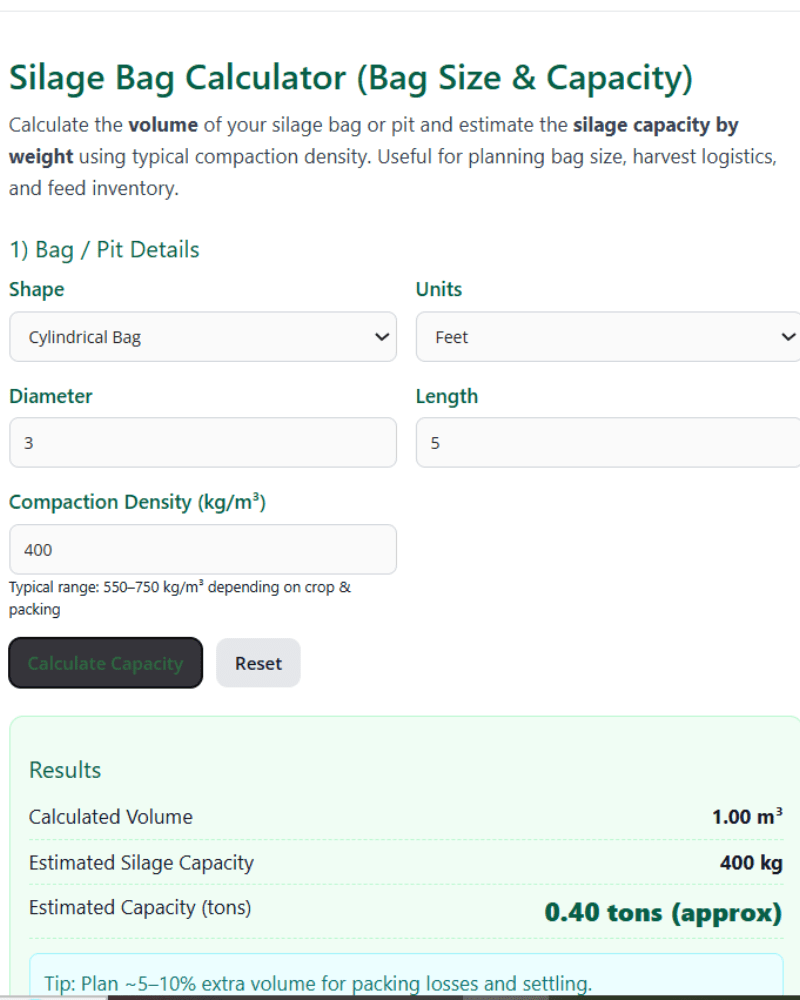
Silage Bag Calculator (Bag Size & Capacity)
Calculate the volume of your silage bag or pit and estimate the silage capacity by weight using typical compaction density. Useful for planning bag size, harvest logistics, and feed inventory.
1) Bag / Pit Details
Why Silage Storage Planning Matters
Silage is a cornerstone of livestock feeding systems worldwide.
From dairy cattle in Europe and North America to beef operations in South America, sheep farms in Australia and New Zealand, and smallholder dairy farmers across Asia and Africa silage is how farmers preserve forage quality through the dry season, winter, or whenever fresh feed is unavailable.
But silage only works if it is stored correctly. And storage planning starts with knowing your capacity.
Here is why getting the calculation right before harvest matters so much:
- Avoiding Underfilling: An underfilled silage bag creates excess air space. Air is silage's biggest enemy it allows oxygen-loving bacteria and moulds to grow, which degrades fermentation quality, increases dry matter losses, and can make the silage unsafe for animals to eat.
- Avoiding Overfilling: Overfilling risks bag bursting, poor sealing, and compromised fermentation. For rectangular pits, overfilling can cause structural issues with retaining walls and difficulties achieving a proper seal at the top.
- Feed Inventory Planning: Knowing how many tonnes of silage your storage holds allows you to calculate exactly how many days of feed you have for your herd. That directly informs your stocking decisions and purchasing plans for the dry season.
- Harvest Logistics: If you know your bag holds 80 tonnes and you expect to harvest 120 tonnes, you know you need a second bag or additional pit space before the harvester arrives not after.
- Cost Control: Silage bags, plastic film, and inoculants are significant costs. Accurate capacity planning helps you buy exactly what you need no more and no less.
According to the Food and Agriculture Organization of the United Nations (FAO), dry matter losses in poorly managed silage storage can range from 10 to 25 percent or higher, compared to just 2 to 5 percent in well-sealed, properly filled structures. Correct bag sizing and filling are among the most important factors in minimizing those losses.
What Does the Calculator Ask For?
The tool is simple and direct. Here is every input explained:
Shape
Choose between two storage shapes:
- Cylindrical Bag: The standard plastic silage tube bag a long cylinder sealed at both ends. Widely used in Europe, North America, Australasia, and increasingly in Asia and Africa. You need the diameter and length of the bag.
- Rectangular Pit / Bag: A bunker silo, drive-over pile, or rectangular walled pit. Common on larger farms and cooperatives. You need the width, height (depth of fill), and length of the structure.
Units
Choose Metres or Feet. All values are converted to metres internally before calculation, so you can enter whatever unit you measured in.
Cylindrical Bag Dimensions
- Diameter: The full width across the centre of the bag in metres or feet. Standard silage tube bags range from 1.8 m (6 ft) to 3.0 m (10 ft) in diameter. The most common size is 2.4 m to 2.7 m (8 to 9 ft).
- Length: The filled length of the bag in metres or feet. This depends on how much material you fill. A typical 2.7 m diameter bag may be filled to 30 to 60 metres in length depending on the harvest volume.
Rectangular Pit / Bag Dimensions
- Width: The internal width of the bunker or pit.
- Height: The depth of silage fill not the wall height. Measure the depth you actually intend to fill to, not the maximum wall height.
- Length: The length of the bunker or pit.
Compaction Density (kg/m3)
This is the most important variable after the physical dimensions.
Compaction density is how tightly the silage is packed measured in kilograms per cubic metre. Higher compaction means more silage weight per unit of volume, fewer air pockets, and better fermentation quality.
The typical range is 550 to 750 kg/m3. The default in the calculator is 650 kg/m3, which is a reasonable average for well-compacted grass or maize silage.
Here is how density varies by crop and packing method:
- Maize / Corn Silage: 650 to 720 kg/m3 when well compacted. Maize silage typically achieves higher densities than grass due to its higher moisture content at harvest.
- Grass / Legume Silage: 550 to 680 kg/m3 depending on moisture and chop length. Wetter grass silage packs more densely. Drier, longer-chopped silage is harder to compact and achieves lower densities.
- Sorghum / Small Grain Silage: 580 to 680 kg/m3. Similar to maize but varies with maturity and moisture at harvest.
- Legume (Alfalfa / Lucerne) Silage: 500 to 620 kg/m3. Legumes are harder to compact due to their fibrous stems.
For reference on recommended compaction density targets by crop, the University of Wisconsin Extension Silage Management Guidelines and the Penn State Extension Silage Storage and Management resources are widely used global references for silage producers.
Understanding Your Results
After clicking Calculate Capacity, the tool returns three key outputs:
Calculated Volume (m3)
This is the geometric volume of your bag or pit the physical space available for silage.
For a cylindrical bag, this is calculated as: Volume = Pi x (Diameter/2)2 x Length.
For a rectangular pit, this is: Volume = Width x Height x Length.
This is the raw space before any density factor is applied.
Estimated Silage Capacity (kg)
This is the estimated weight of silage your bag or pit can hold.
It is calculated as: Silage Weight (kg) = Volume (m3) x Compaction Density (kg/m3).
This is the value you use to check against your expected harvest yield.
Estimated Capacity (Tonnes)
The same weight expressed in metric tonnes (1 tonne = 1,000 kg).
This is the headline planning number. If your bag holds 75 tonnes and your herd needs 2 tonnes per day, you have 37.5 days of silage in that bag.
This is also the number used when comparing against contracted silage purchase volumes or when communicating with a custom harvesting contractor.
The 5 to 10 Percent Buffer Tip
The tool reminds you to plan 5 to 10 percent extra volume beyond your calculated need.
This accounts for packing losses small amounts of silage that fall outside the bag or are trimmed from the pit face during filling. It also accounts for settling silage compresses further after filling, meaning you can often add a small extra amount on top of a filled bag before sealing.
It is always better to have a slightly larger bag than to run short during filling.
Key Features of This Calculator
Key Features:
Two Shape Options
The calculator supports both cylindrical tube bags and rectangular bunker pits. Both are widely used globally, and both have different geometric formulas for volume calculation. The tool applies the correct formula for whichever shape you select.
Adjustable Compaction Density
The density field is fully adjustable. If you know your specific crop and packing method achieves a density of 700 kg/m3, enter that value. If you are estimating for poorly compacted silage at 550 kg/m3, enter that instead.
The ability to adjust density is what makes this calculator significantly more accurate than tools that use a single fixed density for all crops and conditions.
Unit Flexibility
Entering measurements in feet? No problem. The tool converts feet to metres (1 foot = 0.3048 metres) automatically before calculating. You never need to do the unit conversion yourself.
Instant, Clear Output
The results are displayed in three formats cubic metres, kilograms, and tonnes so you can use whichever unit fits your planning and communication needs.
Which Farmers and Users Benefit Most?
- Dairy Cattle Farmers: Silage is the primary conserved forage for dairy herds worldwide. Dairy farmers need to know their total silage tonnage before the end of the grazing or harvest season to plan the indoor feeding period accurately.
- Beef and Feedlot Operators: Large-scale beef operations often fill multiple silage bags or bunker silos per harvest season. This calculator helps them estimate total storage capacity before committing to a harvest volume.
- Sheep and Goat Farmers: In regions with long dry seasons or cold winters, sheep and goat farmers increasingly rely on silage as a supplement or primary feed. Knowing the bag capacity helps them plan whether their storage is sufficient for the size of their flock.
- Custom Silage Contractors: Harvesting contractors who fill bags or pits for multiple farms can use this tool to estimate fill time and bag requirements for each client job during the pre-season planning phase.
- Farm Managers and Nutritionists: Farm consultants and livestock nutritionists who prepare annual feed budgets use silage tonnage as a key input. This tool provides a fast, reliable capacity estimate without requiring field measurements to be converted manually.
- Smallholder Livestock Farmers: In regions where silage is a relatively new practice for smallholders such as parts of sub-Saharan Africa and South Asia this tool provides an accessible, jargon-free way to plan storage capacity for the first time.
Step-by-Step: How to Use the Silage Bag Calculator
Let me walk you through two complete examples one for a cylindrical bag and one for a rectangular bunker pit.
Example 1: Cylindrical Silage Tube Bag
You are about to fill a standard 2.7-metre diameter silage tube bag. You expect to fill it to approximately 45 metres in length. You are filling maize silage and expect a compaction density of 680 kg/m3.
- Open the Silage Bag Calculator on Precision Agriculture Calculators.
- Select Cylindrical Bag from the Shape dropdown.
- Select Metres as the unit.
- Enter Diameter as 2.7.
- Enter Length as 45.
- Enter Compaction Density as 680.
- Click Calculate Capacity.
Result: Volume = Pi x (1.35)2 x 45 = 3.1416 x 1.8225 x 45 = 257.6 m3.
Silage Capacity = 257.6 x 680 = 175,168 kg = approximately 175.2 tonnes.
With a dairy herd consuming 2.5 tonnes of silage per day, this single bag holds approximately 70 days of feed supply.
Adding the 10% buffer: plan for at least 193 tonnes of harvested material to fill this bag properly and allow for packing losses.
Example 2: Rectangular Bunker Silo
You have a concrete bunker silo that is 8 metres wide, 2.5 metres deep (fill height), and 25 metres long. You are filling grass silage with an expected density of 600 kg/m3.
- Select Rectangular Pit / Bag from the Shape dropdown.
- Select Metres.
- Enter Width as 8, Height as 2.5, Length as 25.
- Enter Compaction Density as 600.
- Click Calculate Capacity.
Result: Volume = 8 x 2.5 x 25 = 500 m3.
Silage Capacity = 500 x 600 = 300,000 kg = 300 tonnes.
That is enough to feed a herd of 100 dairy cows at 3 kg silage per cow per day for 1,000 days or more realistically, to carry a large dairy herd through a full winter or dry season at much higher daily feed rates.
This capacity estimate gives you a clear, confident number to share with your harvest contractor and feed planning consultant.
Related Tools on Precision Agriculture Calculators.
Use the Silage Bag Calculator alongside these livestock and feed management tools on Precision Agriculture Calculators:
- Dairy Feed Calculator- Calculate the daily feed ration for your dairy herd and estimate how long your silage store will last.
- Young Animal Feeding Planner- Plan feed requirements for calves and young stock alongside your silage inventory.
- Livestock Weight Estimator- Estimate animal weights to calculate accurate daily dry matter intake targets for silage rationing.
- Cattle/Buffalo Weight Gain Calculator- Track weight gain performance against your silage-based feeding program.
- Goat Farming Profit Forecast- Include silage storage costs and feed inventory in your goat farm profitability forecast.
- Farmer Profit and Loss Calculator- Factor your silage production and storage costs into your overall farm profit and loss calculation.
Frequently Asked Questions
Key Features of faq's:
What is the typical compaction density for silage and how do I choose the right value?
Compaction density for silage typically ranges from 550 to 750 kg/m3 depending on crop type, moisture content, chop length, and packing method. As a starting point: use 650 to 720 kg/m3 for maize silage, 580 to 650 kg/m3 for grass silage, and 500 to 600 kg/m3 for drier or legume silage. If you have previously measured the actual density of your silage by weighing a known volume, use that value for the most accurate result. If unsure, the default of 650 kg/m3 is a reasonable middle estimate for most well-compacted whole-plant silage.
Why should I add a 5 to 10 percent buffer to my calculated capacity?
When filling a silage bag or pit, some material inevitably falls outside the structure during filling and is lost. Additionally, silage settles and compresses further after the bag is sealed, meaning the apparent volume shrinks slightly. Planning for 5 to 10 percent extra harvest material ensures your bag is properly filled which is critical for achieving the anaerobic conditions needed for good fermentation. An underfilled bag with excess air space is much more vulnerable to spoilage than a tightly filled one.
Can I use this calculator for baled silage (round bales)?
The current version of the calculator supports cylindrical tube bags and rectangular pits. Round bales are a different storage format each bale is a separate unit with its own volume and weight. For round bale planning, you would typically estimate bale weight from the baler manufacturer's specifications (usually 400 to 700 kg per bale depending on size and crop) and multiply by the number of bales rather than calculating a bag or pit volume. A future version of this tool may include a round bale option.
Does the calculator account for dry matter content?
The compaction density figure used in this calculator is based on fresh weight silage the total weight including moisture. It does not separate dry matter from water content. If you need to calculate the dry matter tonnes in your silage (for ration formulation and nutritional planning), multiply the estimated total tonnes by your silage dry matter percentage. For example, 175 tonnes of maize silage at 35% dry matter contains approximately 61 tonnes of dry matter.
What is the difference between a silage bag and a bunker silo?
A silage tube bag is a long plastic sleeve typically 1.8 to 3 metres in diameter that is filled by a bag loader machine and sealed at both ends. It is portable, relatively inexpensive, and suitable for farms of all sizes. A bunker silo (or drive-over pile) is a permanent or semi-permanent rectangular structure with concrete or earth walls into which silage is pushed by a loader and compacted by a tractor.
Bunker silos have higher capacity and lower cost per tonne for large operations but require a larger capital investment. Both types are widely used globally, and this calculator supports both shapes.
Conclusion
Silage storage planning is not something you want to figure out on harvest day.
The Silage Bag Calculator on Precision Agriculture Calculators gives you the capacity numbers you need in volume, kilograms, and tonnes before the harvester arrives. Whether you are filling a standard cylindrical tube bag or a large rectangular bunker silo, whether you are growing maize, grass, sorghum, or legume silage, this tool takes your dimensions and compaction density and gives you a clear, reliable estimate in seconds.
Use it to confirm your bag is the right size, plan your harvest logistics, calculate your feed inventory, and make sure your silage operation runs smoothly from field to feed trough every season, every time.
Disclaimer
The Silage Bag Calculator on Precision Agriculture Calculators provides approximate capacity estimates based on geometric volume formulas and a user-specified compaction density. Actual silage capacity and weight will vary depending on crop type, moisture content at harvest, chop length, packing method, equipment used, and operator technique. The compaction density ranges provided are general guidelines and may not reflect the specific characteristics of your crop or operation.
Always add a 5 to 10 percent safety buffer to your calculated capacity when planning harvest volumes. Consult a qualified forage agronomist or silage specialist for site-specific storage design and management recommendations. The author and Precision Agriculture Calculators accept no liability for feed shortages, storage failures, or financial losses arising from decisions made based on this calculator's output.