Introduction: Animal Gestation Calculator
You know the mating date. Now you need the due date. For every farmer who raises livestock, knowing when to expect the birth is one of the most critical pieces of farm management. The due date determines when to shift the pregnant animal to a separate pen, when to change her feed, when to have your vet on standby, and when to be present for the birth.
Getting this wrong has real consequences. A cow that should be in a calving pen is still in the main herd. A sow about to farrow has no farrowing box ready. A pregnant goat is still getting the same feed she had in early pregnancy when she needs double the nutrition.
Every minute of preparation before birth means safer outcomes for mother and offspring.
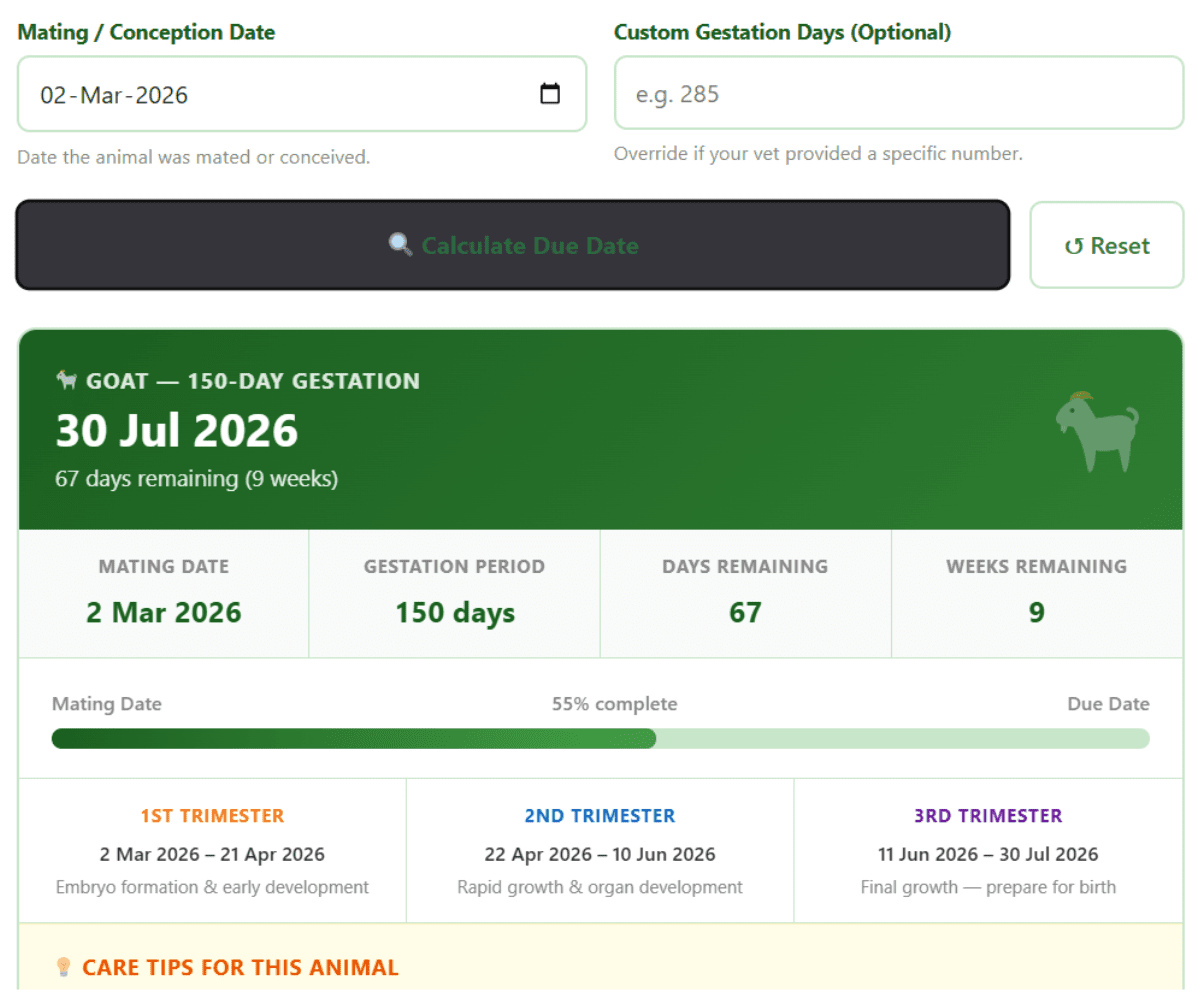
Animal Gestation Calculator: Select your animal, enter the mating or conception date, and the tool calculates the expected due date, days and weeks remaining, a visual pregnancy progress bar, all three trimester date ranges, and a set of five care tips specific to that animal and stage.
It covers 16 species: from cattle and buffalo all the way to camels, elephants, rabbits, and dogs. And if your vet has given you a specific number of gestation days, you can override the default and use that figure instead.
Animal Gestation Calculator
Step 1 — Select Your Animal
Step 2 — Enter Mating / Conception Date
Gestation Period Reference — All Animals
| Animal | Min Days | Average Days | Max Days | Approx. Duration | Offspring Name |
|---|
Why Knowing Your Animal’s Due Date Matters
Livestock birth management is one of the highest-stakes moments in animal husbandry.
According to the World Organisation for Animal Health (WOAH), perinatal mortality (deaths around the time of birth) is one of the leading causes of livestock loss worldwide. A significant proportion of these deaths are preventable through better preparation and timely intervention.
Here’s what accurate due date tracking allows you to do:
- Prepare the birth environment in time. Moving a cow to a clean calving pen, setting up a farrowing crate for a sow, or preparing a quiet kidding area for a doe all need to happen 1 to 2 weeks before the birth. If you don’t know when the birth is coming, this preparation either happens too late or not at all.
- Adjust nutrition at the right trimester. Energy, protein, calcium, and mineral requirements change dramatically across the three trimesters. A doe goat needs approximately 150 percent of her normal energy intake in the last 6 weeks. A cow in the close-up dry period needs specific transition cow nutrition. These adjustments require knowing when each trimester starts and ends.
- Arrange veterinary support if needed. First-time mothers, animals with a history of difficult births, or valuable breeding animals should have a vet’s contact ready from 2 weeks before the due date. You can only arrange this if you know when the birth is expected.
- Plan colostrum management. Newborn calves, kids, foals, and lambs must receive colostrum (first milk) within 2 to 6 hours of birth. This is the critical window for passive immunity transfer. Missing this window because no one was present at the birth dramatically increases neonatal mortality risk.
- Schedule labour and night checks. Many animals give birth at night or in the early morning. Knowing the due date window lets you arrange the correct watch schedule so someone is present or nearby at the critical time.
Research published through the Food and Agriculture Organization of the United Nations (FAO) confirms that better periparturient (around-birth) management is one of the highest-return investments in livestock production, reducing neonatal mortality and improving lifetime productivity of both dam and offspring.
The 16 Animals Covered and Their Gestation Periods
Each animal in the calculator has a specific average gestation period based on published veterinary reference data, along with minimum and maximum ranges that reflect natural variation.
Large Livestock
- Cow: 283 days average (270 to 295 range). Approximately 9.5 months. Offspring: Calf. The most widely tracked gestation period in livestock farming globally. Breed variation is significant.
- Buffalo: 310 days average (300 to 320 range). Approximately 10.3 months. Offspring: Calf. Longer than cattle. Buffalo are more sensitive to heat during pregnancy and require shade and cool water.
- Horse: 340 days average (320 to 360 range). Approximately 11.3 months. Offspring: Foal. Highly variable gestation. Foals born before 300 days require immediate veterinary care.
- Donkey: 365 days average (350 to 380 range). Approximately 12 months. Offspring: Foal. Donkey gestation is roughly one full year. Donkeys are stoic and may not show obvious signs of approaching birth.
- Camel: 390 days average (370 to 410 range). Approximately 13 months. Offspring: Calf. One of the longest gestations among domestic animals. Singles are normal; twins are extremely rare.
- Elephant: 660 days average (620 to 700 range). Approximately 22 months. Offspring: Calf. The longest gestation of any land mammal. Calves weigh 90 to 120 kg at birth and can stand within hours.
Small Ruminants
- Goat: 150 days average (145 to 155 range). Approximately 5 months. Offspring: Kid. Twins and triplets are common. Navel disinfection of newborn kids is essential immediately after birth.
- Sheep: 147 days average (142 to 152 range). Approximately 5 months. Offspring: Lamb. Very consistent gestation. Ewes rarely deliver more than 3 days from the predicted date under good management.
- Deer: 200 days average (190 to 210 range). Approximately 6.5 months. Offspring: Fawn. Does typically give birth alone in a secluded location. Twins are common in well-nourished deer.
Camelids
- Llama: 350 days average (335 to 360 range). Approximately 11.5 months. Offspring: Cria. Llamas almost always give birth during daylight hours, a unique and practical characteristic for farm management.
- Alpaca: 345 days average (330 to 358 range). Approximately 11.5 months. Offspring: Cria. Like llamas, alpaca births (called unpacking) occur almost exclusively between 8 AM and 2 PM.
Pigs
- Pig (Sow): 114 days average (112 to 116 range). Approximately 3.8 months. Offspring: Piglet. The classic memory aid is 3 months, 3 weeks, 3 days. One of the most consistent gestations in farm animals. Iron injection for piglets within 3 days of birth is essential.
Companion and Small Animals
- Rabbit: 31 days average (28 to 35 range). Approximately 1 month. Offspring: Kit. The shortest gestation on the list. A nesting box must be provided 1 week before the expected date.
- Dog: 63 days average (58 to 68 range). Approximately 2 months. Offspring: Puppy. Food should increase gradually from week 5, reaching 150 percent of normal by the final weeks.
- Cat: 63 days average (60 to 67 range). Approximately 2 months. Offspring: Kitten. Cats typically handle birth independently but benefit from a quiet, dark nesting area.
- Guinea Pig: 68 days average (59 to 72 range). Approximately 10 weeks. Offspring: Pup. Uniquely, guinea pig pups are born fully furred and with eyes open, and can eat solid food within hours of birth.
What Does the Calculator Ask You to Enter?
Step 1: Select Your Animal
A grid of 16 animal buttons shows the emoji, name, and average gestation days for each animal. Click your species.
The selected animal turns dark green to confirm your selection. The average gestation period shown on each button gives you an immediate reference before you even calculate.
Step 2: Mating or Conception Date
Enter the date when mating occurred or when conception was confirmed. The default date is today.
Use the actual mating date if known. For AI (artificial insemination), use the insemination date. For natural mating where you’re not certain of the exact date, use the middle of the mating window as an estimate.
The more accurate your mating date, the more accurate your due date prediction.
Custom Gestation Days (Optional)
If your veterinarian has told you a specific gestation length for your individual animal, breed, or pregnancy, enter it here.
This overrides the species average. For example, some cattle breeds consistently have slightly shorter or longer gestations than the 283-day average. A vet monitoring a high-value mare may give a specific day count based on ultrasound measurement. Enter that number here.
What Do Your Results Show You?
Due Date
The expected birth date displayed prominently in large text at the top of the result panel.
For practical farm management, treat this date as the centre of a window rather than an exact prediction. Add the minimum and maximum range for your species to understand how wide that window is. For a cow, the window spans 270 to 295 days from mating, a 25-day range.
Days and Weeks Remaining
The exact number of days and weeks remaining until the due date, calculated from today’s date.
If the due date has already passed, the result shows ‘Overdue by X days’ with a message to consult your vet. Overdue by a few days within the natural range is normal for some species. Significantly overdue warrants veterinary assessment.
Pregnancy Progress Bar
A visual progress bar showing what percentage of the total gestation period has elapsed from the mating date to today.
This is a quick visual reference for where you are in the pregnancy. At 33 percent you’re at the end of the first trimester. At 67 percent you’re entering the third trimester. At 100 percent the due date has arrived.
Three Trimester Date Ranges
The gestation is divided into three equal thirds. Each trimester shows the start and end date plus a description of what’s happening biologically.
- First Trimester: Embryo formation and early development. Nutritional requirements are not yet elevated above baseline. Focus is on preventing stress, disease, and chemical exposure.
- Second Trimester: Rapid growth and organ development. Fetal demand begins increasing. Nutrition quality becomes more important.
- Third Trimester: Final growth and preparation for birth. The most critical nutritional period. Energy, protein, calcium, and mineral requirements are highest. Prepare the birth environment. This is the time to take action.
Knowing exactly when each trimester starts and ends for your specific mating date is more useful than a generic guideline. The calculator gives you the actual calendar dates for your animal.
Animal-Specific Care Tips
Five practical care tips specific to the selected animal appear in the results.
These are not generic livestock tips. Each species has its own specific guidance. The pig’s tips mention the 3 months, 3 weeks, 3 days memory rule and the importance of iron injections for piglets. The horse’s tips warn that foals born before 300 days are premature and need immediate veterinary care. The llama’s tips note that births almost always occur during daylight hours.
These tips summarize the most important species-specific management knowledge in five actionable points.
What Makes This Calculator More Than a Basic Date Calculator
16 Species with Breed-Verified Ranges
Most online animal pregnancy calculators cover 4 or 5 common livestock species. This tool covers 16, from the 31-day rabbit to the 660-day elephant.
Each species has a minimum and maximum range, not just an average. This range is shown in the reference table and helps you understand how much natural variation exists. A horse’s range of 320 to 360 days is very different from a pig’s 112 to 116-day range. Knowing the range tells you when to start watching carefully.
Trimester-Based Planning Built In
The three trimester date ranges are automatically calculated for your specific mating date and animal.
You don’t need to manually calculate one-third and two-thirds of the gestation period. The tool does it and gives you the actual calendar dates. You can add these dates to your farm calendar immediately.
Overdue Alert
If today’s date is past the calculated due date, the result changes to an overdue message with the number of days overdue.
Being a few days overdue within the natural range is normal for most species. Being significantly overdue, especially beyond the maximum range, is a flag to consult your veterinarian. The overdue alert draws attention to this situation immediately rather than showing a negative days-remaining number that could be missed.
Custom Gestation Override
The optional custom gestation days field is a professional feature that most farm animal calculators don’t offer.
Vets monitoring high-value animals through ultrasound can provide specific gestation predictions for individual pregnancies. Exotic species not on the standard list can be calculated by entering their known gestation days. Breeds with documented shorter or longer gestations than the species average can be calculated accurately.
Reference Table for All 16 Animals
A complete reference table appears below the calculator showing all 16 animals with their minimum, average, and maximum gestation days, approximate duration in months, and offspring name.
This table is useful on its own as a quick livestock reference. Print it and keep it in the farm office or livestock management folder.
Who Benefits Most from This Tool?
- Cattle and Dairy Farmers: Cow gestation management is central to milk production planning, dry period management, and calving season preparation. Track every confirmed mating date and use this tool to plan each cow’s calving date, transition feeding program, and calving pen availability.
- Goat and Sheep Farmers: Small ruminant births happen quickly and often produce multiples. Knowing the kidding or lambing date lets you prepare kidding pens, ensure colostrum availability, and plan for the extra labour intensive period.
- Pig Farmers: With the very consistent 114-day gestation, sow due dates are highly predictable. Use the calculator to plan farrowing crate schedules, piglet iron injections, and weaning timelines across the entire sow herd.
- Horse and Equine Breeders: Mare gestation is long (nearly a year) and variable. The 320 to 360-day range means monitoring begins early. The custom gestation override is particularly useful here for vet-informed predictions.
- Zoo Professionals: Camels, deer, llamas, alpacas, and elephants have specific gestation periods that aren’t in most livestock calculators. This tool covers them all with species-specific care guidance.
- Veterinarians and Animal Health Extension Workers: A quick field tool for calculating due dates during farm visits without needing to remember species-specific gestation periods or perform manual date arithmetic.
Step-by-Step: How to Use the Animal Gestation Calculator
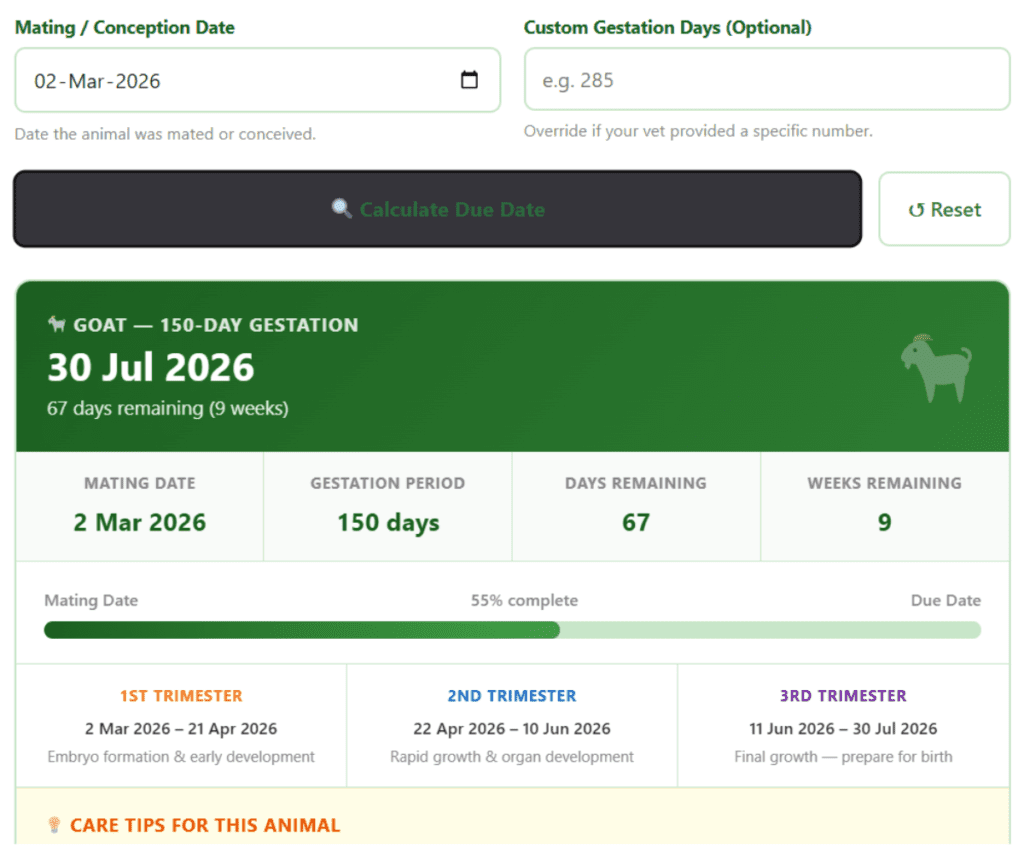
Here’s a complete example. Your doe goat was mated on 15 March. You want to know the due date and trimester plan.
- Open the Animal Gestation Calculator.
- Click the Goat button in the animal grid.
- The button turns dark green confirming your selection. The button shows 150 days as the average gestation.
- Enter 15 March as the mating or conception date.
- Leave Custom Gestation Days blank to use the 150-day average.
- Click Calculate Due Date.
Here’s what the results show:
- Due Date: 12 August (150 days from 15 March).
- Days remaining: depends on today’s date relative to 12 August.
- Progress bar: shows percentage of gestation completed.
- First trimester: 15 March to 14 April (days 1 to 50).
- Second trimester: 15 April to 14 June (days 51 to 100).
- Third trimester: 15 June to 12 August (days 101 to 150).
- Five goat-specific care tips covering concentrate feed increase in the last 6 weeks, calcium supplementation, separating the doe from the herd, checking twins are nursing, and navel disinfection for newborn kids.
With these dates on your farm calendar, you know to increase concentrate feed from 1 July onwards (6 weeks before the 12 August due date), separate the doe from the main herd around 5 August (1 week before), and have your colostrum plan ready for the kids.
For species-specific gestation data, neonatal care protocols, and pregnancy management guidelines, the World Organisation for Animal Health (WOAH) Animal Health and Welfare Technical Codes and the FAO Animal Production and Health Division resources are comprehensive globally available references. For breed-specific gestation data, consult your national livestock breed registry or your veterinarian.
Related Tools
Use the Animal Gestation Calculator alongside these tools for complete livestock management:
- Young Animal Feeding Planner — Plan the colostrum and milk feeding schedule for newborn calves, kids, lambs, or foals immediately after birth.
- Dairy Feed Calculator — Plan the transition feeding program for cows in the final weeks before calving and into early lactation.
- Livestock Heat Stress Index Calculator — Monitor temperature and humidity conditions affecting pregnant animals, especially during the third trimester when heat stress risk is highest.
- Animal’s Weight Gain Calculator — Track body condition and weight of pregnant animals to ensure they’re not losing condition during late pregnancy.
Frequently Asked Questions
My animal is overdue by a few days. Should I be worried?
It depends on how many days overdue and your species.
For goats and sheep, delivering 3 to 5 days after the predicted date is common and not a concern if the animal appears comfortable and shows normal pre-birth signs.
For cows, going 1 to 2 weeks past the predicted date while still within the 270 to 295-day range is normal. Beyond 295 days, consult your vet.
For pigs, the 112 to 116-day range is very tight. Going more than 5 days past 114 days warrants veterinary attention.
Any animal showing distress, prolonged straining without delivery, or abnormal discharge is a veterinary emergency regardless of how close to or far from the due date she is.
How accurate is the mating date if I didn’t observe the mating directly?
For natural mating where you didn’t observe the actual event, use the middle of the period when the male was with the female as your best estimate.
For example, if the buck was introduced on 1 March and removed on 5 March, use 3 March as your estimated mating date. Your due date will be accurate to within a few days in either direction.
Pregnancy diagnosis by ultrasound at 30 to 60 days can confirm pregnancy and give a more accurate conception date based on fetal size measurements. Use the custom gestation days field with any vet-provided specific date.
What is colostrum and why does the calculator mention it for so many species?
Colostrum is the thick, yellowish first milk produced by the mother immediately after birth. It contains very high concentrations of immunoglobulins (antibodies), growth factors, and nutrients that newborns cannot produce themselves.
Most livestock species are born with no passive immunity from their mother. The only way they get immune protection in the first weeks of life is by absorbing these antibodies from colostrum. The gut can only absorb these large antibody molecules for a short window after birth: roughly 6 to 12 hours in calves and foals, and slightly longer in some other species.
Missing this colostrum window is one of the most preventable causes of neonatal mortality. Being present at the birth because you know the due date is the simplest way to ensure every newborn receives colostrum in time.
Can I use this calculator for wildlife or zoo animals?
The calculator covers some species that are managed in both farm and zoo settings: deer, camel, elephant, llama, and alpaca.
For other wild or exotic species not on the list, use the custom gestation days field. Enter the known gestation period for your species (obtainable from veterinary references or the facility’s animal records) and use any mating or observed conception date as the start date.
The tool shows three trimesters. Do animals actually have trimesters like humans?
The trimester concept is used in human obstetrics but is applied to animal gestation as a practical planning framework, not a precise biological term.
Biologically, embryo and fetal development in mammals follows similar broad phases: initial embryo formation and implantation, rapid organ and body structure development, and final growth and preparation for birth. The three-trimester framework maps approximately to these phases.
For practical livestock management, the most important trimester is the third. This is when nutritional requirements are highest, when birth preparation begins, and when the risk of pregnancy-related complications is greatest. Knowing when the third trimester starts for your specific animal on your specific mating date is the most actionable piece of information the calculator provides.
Conclusion
Knowing your animal’s due date is not just a calendar exercise. It’s the foundation of everything that needs to happen before a safe, healthy birth: the nutrition changes, the housing preparation, the veterinary contacts, the colostrum plan, and the night-watch schedule.
The Animal Gestation Calculator on Precision Agriculture Calculators makes this planning instant for 16 species. Select your animal, enter the mating date, and get the due date, trimester calendar, progress tracking, and species-specific care guidance in one complete result. Keep the reference table printed in your farm office so you always have gestation periods for every species at hand. Use it from the moment of mating and let preparation protect what matters most.
Disclaimer
The Animal Gestation Calculator on Precision Agriculture Calculators provides due date estimates based on published average gestation periods for each species. These are estimates only. Actual birth dates may vary by several days to several weeks depending on breed, individual variation, nutritional status, health, and environmental factors.
Minimum and maximum gestation ranges shown are general guidelines and individual animals may fall outside these ranges while still experiencing normal pregnancies. The three trimester date ranges are equal mathematical divisions of the total gestation period and are provided as a planning framework rather than precise biological stage markers. An overdue alert does not constitute a diagnosis of dystocia or pregnancy complication. Always consult a qualified veterinarian for individual pregnancy assessment, difficult births, or any signs of distress in pregnant animals.
The care tips provided are general species-level guidance and may not apply to all breeds, management systems, or individual health situations. The author accept no liability for animal health outcomes arising from breeding or birth management decisions made based on this calculator.