Every livestock farmer wants their animals to grow well. But most farmers have no idea how fast their animals are actually growing. They look at the animal, it seems bigger than last month, and they move on. They don’t have a number. They don’t have a benchmark. And they don’t know whether their feed is being converted efficiently or wasted.
This is where Average Daily Gain (ADG) and Feed Conversion Ratio (FCR) become essential tools.
ADG tells you exactly how many kilograms your animal gains per day. FCR tells you how many kilograms of feed it takes to produce one kilogram of live weight gain. Together, these two numbers tell you everything about the economics and productivity of your livestock operation.
The Cattle and Buffalo Weight Gain Calculator to make calculations instant for any of 12 common livestock species.
The tool has four tabs. Tab 1 calculates ADG from two weight measurements. Tab 2 projects how long it will take your animal to reach a target weight. Tab 3 calculates your FCR from feed consumed and weight gained. Tab 4 is a reference table covering ADG ranges, FCR benchmarks, and market weights for all 12 animals.
You don’t need a computer science background or a complex spreadsheet. Enter a few numbers and get the performance metrics your livestock operation depends on.
Enter the animal’s starting and ending weight with the number of days between measurements to calculate Average Daily Gain (ADG) and performance rating.
Enter the current weight, target weight, and expected ADG to calculate days needed to reach target — with a monthly growth schedule.
Feed Conversion Ratio (FCR) = Feed consumed ÷ Live weight gain. A lower FCR means better feed efficiency.
| Animal | Typical ADG (kg/day) | Typical FCR Range | Market Weight (kg) | Key Note |
|---|
Why ADG and FCR Are the Two Most Important Numbers in Livestock Production
Livestock farming is fundamentally a business of converting feed into animal weight.
According to the Food and Agriculture Organization of the United Nations (FAO), feed costs represent 60 to 70 percent of total livestock production costs globally. The efficiency with which an animal converts feed to body weight is therefore the single biggest driver of profitability in any livestock enterprise.
Here’s why ADG and FCR matter so specifically:
- ADG directly determines your income timeline. A buffalo calf gaining 0.8 kg per day reaches market weight in significantly less time than one gaining 0.5 kg per day. The difference is not just in time: it’s in total feed cost, housing cost, labour cost, and opportunity cost of capital tied up in the animal.
- ADG flags health and nutrition problems early. A sudden drop in ADG is often the earliest signal that something is wrong: a nutritional deficiency, a subclinical disease, parasite infestation, or water stress. Tracking ADG regularly means catching these problems before they cause serious production losses.
- FCR reveals feed program efficiency. You may be feeding an animal well in terms of quantity, but if the feed quality is poor, the FCR will be high and you’re wasting money. An FCR of 9 in a cattle steer means 9 kg of feed for every 1 kg of gain. An FCR of 6 on the same animal means 3 kg less feed per kg of gain. At scale, this difference is enormous.
- FCR guides breed and feed decisions. Crossbred cattle consistently achieve better FCR than indigenous breeds on the same diet. High-energy supplementary feed improves FCR over roughage-only rations. Knowing your current FCR lets you evaluate whether a breed change or feed upgrade investment will pay back.
- Target weight planning prevents over-feeding and under-feeding. Knowing how many days it will take to reach market weight at the current ADG lets you plan feed procurement, housing turnover, and sale timing precisely. Without this calculation, most farmers either sell too early at lower weight or keep animals too long, feeding them past the point of efficient gain.
Research reviewed by the World Organisation for Animal Health (WOAH) consistently identifies systematic performance monitoring, including regular weighing and ADG tracking, as a foundational practice for improving livestock productivity in both smallholder and commercial farming systems.
The 12 Animals Covered and Their Performance Benchmarks
The calculator covers 12 livestock species with individual ADG ranges, FCR benchmarks, and management notes for each.
Cattle
- Cow (Crossbred Cattle): ADG 0.4 to 0.9 kg per day. Good performance target: 0.7 kg per day. Crossbred cattle on good nutrition typically achieve 0.6 to 0.8 kg per day. Indigenous breeds manage 0.3 to 0.5 kg per day under the same conditions. FCR typically 5 to 9.
- Bull (Intact Male): ADG 0.6 to 1.4 kg per day. Good target: 0.9 kg per day. Intact bulls gain 15 to 20 percent faster than castrated steers due to the anabolic effect of testosterone. FCR 5 to 8.
- Steer (Castrated Male): ADG 0.5 to 1.1 kg per day. Good target: 0.75 kg per day. Steers on feedlot rations with grain finishing can reach 1.0 to 1.2 kg per day. FCR 6 to 9.
- Heifer: ADG 0.4 to 0.9 kg per day. Good target: 0.65 kg per day. Heifers should reach 60 to 65 percent of their mature body weight at first service, typically 300 to 350 kg for crossbred heifers. FCR 6 to 10.
- Calf (0 to 6 months): ADG 0.3 to 0.8 kg per day. Good target: 0.55 kg per day. Pre-weaning calves on good milk plus creep feed achieve 0.4 to 0.7 kg per day. Colostrum feeding in the first 6 hours is critical for survival and lifetime performance. FCR 4 to 7.
Buffalo
- Buffalo: ADG 0.4 to 0.8 kg per day. Good target: 0.65 kg per day. Murrah and Surti buffaloes on good green fodder and concentrates achieve 0.5 to 0.8 kg per day. Buffalo are generally slower to mature than cattle and require more time to reach market weight. FCR 6 to 10.
Small Ruminants
- Goat: ADG 0.05 to 0.2 kg per day. Good target: 0.12 kg per day. Boer and crossbred meat goats achieve 0.15 to 0.20 kg per day. Indigenous breeds typically manage 0.06 to 0.10 kg per day. FCR 4 to 7.
- Sheep and Lamb: ADG 0.1 to 0.3 kg per day. Good target: 0.18 kg per day. Lambs from weaning to market achieve 0.15 to 0.25 kg per day under good management. Rams gain 10 to 15 percent faster than ewes. FCR 4 to 7.
Other Species
- Pig: ADG 0.4 to 0.9 kg per day. Good target: 0.65 kg per day. Pigs have the best FCR of all common meat animals. Commercial breeds achieve FCR 2.5 to 3.0 at market weight, making them the most feed-efficient large meat animal farmed globally. FCR 2.5 to 4.
- Horse and Pony: ADG 0.3 to 1.0 kg per day for young growing horses. Weight gain slows significantly after 2 years. FCR 7 to 12.
- Deer: ADG 0.1 to 0.4 kg per day. Farmed deer show strong seasonal growth patterns, gaining fastest in summer. FCR 4 to 8.
- Rabbit: ADG 0.02 to 0.05 kg per day. Commercial broiler rabbits reach market weight of 2.0 to 2.5 kg at 70 to 80 days. FCR 3 to 5.
What Each Tab of the Calculator Does
Read this as given:
Tab 1: Weight and ADG Calculator
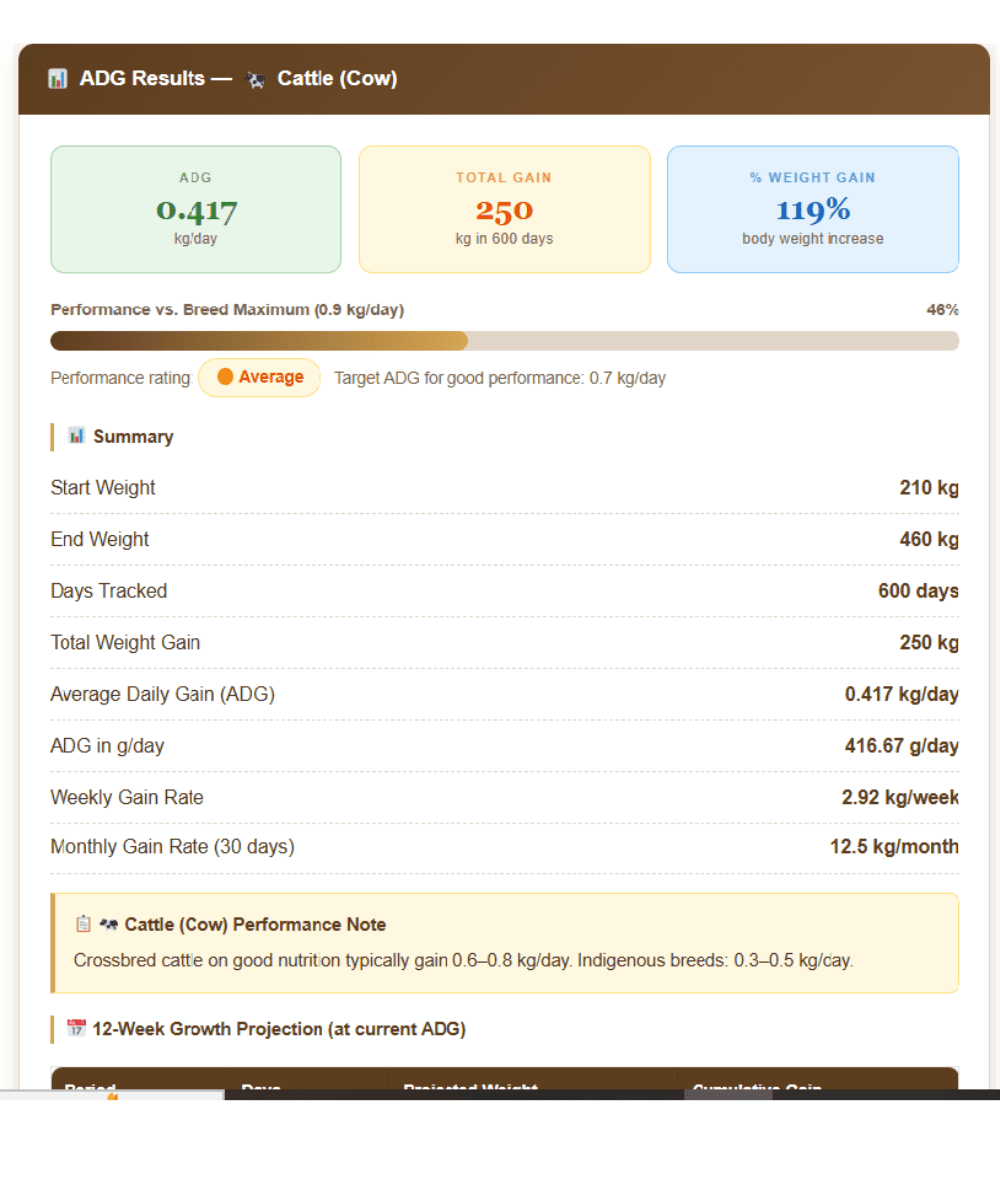
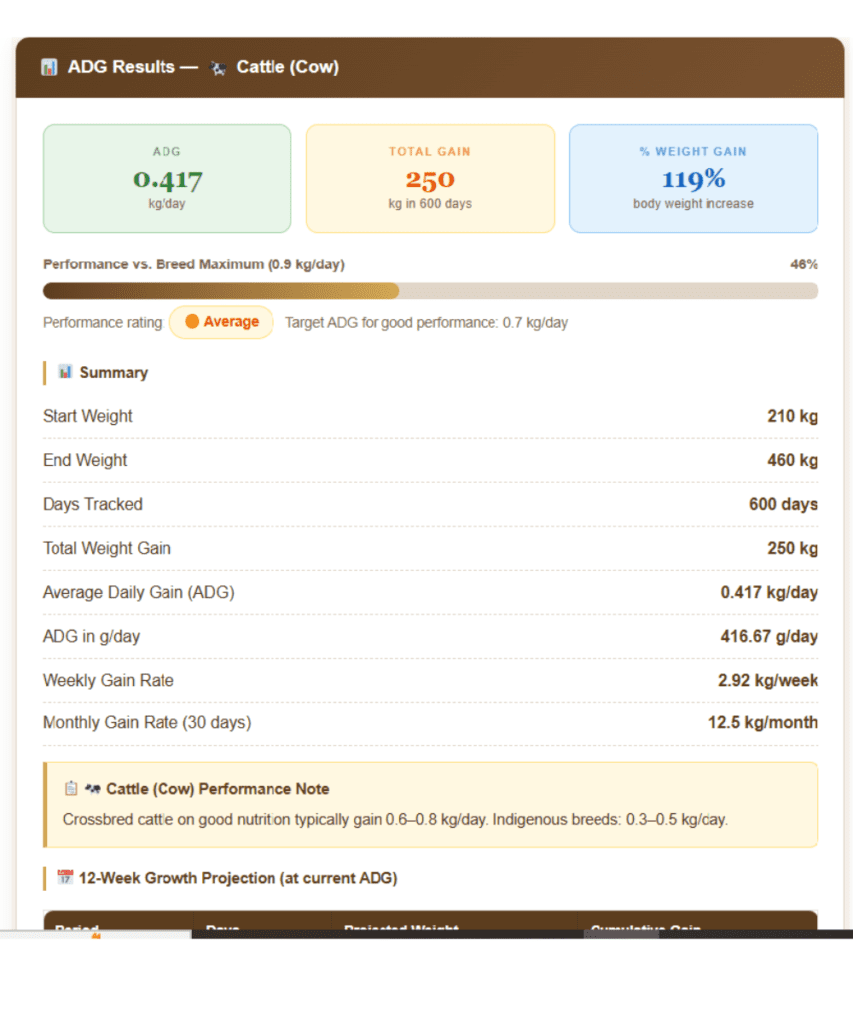
The core calculation. Enter your animal’s starting weight, ending weight, and the number of days between the two weighings. The tool calculates ADG, total weight gain, percentage body weight increase, and daily and monthly gain rates.
Results include a performance rating comparing your ADG against the breed benchmark (Excellent, Good, Average, Below Average), a visual progress bar showing where your animal sits relative to the breed maximum ADG, and a 12-week growth projection table showing expected weight at each week if the current ADG continues.
Tab 2: Target Weight Planner
Planning mode. Enter your animal’s current weight, target weight (market weight, breeding weight, or any goal), and expected ADG. The tool calculates exactly how many days, weeks, and months it will take to reach that target.
Results include a progress bar showing what percentage of the target has already been reached, a month-by-month milestone table showing projected weight at each monthly checkpoint until target is reached.
This tab is essential for planning sale timing, feed procurement for the remaining feeding period, and housing turnover scheduling.
Tab 3: FCR Calculator
Feed efficiency analysis. Enter the total feed consumed over the period, total weight gained, number of days, and number of animals. The tool calculates FCR and rates it against the breed’s typical FCR range.
An optional daily feed per animal field cross-checks your total feed input against the expected total from daily feed rate multiplied by days multiplied by number of animals. This catches data entry errors before they lead to wrong conclusions.
Results include an FCR performance rating, calculated ADG from the data, and five specific improvement strategies covering feed quality, feed form, animal age, health status, and breed.
Tab 4: ADG and FCR Reference Table
A complete reference showing all 12 animals with their ADG range, good performance target, typical FCR range, typical market weight, and a management note for each species.
Use this tab to benchmark your results from Tabs 1 and 3, or as a standalone reference when advising on livestock nutrition or when comparing species options for a new enterprise.
What Does the Calculator Ask You to Enter?
Following info input in this tool:
Animal Type Selection
A grid of 12 animal buttons shows the emoji, name, and typical ADG range for each animal. Clicking a button sets the breed benchmark for performance rating and auto-fills the expected ADG in Tab 2.
Animal selection is optional. If you skip it, the calculation runs without breed-specific benchmarking but still gives you the core ADG and FCR numbers.
Weight Unit
Toggle between kilograms and pounds. The conversion happens automatically. All calculations use kilograms internally.
Tab 1 Inputs
- Starting Weight: The weight at the beginning of your tracking period. From a scale reading, your livestock management record, or a purchased animal’s weight at arrival.
- Ending Weight: The current or final weight. From the most recent scale reading.
- Days Between Weighings: The exact number of days from the first to the second weighing. Even if you weigh weekly, enter the precise number of days for accurate ADG.
Tab 2 Inputs
- Current Weight: Today’s weight or the most recent scale reading.
- Target Weight: The goal weight for the animal. This could be your target market weight, the minimum weight for a breeding program, or any production milestone.
- Expected ADG: Your breed’s typical daily gain under your management system. Auto-fills from the animal selection but can be overridden with your actual measured ADG from Tab 1.
Tab 3 Inputs
- Total Feed Consumed: Total feed in kilograms consumed by the animal or herd over the period. Use dry matter basis for accurate FCR.
- Weight Gain Achieved: End weight minus start weight. Total live weight gain over the measurement period.
- Duration in Days: The feeding period length. Used to calculate ADG alongside FCR.
- Daily Feed per Animal (optional): If you know your daily feed allocation, the tool cross-checks this against the total feed you entered.
- Number of Animals: For herd-level FCR where total feed and total gain cover multiple animals.
What Do Your Results Show You?
The results given as :
ADG in kg/day and g/day
The primary result. Daily gain expressed in kilograms with three decimal places (important for small animals like goats and rabbits where gains are in grams) and also expressed in grams per day for easier communication.
A goat gaining 0.120 kg per day is gaining 120 grams per day. Both numbers tell the same story. The gram format is more intuitive for small animals.
Performance Rating
Four rating levels based on comparison with the selected animal’s breed benchmark: Excellent (at or above the good performance target), Good (70 to 99 percent of good target), Average (50 to 69 percent), and Below Average (below 50 percent of good target).
This rating immediately contextualizes your number. An ADG of 0.5 kg per day is excellent for an indigenous cow but below average for a crossbred steer.
12-Week Growth Projection Table
In Tab 1, a table projects the animal’s expected weight at the end of each of the next 12 weeks if the current ADG continues. This tells you when the animal will reach various weight milestones without any additional calculation.
Monthly Milestone Table
In Tab 2, a month-by-month table shows expected weight at each monthly checkpoint from today until the target is reached. The month where the target is reached is highlighted with a trophy icon.
FCR Rating and Improvement Tips
In Tab 3, the FCR is rated Excellent, Good, Average, or Poor against the selected animal’s typical FCR range. Five specific improvement strategies explain what to change in feed quality, feed form, animal age at feeding, health management, and breed selection to bring FCR down.
What Makes This Calculator Useful for Daily Farm Management
12 Animals with Individual Benchmarks
A single ADG calculation formula works for all livestock species but the interpretation is completely different. An ADG of 0.12 kg per day is excellent for a goat and critically poor for a buffalo. The species-specific benchmarking makes the results meaningful.
Cross-Check Feature in FCR Tab
The optional daily feed input allows the tool to cross-check your total feed figure against what the daily rate implies.
If you enter daily feed of 7 kg over 90 days for one animal, the expected total is 630 kg. If you entered 850 kg as total feed, the cross-check flags the discrepancy. This prevents calculation errors from wrong data entry before they produce wrong conclusions.
ADG Auto-Fill in Tab 2
When you select an animal in Tab 2, the expected ADG field auto-fills with that animal’s good performance target. This gives a realistic default for planning rather than leaving the field blank.
You can and should override this with your actual measured ADG from Tab 1 once you have real data from your animals. Starting with the benchmark ADG gives you a realistic planning baseline.
Performance Progress Bar
The visual progress bar in Tabs 1 and 3 gives an immediate visual sense of where the animal sits against the breed maximum.
A bar at 40 percent tells you the animal is performing well below potential. A bar at 90 percent tells you you’re getting near maximum performance from your current genetics and feed system.
FCR Improvement Framework
Rather than just giving you a number and a rating, Tab 3 provides five specific, actionable improvement strategies covering every dimension of feed efficiency.
These strategies explain the agronomic and management reasons behind FCR variation, not just a generic improve your feed tip.
Who Benefits Most from This Calculator?
- Cattle and Buffalo Farmers Running Feedlot or Intensive Systems: Weekly weighing and ADG tracking is standard practice in commercial feedlots. This tool makes the calculation instant and provides the 12-week projection needed for feed procurement and sale scheduling.
- Smallholder Livestock Farmers Weighing Animals for the First Time: Many smallholder farmers have never calculated ADG. This tool makes the concept accessible and immediately shows whether their animals are growing as well as they should be under good management.
- Goat and Sheep Farmers Planning Market Sales: Tab 2’s target weight planner tells you exactly how many weeks until your goat or lamb reaches the target market weight at the current ADG. This removes the guesswork from sale timing and allows you to commit to a buyer with confidence.
- Dairy Farmers Monitoring Heifer Growth: Heifers need to reach 60 to 65 percent of mature body weight at first service. Use Tab 2 to track whether your heifers are on track to reach breeding weight at the right age. Late breeding due to poor growth rate is one of the most common causes of delayed calving intervals.
- Livestock Feed Suppliers and Advisors: Use Tab 3’s FCR calculator to demonstrate the economic impact of feed quality upgrades to farmers. Calculate FCR with current feed, then project FCR improvement with better feed, and translate that into cost per kg of gain.
- Agricultural Extension Workers and Veterinarians: A quick field tool for assessing livestock growth performance during farm visits and translating body condition observations into objective performance numbers.
Step-by-Step: How to Use All Three Calculation Tabs
Step-by-Step guide:
Tab 1 Example: Calculating ADG for a Buffalo
You weighed your buffalo at 250 kg at the start of the month. Sixty days later, it weighs 295 kg. You want to know the ADG and performance rating.
- Open the Cattle and Buffalo Weight Gain Calculator.
- Stay on Tab 1.
- Click Buffalo in the animal selector.
- Keep kg as the weight unit.
- Enter Starting Weight as 250.
- Enter Ending Weight as 295.
- Enter Days as 60.
- Click Calculate ADG.
Results: ADG = (295 minus 250) / 60 = 0.750 kg/day = 750 g/day. Total gain = 45 kg. Performance: Good (0.75 is above the 0.65 good target for buffalo). Weekly gain rate = 5.25 kg. The 12-week projection table shows expected weights from week 1 to week 12.
Tab 2 Example: Planning Target Weight for a Goat
Your meat goat weighs 18 kg today. Market weight is 30 kg. You expect 0.12 kg per day ADG.
- Click Tab 2.
- Click Goat in the animal selector. ADG auto-fills to 0.12.
- Enter Current Weight as 18.
- Enter Target Weight as 30.
- ADG is already filled at 0.12. Leave it or adjust to your actual ADG.
- Click Calculate Target Plan.
Results: Weight needed = 30 minus 18 = 12 kg. Days = 12 / 0.12 = 100 days. Weeks = 15 weeks. Months = 3.3 months. Progress bar shows 60 percent of target already reached. Monthly milestone table shows the goat reaching 21.6 kg by month 1, 25.2 kg by month 2, and 30 kg by the end of month 3.
Tab 3 Example: Calculating FCR for Feedlot Steers
You have 5 steers that collectively consumed 2,100 kg of feed over 90 days. Their combined weight gain was 270 kg.
- Click Tab 3.
- Click Steer in the animal selector.
- Enter Total Feed as 2,100 kg.
- Enter Weight Gain as 270 kg.
- Enter Days as 90.
- Enter Number of Animals as 5.
- Click Calculate FCR.
Results: FCR = 2,100 / 270 = 7.78. ADG per animal = 270 / (90 x 5) = 0.6 kg/day. FCR rating: Average (within the 6 to 9 range for steers). The improvement tips explain that grain finishing, health management, and crossbreeding can bring this FCR down toward the 6 end of the range.
For ADG benchmarks, FCR standards, and livestock nutrition guidelines by species, the FAO Animal Production and Health Division and the World Organisation for Animal Health (WOAH) Terrestrial Animal Health Standards provide internationally recognized reference data. For breed-specific growth standards, consult your national livestock breed improvement program or local veterinary university.
Frequently Asked Questions
Some faq’s with its answers:
How often should I weigh my animals to track ADG accurately?
For most livestock operations, weighing every 2 to 4 weeks gives a good ADG picture. Weighing too frequently (every few days) introduces variability from gut fill and water intake that makes ADG readings noisy and hard to interpret.
The most accurate ADG is calculated from weighings taken at the same time of day, ideally after overnight fasting, and with the same scale each time. A single weighing variation of 5 to 10 percent due to gut fill can significantly distort a short-period ADG calculation.
For calves, weekly weighing in the first 3 months is valuable because this is the period of highest growth rate variability and earliest opportunity to identify nutrition or health problems.
What is a healthy ADG for my cattle or buffalo?
It depends on the breed and management system. As a general benchmark, crossbred cattle under good management in a tropical environment should achieve 0.6 to 0.8 kg per day from weaning to 18 months. Indigenous breeds typically manage 0.4 to 0.5 kg per day on the same diet.
Buffalo are inherently slower growing than cattle. A good ADG for Murrah buffalo in intensive management is 0.6 to 0.7 kg per day. Under semi-intensive management with mainly roughage, 0.4 to 0.5 kg per day is realistic.
The Tab 4 reference table in this calculator shows the typical ADG ranges for all 12 species. Use these as your benchmarks and investigate if your animals are consistently falling in the lower half of their species range.
What causes a sudden drop in ADG?
Sudden ADG decline has four common causes: disease or parasite load, feed change or feed shortage, heat stress, and social stress from overcrowding or mixing animals.
The most common overlooked cause is internal parasites. Heavy worm burdens in cattle, buffalo, and small ruminants can cause animals to consume feed normally while gaining little or no weight. The FCR appears terrible and the animal looks thin despite adequate feeding. Regular deworming schedules prevent this.
If ADG drops suddenly, check in this order: is the animal sick? Has the feed changed? Is the temperature and humidity causing heat stress? Has stocking density changed? A systematic check through these four factors identifies the cause in most cases.
What is FCR and what is a good FCR for my animals?
FCR is Feed Conversion Ratio: the kilograms of feed required to produce one kilogram of live weight gain. Lower is better. FCR of 5 means 5 kg of feed per kg of gain. FCR of 8 means 8 kg of feed per kg of gain.
Good FCR benchmarks: pigs 2.5 to 3.5, sheep and lambs 4 to 6, cattle and buffalo 5 to 8, horses 7 to 10. Pigs have the best natural feed conversion efficiency of any common livestock species, which is why they are used so heavily in commercial meat production globally.
Important: FCR is calculated on dry matter basis for accuracy. Fresh green fodder has 80 to 90 percent water content. If you feed 100 kg of fresh grass, the dry matter is only 10 to 20 kg. Using fresh weight overstates the feed input and produces misleadingly high FCR figures. For mixed rations, calculate or estimate dry matter content before using these numbers.
Can I use this calculator for poultry?
This calculator is designed for ruminants and medium-to-large mammals. The ADG and FCR concepts apply equally to poultry, but the numbers and benchmarks are very different. Broiler chickens achieve 0.04 to 0.07 kg per day ADG and FCR of 1.6 to 2.0, which are outside the ranges designed for this tool.
For poultry production planning, use the Poultry Feed and Profit Calculator, which is specifically designed for the broiler and layer production system.
Conclusion
You can’t manage what you don’t measure. And in livestock farming, the two numbers that matter most are how fast your animals are growing and how efficiently they’re converting feed into weight.
The Cattle and Buffalo Weight Gain Calculator on Precision Agriculture Calculators puts both of those numbers at your fingertips for 12 livestock species. Tab 1 calculates your ADG from two simple weight measurements and benchmarks it against breed standards. Tab 2 projects how long until your animal reaches target weight. Tab 3 calculates your FCR and tells you exactly which lever to pull to improve it. Tab 4 gives you the reference data for all 12 animals in one place.
Start weighing your animals regularly. Enter the numbers here. Let the data guide your feed and management decisions. Your livestock operation will perform better and your feed costs will go further.
Disclaimer
The Cattle and Buffalo Weight Gain Calculator on Precision Agriculture Calculators provides ADG, FCR, and target weight projections based on standard livestock production formulas. Results are estimates for planning and monitoring purposes only. Actual weight gain and feed conversion vary significantly with animal breed, age, sex, health status, feed quality and quantity, water availability, climate, housing conditions, and management practices.
ADG benchmarks shown in the reference table are typical ranges for animals under good management in tropical and subtropical conditions and may differ from your specific breed, region, or management system. FCR calculations assume dry matter basis for feed inputs. Using fresh weight for high-moisture feeds will produce inaccurate FCR values.
The 12-week and monthly projections assume constant ADG throughout the projection period, which may not reflect actual growth patterns that slow with age and as animals approach maturity.
Always consult your local veterinarian or livestock extension officer for breed-specific recommendations and health management guidance. The author accept no liability for livestock production losses or financial decisions made based on this calculator.