Introduction: Farm Machinery Valuation & Depreciation Guide
Many farmers and agricultural entrepreneurs know their machinery depreciates, but they aren’t sure how to calculate its true market value, how different implement categories lose worth, or how usage hours and physical condition alter the final appraisal.
Overestimating equipment value means your used assets will sit listed online or in the yard for months without a single buyer. Underestimating asset value means you leave hard-earned capital on the table during a trade-in.
Valuing farm equipment is not a one-size-fits-all calculation. A primary mover like a tractor retains its core chassis value much longer than a high-friction soil implement like a rotavator. Furthermore, regional transport laws impose strict operational lifespans that can instantly alter a machine’s legal and economic viability.
We built the Farm Machinery Valuation & Depreciation Engine on Precision Agriculture Calculators to provide farmers, buyers, and sellers with an accurate, data-backed asset appraisal framework across multiple global currencies and 21 major machinery categories.
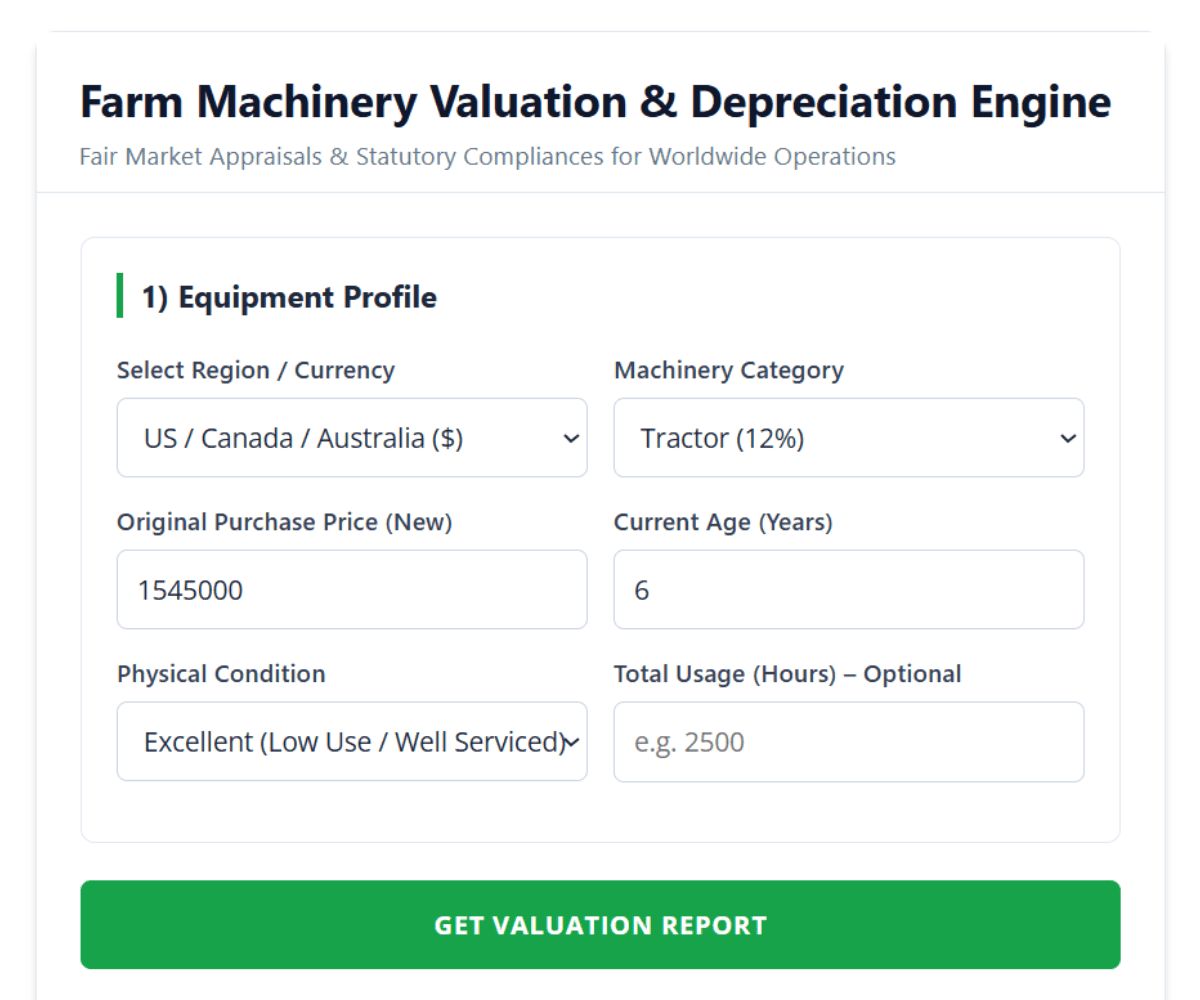
Farm Machinery Valuation & Depreciation Engine (Decision Support System)
This tool helps agricultural operators determine the fair market value, historical depreciation logs, and future 3-year value projections for vital field machinery.
Farm Machinery Valuation & Depreciation Engine
Fair Market Appraisals & Statutory Compliances for Worldwide Operations
| Year | Opening Value | Depreciation Applied | Closing Value |
|---|
| Future Target | Projected Market Value |
|---|
Why Accurate Machinery Valuation is Critical for Farm Profitability
Machinery represents one of the largest capital expenditures on a modern farm’s balance sheet. Relying on guesswork or arbitrary dealership quotes directly harms your operational margins.
Financial frameworks validated by global agricultural institutions confirm that precise asset evaluation yields several direct benefits:
- Smarter Peer-to-Peer Trading: Equips you with independent, mathematical leverage when negotiating used equipment purchases or sales, preventing dealership exploitation.
- Optimized Tax Deductions: Most tax jurisdictions allow agricultural operations to write off equipment depreciation against gross farm income, directly lowering your annual tax liabilities.
- Precise Insurance Refinement: Insuring old machinery at its original purchase price causes you to overpay on insurance premiums for coverage payouts you can never legally claim.
- Collateral Transparency: When applying for agricultural expansion loans, clear asset valuation reports prove your true net worth to banking institutions instantly.
The Mechanics of Agricultural Depreciation: The WDV Method
This engine utilizes the Written Down Value (WDV) Method (also known as the declining balance method) to execute asset calculations. Unlike straight-line depreciation—which incorrectly assumes a tractor loses the exact same amount of value every single year—the WDV method applies a fixed annual percentage to the remaining book value of the machine.
Our engine refines this framework by integrating a 4% first-year initialization drop across all profiles. This accounts for immediate showroom-to-field asset devaluation, mimicking genuine transactional market trends.
Category-Specific Depreciation Behaviors Covered by the Engine
Different implements face varying degrees of structural fatigue, environmental risk, and mechanical wear. The tool maps 21 different asset selections across distinct base depreciation brackets:
1. Tractors & Prime Movers (12% Base Rate)
Tractors, mini-tractors, and heavy earthmoving equipment (like excavators or backhoes) retain their value steadily over a 10 to 15-year operational lifecycle. Because they are engineered for long-term chassis rebuilds, they depreciate at a slower rate.
2. Land Preparation & Tillage (10% – 15% Base Rate)
Implements subjected to extreme ground friction degrade faster. Rotavators, cultivators, and harrows carry a 15% rate due to constant treading and gear fatigue. Conversely, simple structural tools like moldboard plows carry a lower 10% rate because they lack complex moving parts and are cheap to repair.
3. Sowing, Planting & Spraying (10% – 20% Base Rate)
Precision metering mechanisms like seed drills (10%) or rice transplanters (12%) are highly seasonal and hold value well if properly housed. However, crop management tools like power sprayers and weeders bear the highest depreciation rate at 20% due to regular contact with highly corrosive chemical fertilizers and intense vibration stress.
4. Harvesting, Threshing & Haulage (10% – 15% Base Rate)
Combine harvesters (15%) represent immense capital outlays but encounter severe, dense crop-wear during seasonal windows. Simple transport assets, such as tractor trolleys or water tankers, carry a stable 10% rate because their simple frame structures last for decades with basic maintenance.
How the Structural Hour Penalty and Condition Modifiers Work
The Usage Hour Penalty System
The engine uses a specialized usage analyzer for powertrain-dependent machinery (tractors, mini-tractors, earthmovers, and combine harvesters). If a user inputs operational hours that reveal an annualized workload exceeding 1,000 hours per year, the engine triggers an automatic 8% heavy-use penalty to account for internal engine and transmission fatigue.
Physical Condition Multipliers
A well-maintained tool is worth more than a neglected one. The engine applies precise mathematical modifiers to the calculated WDV baseline based on user selection:
- Excellent Condition: Applies a +8% value bonus (assumes documented maintenance logs and clean components).
- Average Condition: Applies a 1.0 neutral modifier (standard field wear and tear).
- Poor Condition: Applies a -12% value deduction (indicates immediate mechanical attention or structural overhaul is required).
What Does the Calculator Ask You to Enter?
- Region / Currency: Adjusts the monetary display symbol ($,₹,€,£) and activates localized regulatory compliance rule sets.
- Machinery Category: Maps the specific asset to its standard industrial depreciation speed.
- Original Purchase Price: The total cost paid for the machinery when brand new, including showroom delivery taxes.
- Current Age: The total number of years the machine has been in service since its manufacture date.
- Physical Condition: The real-world operational health ranking of the implement.
- Total Usage Hours (Optional): Historical hour-meter reading, used to audit heavy powertrain fatigue.
What Do Your Valuation Results Show You?
- Estimated Fair Market Value: The core calculated appraisal value for the asset today.
- Target Negotiation Corridor: A tight 5% upper and lower boundary layout proving the optimal pricing window for fair trades.
- Total Depreciation Incurred: The total amount of asset value that has been used up or lost over time.
- Initial Year Baseline Drop: The absolute value lost during the first year of field deployment.
- Year-Over-Year Valuation Schedule: A detailed historical table showing opening values, applied depreciation amounts, and closing values for every year of the machine’s life.
- 3-Year Future Value Prediction: A predictive forward-looking ledger calculating what the tool will be worth over the next three seasons to help you plan your next trade-in perfectly.
- Regional Policy Notification Banners: Country-specific rule monitors. For instance, selecting India ($\{₹}$) triggers warnings as the machine nears or crosses the strict 15-year statutory RTO registration and fitness certification threshold.
What Makes This Tool More Than a Generic Depreciation Table
Real-World Transaction Modeling
Most internet tools simply multiply your price by a single flat percentage. This engine runs iterative loop calculations, tracking first-year slumps, adjusting for conditional maintenance quality, and applying heavy usage penalties to mirror true marketplace dynamics.
Policy-Linked Security Auditing
By linking age inputs to regional legal metrics (such as European emission guidelines or Indian RTO lifecycle ceilings), the tool ensures you don’t buy a machine that is legally nearing operational bans or expensive mandatory re-testing phases.
Who Benefits Most from This Valuation Engine?
- Farmers Upgrading Equipment: Find out exactly what your trade-in tractor is worth before talking to dealership sales agents.
- Pre-Owned Equipment Buyers: Verify if a used marketplace listing is priced fairly or significantly overvalued.
- Accountants & Farm Managers: Build detailed, year-by-year asset schedules for tax deductions and farm balance declarations.
- Agricultural Cooperative Managers: Manage collective machinery pools and assess depreciation for shared structural implements accurately.
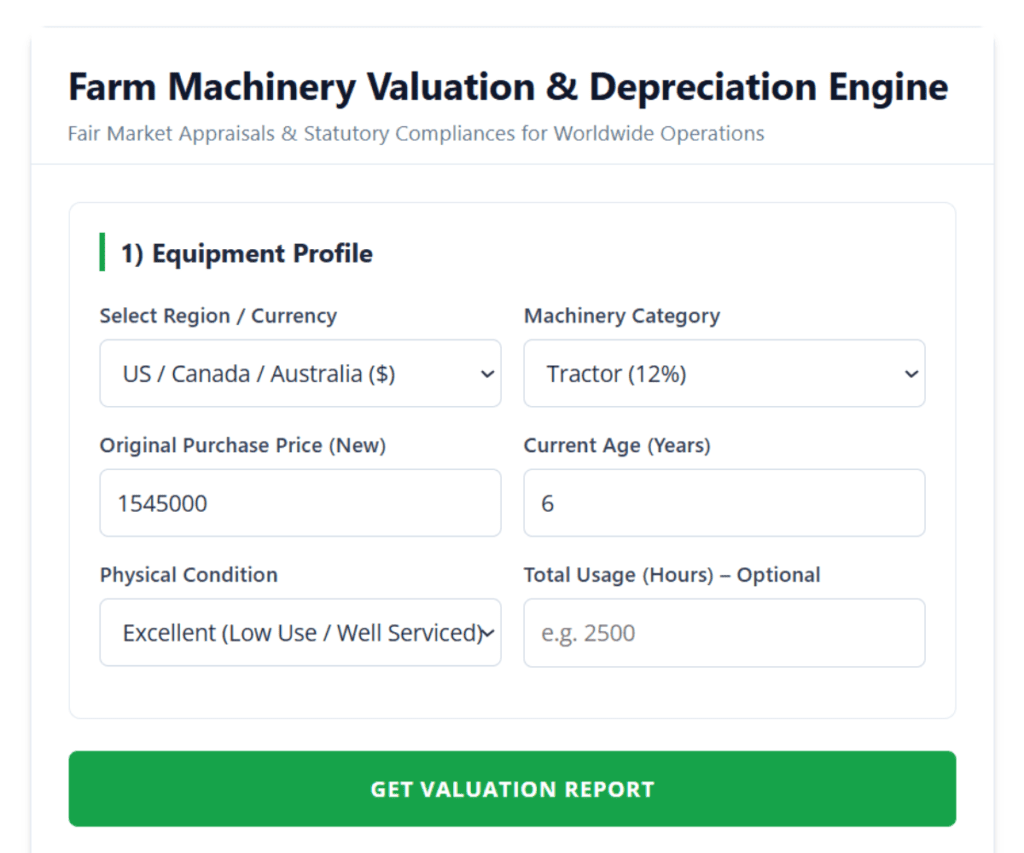
Step-by-Step: How to Use the Farm Machinery Valuation Engine
Let’s work through an example. Suppose you own a standard Tractor in India. You bought it new for $\ {₹}$7,500,000, it is 4 years old, in Excellent condition, and shows 2,500 total hours on the meter.
- Set the region selection dropdown to India ($\ {₹}$).
- Under Category, choose Tractor.
- Type
750000into the Original Purchase Price field. - Input
4in the Current Age box. - Set the Physical Condition dropdown to Excellent.
- Enter
2500in the optional Total Usage Hours field (this averages 625 hours/year, which is safely under the heavy-use penalty threshold). - Click GENERATE VALUATION REPORT.
The engine will instantly compute the historical diminishing value, add the 8% bonus for its excellent condition rating, print out the year-by-year schedule, and map out what the tractor will be worth when it hits ages 5, 6, and 7.
Related Tools
- Advanced Spray Calculator – Evaluate chemical consumption costs alongside your spraying machinery’s depreciating asset lifecycle.
- Liquid Fertilizer Dilution Calculator – Calculate input costs accurately to balance equipment overheads against field crop cycles.
- Crop Growing Season Planner – Coordinate machinery deployment and maintenance calendars across your seasonal harvest windows.
Frequently Asked Questions
My equipment has a zero value on my tax ledger. Can I still use this tool?
Yes. Accounting books often depreciate assets down to a minimal scrap value for tax purposes. However, the real-world market value (salvage worth) of a working tractor rarely drops below 10% of its original cost if it remains operational. The engine automatically applies a 10% floor limit to safeguard true asset utility values.
Does this calculator account for specific machinery brands?
This tool establishes a structural, industry-wide baseline value based on equipment mechanics. Premium brands with extensive service networks often hold a small premium over this baseline, while rare or obscure brands might trade near the bottom of the target negotiation corridor.
Can I use these figures for official legal disputes or bank insurance filings?
This engine provides an informative marketplace appraisal baseline based on standardized horticultural and agricultural accounting frameworks. While it serves as a highly accurate field reference, formal legal, banking, or tax disputes may require an on-site physical appraisal by a certified asset valuer.
Data Accuracy & Authorized Valuation Standards
Our Farm Machinery Valuation & Depreciation Engine is built entirely on recognized industrial engineering frameworks, statutory insurance rules, and international asset accounting standards. The calculations within this tool utilize the specific guidelines maintained by the following official authorities:
- Statutory Automobile Depreciation Rules: For standard on-road baselines, the engine incorporates the Insured Declared Value (IDV) depreciation scales mandated under General Regulation 8 (GR-8) of the India Motor Tariff, which can be verified directly via the Insurance Regulatory and Development Authority of India (IRDAI).
- Global Asset & Fleet Accounting: For commercial machinery, fleet audits, and professional enterprise valuations, the core principles of economic and functional obsolescence follow the IVS 300 (Plant and Equipment) valuation standard established by the International Valuation Standards Council (IVSC).
- Agricultural Engineering & Hour Fatigue: To accurately calculate structural depreciation based on power-take-off (PTO) operational hours rather than simple calendar age, the mathematical engine incorporates the empirical wear constants outlined in the D497 Machinery Management Standards published by the American Society of Agricultural and Biological Engineers (ASABE).
- National Tractor Performance Benchmarks: Asset lifecycle thresholds and operational performance guidelines for tractors deployed under regional finance parameters conform to the structural recommendations verified by the Bureau of Indian Standards (BIS).
Conclusion
Managing farm equipment requires clear financial data alongside solid mechanical maintenance. By using precise category rates, usage auditing, and conditional adjustments, the Farm Machinery Valuation Engine replaces guesswork with mathematical clarity. Run your equipment profile today to protect your equity and plan your next machinery transaction with absolute certainty.
Disclaimer
The valuation assessments, depreciation schedules, and predictive charts provided by this engine are meant to serve strictly as industry baseline calculations and informative economic indicators. Real-world localized machine values can vary based on brand premium variations, changing regional supply-demand dynamics, fuel price shifts, and internal component wear that cannot be scanned via an online interface. Always consult with certified machinery technicians and verify local vehicle registries, lien clearances, and title deeds before executing financial transactions.