Introduction
The weather forecast says 2 degrees tonight. Should you be worried?
The answer depends entirely on what you’re growing and at what stage.
A wheat crop at the vegetative stage can handle 2 degrees comfortably. The same temperature during wheat flowering destroys the florets and collapses grain set. A tomato at any stage is already at serious risk. Spinach barely notices.
The temperature is the same. The damage is completely different. And most farmers don’t know which side of that line their crop is on.
Check whether tonight’s forecasted temperature will damage or kill your crop at its current growth stage. Free crop risk temperature calculator covering frost risk and heat stress for 40+ crops. Enter crop type, growth stage, and tonight’s low temperature to get damage risk level and protective action advice.
That’s the problem the Frost Alert Logic Crop Risk Temperature Calculator on Precision Agriculture Calculators solves.
Type your crop name, enter tonight’s forecast temperature, select your growth stage, and the tool instantly tells you whether you’re safe, in watch territory, at danger level, in severe risk, or facing potential crop kill.
It covers 100 crops across 14 categories with individual frost thresholds for every growth stage and every crop. It also covers heat stress and extreme heat on the upper end, because temperature damage goes both ways.
And for every risk level, it gives you a specific list of actions to take right now.
❄️ Frost Alert Logic — Crop Risk Temperature Calculator
Step 1 — Type Your Crop Name
Step 2 — Enter Temperature & Crop Stage
Frost Risk Reference — All 100 Crops
| Crop | Category | Safe Above | Watch | Danger | Severe | Lethal Kill | Heat Stress Above | Most Sensitive Stage |
|---|
Why Crop Temperature Risk Is More Complex Than Most Farmers Realize
Temperature damage to crops is not a single threshold. Every crop has different cold tolerance at different stages of its life cycle.
According to the Food and Agriculture Organization of the United Nations (FAO) Agrometeorological Assessment resources, frost and cold damage is one of the leading causes of crop yield loss globally, with the critical factor being the temperature at which a crop is exposed rather than just whether frost occurs.
Here’s what most farmers don’t realize about temperature risk:
- The most sensitive stage is almost always flowering. Open flowers, pollen, and florets are the least cold-tolerant tissues on most crop plants. Wheat florets are killed at minus 1 degree Celsius. Mango panicles are damaged at 10 degrees Celsius. Tomato flowers drop at 0 degrees. A single night at the wrong temperature during flowering can eliminate the entire season’s harvest potential.
- The same crop is dramatically different at different stages. An onion seedling is damaged near 0 degrees Celsius. An established onion bulb in the vegetative stage survives minus 7 degrees. The same species, the same farm, completely different thresholds.
- Cold-tolerant crops still have vulnerable periods. Barley is one of the hardiest cereals, surviving minus 6 degrees in the vegetative stage. But its florets are damaged at minus 2 degrees at flowering, the same threshold as many much more sensitive crops. Cold hardiness in one stage does not mean cold hardiness in all stages.
- Heat stress is equally damaging and equally stage-specific. Above a species-specific maximum temperature, crops experience heat stress that causes pollen sterility, fruit drop, flower abortion, and leaf scorch. A tomato above 38 degrees Celsius suffers pollen damage. Sesame above 45 degrees has severe production loss.
Research reviewed by the USDA Agricultural Research Service (ARS) Climate Change and Agriculture program consistently identifies frost and heat events during reproductive stages (flowering and fruit set) as the most economically damaging weather events in crop production, with losses sometimes exceeding 80 percent of potential yield from a single exposure.
The Seven Risk Levels and What They Mean
The calculator classifies every temperature against a crop and stage combination into one of seven risk levels.
Safe: Crop Is in Normal Growing Range
Temperature is above the crop’s safe minimum and below the heat stress threshold. No action needed. Continue normal management.
Watch: Low Frost Risk, Stay Alert
Temperature is approaching the danger zone but still 3 degrees above the stage-specific frost kill threshold. No immediate crop protection action required, but you should monitor overnight and have your protection measures ready.
Danger: Moderate Risk, Act Now
Temperature is within 1 to 3 degrees of the frost kill threshold. Crop tissues are at risk of chilling injury. Irrigation, row covers, or polytunnel protection should be deployed before nightfall. Harvest ripe produce if possible.
Severe: High Risk, Protect Crop Immediately
Temperature is at or within 1 degree above the kill threshold. Expect significant damage unless protective action is taken immediately. This is the emergency response zone.
Kill: Critical, Lethal Frost Risk
Temperature is below the stage-specific kill threshold. Without intervention, the crop or the critical tissue (flowers, fruitlets, seedlings) will likely be destroyed. Maximum protection, emergency irrigation, and harvest of marketable produce should happen right now.
Heat Stress: Temperature Too High for This Crop
Temperature exceeds the crop’s maximum comfortable growing threshold. Pollen damage, blossom drop, wilting, and reduced fruit set are likely. Stop irrigation during peak heat, apply shade nets if available, and irrigate only in early morning or evening.
Heat Extreme: Lethal Heat Risk
Temperature exceeds 10 degrees above the crop’s heat maximum. Crop damage is likely irreversible at this level. Emergency shade application, immediate pre-harvest of mature produce, and no fertilizer application are the priority actions.
The 100 Crops and 14 Categories Covered
This is the most comprehensive crop-specific temperature risk database available in a free online calculator.
Cereals and Grains
Wheat, Rice (Paddy), Maize (Corn), Barley, Sorghum, Pearl Millet (Bajra), Oats, and Rye. Each with distinct frost thresholds reflecting their cold tolerance: rye survives minus 8 degrees in vegetative stage while rice requires a minimum of 15 degrees at flowering.
Vegetables
Tomato, Potato, Onion, Garlic, Cauliflower, Cabbage, Broccoli, Spinach, Peas, Carrot, Capsicum/Bell Pepper, Brinjal/Eggplant, Cucumber, Pumpkin/Squash, Beetroot, Radish, Lettuce, Celery, Asparagus, Okra (Bhindi), Bitter Gourd (Karela), Bottle Gourd (Lauki), Ridge Gourd (Turai), Watermelon, Muskmelon (Kharbooja), and Amaranth.
Vegetables span the full range of cold tolerance: spinach survives minus 9 degrees at the vegetative stage while cucumber is destroyed at 5 degrees at the seedling stage.
Pulses
Chickpea, Lentil, Soybean, Mung Bean (Moong), Pigeon Pea (Tur/Arhar), Groundnut (Peanut), Cluster Bean (Guar), Cowpea (Lobia), Moth Bean (Matki), Horse Gram (Kulthi), Kidney Bean (Rajma), and Black-eyed Pea (Chawli).
Oilseeds
Mustard/Canola, Sunflower, Sesame (Til), Linseed (Flaxseed), Castor, Safflower, Niger Seed (Ramtil), and Hemp. Mustard is the hardiest oilseed, surviving minus 5 degrees in vegetative stage. Sesame is tropical and stops germinating below 10 degrees.
Fruits
Mango, Banana, Grapes, Strawberry, Papaya, Guava, Lemon/Citrus, Pomegranate, Apple, Peach/Nectarine, Pineapple, Pomelo/Grapefruit, Ber (Indian Jujube), Jamun, Amla (Indian Gooseberry), Pear, Plum/Cherry, Fig, Avocado, Litchi, Jackfruit, and Custard Apple (Sitaphal). Mango is particularly notable: its panicles are damaged at 10 degrees Celsius, making it vulnerable to temperature events that most farmers would not consider a frost risk.
Cash Crops, Spices, Herbs, Plantation, and Others
Cotton, Sugarcane, Tea, Coffee, Tobacco, and Jute in cash crops. Chilli/Pepper, Turmeric, Ginger, Coriander (Dhania), Fenugreek (Methi), and Cumin (Jeera) in spices. Mint (Pudina), Tulsi, Stevia, Lemongrass, and Curry Leaf in herbs. Coconut, Rubber, and Oil Palm in plantation crops. Alfalfa/Lucerne and Berseem in fodder. Marigold and Rose in flowers. Eucalyptus, Bamboo, Drumstick (Moringa), and Tamarind in trees. Sweet Potato, Cassava, and Yam in root crops. Lotus/Water Lily in water crops.
What Does the Calculator Ask You to Enter?
Temperature Unit
Toggle between Celsius and Fahrenheit. The entire tool converts automatically when you switch. The reference table, damage grid, and all thresholds update instantly. UK, USA, and Commonwealth farmers can work in Fahrenheit without any manual conversion.
Crop Search
Type any part of your crop name in the search box. The autocomplete dropdown filters all 100 crops as you type. Search by common name (tomato, bhindi, turai), scientific category (cereal, pulse, oilseed), or local name (moong, arhar, bajra).
Arrow keys navigate the dropdown. Enter selects. A green chip confirms your selected crop. Click the X to clear and choose a different crop.
Current or Forecast Temperature
Enter tonight’s forecast minimum temperature or your current field temperature reading. The tool evaluates the risk at that exact temperature against your selected crop and stage.
For frost planning, always use the forecast minimum temperature, not the current afternoon temperature. Frost risk occurs at the coldest point of the night, typically 30 to 90 minutes before sunrise.
Crop Growth Stage
Five stages: Seedling or Germination, Vegetative Growth, Flowering or Pollination, Fruiting or Pod Fill, and Near Maturity.
This is the most important input after temperature. The same temperature produces completely different risk ratings at different stages. When in doubt about which stage your crop is in:
- Seedling: From germination until the plant has 4 to 6 true leaves.
- Vegetative: Active leaf and stem growth. No flowers visible yet.
- Flowering: Any open flowers, flower buds, or active pollination visible.
- Fruiting: Fruit or pod development underway. Seeds forming.
- Maturity: Crop approaching harvest. Grain hardening or fruit ripening.
What Do Your Results Show You?
Risk Header with Level and Title
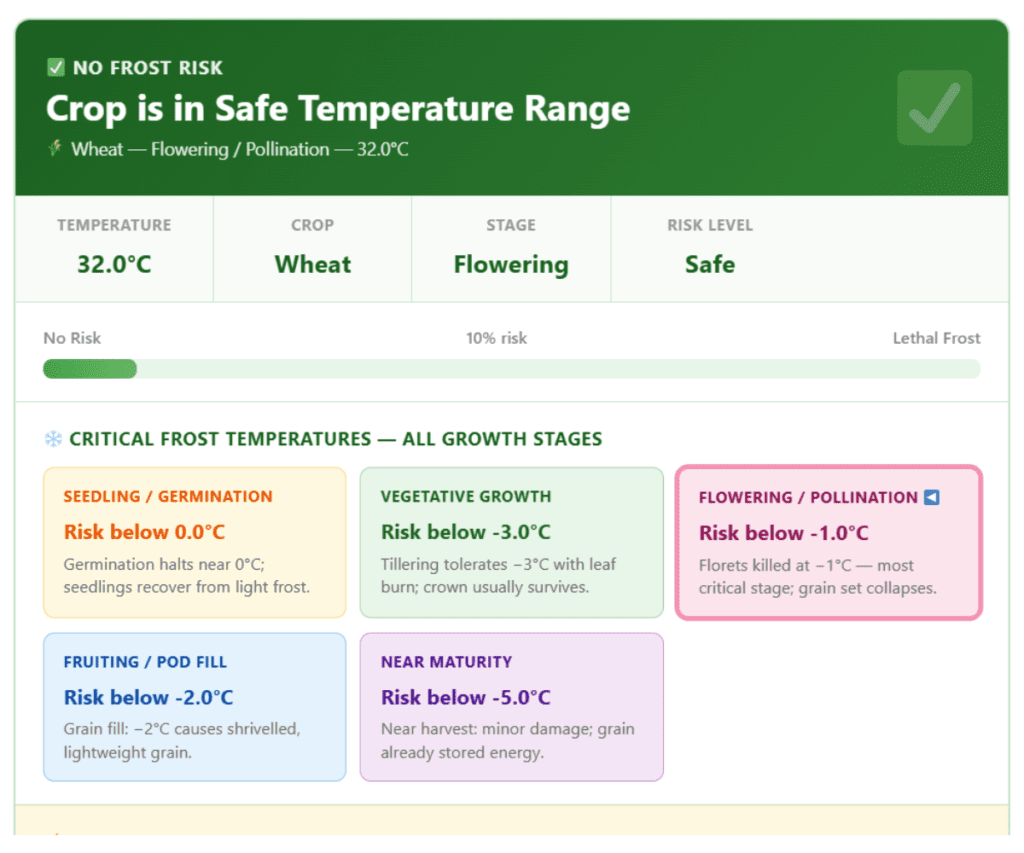
The result panel header changes colour and label based on risk level.
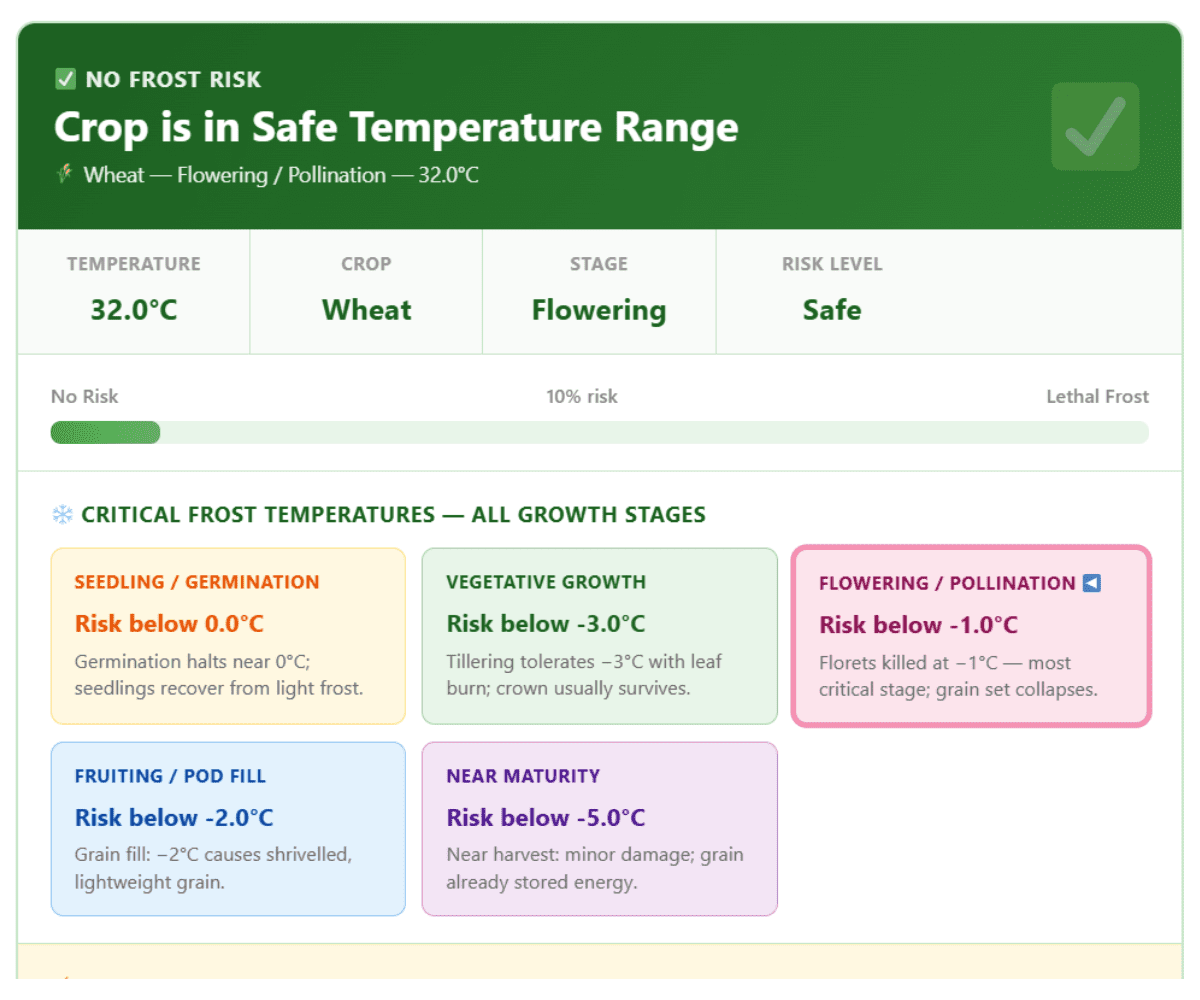
Green means safe. Orange means watch. Blue means frost danger. Purple means severe. Red means lethal frost. A different shade of orange means heat stress. Deep orange-red means extreme heat.
The colour change is immediate and unmissable. You see the risk level before you read a single number.
Four Key Statistics
Confirms your temperature, crop name, growth stage, and risk level in plain text. These four numbers summarize everything you need to communicate the situation to someone else, your farm worker, your agronomist, or your insurance company.
Risk Meter Bar
A progress bar from No Risk to Lethal Frost shows where the current temperature falls on the overall risk spectrum. 10 percent bar means comfortable safe zone. 100 percent means maximum risk.
The bar fills with animation when results appear, making the risk level viscerally clear even for farmers who prefer visual information over text.
Critical Frost Temperatures Damage Grid
This is the most educational part of the result.
Five cards show the frost kill threshold and damage description for every growth stage of your selected crop. Your currently selected stage is highlighted with a border.
This damage grid answers the question you’ll ask next week or next season: at what temperature is this crop damaged at this stage? You don’t have to run the calculator again. The full picture is right there.
Each card includes a specific damage description. For wheat at flowering: florets killed at minus 1 degree Celsius, grain set collapses. For tomato at seedling stage: below 5 degrees causes chilling injury, 0 degrees kills seedlings.
Recommended Actions
The most immediately practical output. A specific list of 3 to 5 actions tailored to the risk level and your crop.
Safe actions might include continuing normal monitoring. Watch actions suggest closing greenhouse vents. Danger actions specify irrigation timing. Severe actions call for thermal blankets and emergency greenhouse heating. Kill-level actions tell you to harvest all marketable fruit immediately and document for insurance.
For heat stress, the actions focus on shade nets, stopping midday irrigation, and early morning or evening watering. For extreme heat, the priority is shade application and pre-harvest of mature produce.
What Makes This Tool Unlike Any Other Crop Temperature Calculator
100 Crops with Individual Stage-Specific Thresholds
Most frost calculators cover 10 to 20 common crops with a single kill temperature. This tool covers 100 crops with 5 individual stage-specific thresholds each.
That’s 500 data points for cold damage alone, plus 100 heat stress thresholds. The result is a calculation that reflects real agronomic knowledge rather than a single generic number.
Both Frost and Heat Risk in One Tool
No other free crop temperature tool covers both sides of the temperature risk spectrum with the same depth.
Tropical crops like okra, watermelon, cassava, and oil palm are more likely to suffer heat stress or even cold chilling injury at temperatures that feel mild to a temperate-climate farmer. This tool handles both correctly for all 100 crops.
Crop-Specific Damage Descriptions
For every crop at every stage, the damage grid shows a specific biological description of what happens when the threshold is crossed.
Not just a number. A description like: florets killed at minus 1 degree Celsius, grain set collapses. Or: below 15 degrees during heading causes pollen sterility. Or: below 12 degrees causes bunch deformity in banana.
This level of specificity comes from published agronomic research and extension literature for each crop.
Crop-Specific Action Lists
Actions are not generic. The kill-level actions for a strawberry farm include running overhead irrigation all night (because ice forming on flowers at 0 degrees actually protects them). The kill-level actions for sugarcane say to harvest immediately because sucrose inverts rapidly after freeze. The kill-level actions for potato say to wait 5 days before digging to assess tuber viability.
These nuances matter. A generic harvest immediately instruction for potato would be wrong. A generic don’t irrigate instruction for strawberry at frost risk would destroy the crop.
Autocomplete Search for 100 Crops
Typing any part of a crop name instantly filters the list. Typing mo finds Moong Bean, Moringa, and Moth Bean. Typing bitter finds Bitter Gourd. Typing 19 or gra finds multiple crops in a single keystroke.
Keyboard navigation with arrow keys and Enter means you can select your crop without touching the mouse. This is particularly useful on mobile devices.
Who Benefits Most from This Tool?
- Farmers in Frost-Prone Regions: Highland and temperate farmers who face regular frost risk from October to March in the northern hemisphere or April to September in the southern hemisphere. Check tonight’s forecast temperature against every crop in the field before sunset.
- Farmers Receiving Cold Alert Messages: Many agricultural extension services and weather apps send cold alert notifications but don’t tell farmers which specific crops are at risk at their current stage. Use this tool to translate a generic cold alert into a crop-specific action plan.
- Growers of Heat-Sensitive Tropical Crops: Farmers in hot climates growing mangoes, bananas, papayas, and other tropical species need to know when temperatures exceed the heat stress threshold. The tool covers the upper limit just as precisely as the lower limit.
- Protected Cultivation and Greenhouse Farmers: Polytunnel and greenhouse operators making decisions about when to close vents, when to turn on heating, or when a specific crop inside is at risk even in a protected environment.
- Agronomists and Extension Workers: A reference tool for answering the question: will this temperature tonight damage my farmer’s crop? The 100-crop reference table at the bottom of the tool is a complete look-up database usable without entering any inputs at all.
- Agricultural Students and Researchers: The comprehensive crop-specific threshold database covering 14 categories and 500 individual damage data points makes this a reference resource for crop physiology and agroclimatology studies.
Step-by-Step: How to Use the Crop Risk Temperature Calculator
Here’s a complete example. The forecast says 1 degree Celsius overnight. You have chickpea flowering in the field. You want to know whether to take emergency action tonight.
- Open the Frost Alert Logic Crop Risk Temperature Calculator.
- Temperature unit is set to Celsius by default.
- Type ‘chickpea’ in the search box.
- Select Chickpea from the dropdown.
- Enter Temperature as 1.
- Select Flowering as the Crop Stage.
- Click Check Frost Risk.
Here’s what the result shows:
- Header: Red-orange ‘Severe Frost’ header. Title: High Risk, Protect Crop Now.
- Chickpea flowering frost kill threshold = minus 2 degrees Celsius.
- 1 degree is 3 degrees above the kill threshold but within the ‘severe’ zone.
- Risk meter fills to 80 percent.
- Damage grid shows: flowering stage card highlighted. Risk below minus 2 degrees. Damage note: minus 2 degrees causes flower and bud abortion, reducing pod count.
- Actions: Apply foliar potassium spray. Assess pollination success 5 to 7 days after frost. Irrigate before frost night.
The 1-degree forecast is in the Severe risk zone for chickpea at flowering. You should irrigate before nightfall, apply a potassium spray to improve frost hardiness, and plan to assess pollination success in a week.
If the forecast had said 4 degrees instead of 1 degree, the result would show Watch, low risk: monitor overnight but no emergency action required.
If the forecast said minus 4 degrees, the result would show Kill: lethal frost. The action list would say evaluate early harvest and document for insurance.
For species-specific frost damage thresholds and crop cold hardiness research, the FAO Agrometeorological resources and early warning systems and the USDA Agricultural Research Service Climate Change and Agriculture program publish the underlying agronomic research that informs crop temperature risk data globally. For local frost forecasting and agricultural weather alerts, contact your national meteorological service.
Related Tools
Use the Crop Risk Temperature Calculator alongside these tools for complete seasonal weather and crop management:
- Irrigation Scheduling Calendar — Pre-frost irrigation is one of the most effective protection methods. Use this tool to plan your irrigation timing and pump run hours for overnight frost protection.
- Evapotranspiration (ET) Calculator — ET drops sharply during cold events. Adjust your irrigation schedule when temperatures are below normal.
- Livestock Heat Stress Index Calculator — While this tool covers crop temperature risk, your animals also face heat and cold stress. Check both when extreme temperature events are forecast.
Frequently Asked Questions
What temperature causes frost damage to crops?
There is no single answer. It depends entirely on the crop and its current growth stage.
Rye at the vegetative stage survives minus 8 degrees Celsius. A cucumber seedling is destroyed at 8 degrees Celsius. Mango at flowering is damaged at 10 degrees Celsius, which is above freezing and would not be called frost by most farmers.
This is exactly why a crop-specific, stage-specific tool is necessary. The question ‘what temperature causes frost damage’ only has a useful answer when you specify the crop and the stage.
Why is flowering the most sensitive stage for almost every crop?
Open flowers contain pollen grains and ovules, the reproductive cells of the plant. These cells have very high metabolic activity and very thin cell walls. They are far more susceptible to ice crystal formation and cell membrane damage than the thick-walled vegetative tissues of stems and leaves.
Additionally, once pollination fails or florets are killed, the entire season’s yield potential for that individual flower is permanently lost. A leaf can recover from mild frost damage. A killed flower cannot resume its function.
This biological reality is why the most critical protection interventions, overhead irrigation for strawberries, wind machines for vineyards, smudge fires for citrus orchards, are all deployed specifically during the flowering stage.
How does overhead irrigation protect against frost?
When water freezes, it releases heat: approximately 80 calories per gram of water frozen. Overhead irrigation continuously supplies unfrozen water that releases heat as it freezes on and around plant tissues.
As long as water is continuously flowing and freezing, the plant surface temperature is held at approximately 0 degrees Celsius, which is above the kill threshold for most flowers (typically minus 1 to minus 3 degrees).
The key word is continuously. The irrigation must run from when temperatures drop to near freezing until temperatures rise above freezing in the morning. Stopping too early removes the ice shell and the latent heat protection, exposing the flower to the ambient temperature.
My crop shows a safe reading but I can see frost on the ground. Should I still be concerned?
Yes. Ground-level frost can occur when air temperature is still above 0 degrees Celsius if ground surfaces radiate heat and cool below 0 degrees due to radiation frost.
The most reliable way to assess crop risk is with a thermometer at the height of the sensitive plant tissue, not at standard meteorological station height (1.5 metres above ground).
Use the Watch level from this tool as your trigger to get out and check actual field conditions when the forecast temperature is within 3 degrees of your crop’s kill threshold.
Does the tool cover chilling injury as well as frost?
Yes. For tropical and subtropical crops like rice, banana, papaya, okra, and cucumber, the damage threshold shown in the tool is the temperature at which chilling injury begins, not necessarily the frost point of 0 degrees Celsius.
Chilling injury is cellular damage that occurs at temperatures above 0 degrees in cold-sensitive species. Rice at the heading stage is damaged at 15 degrees Celsius. Cucumber is damaged at 5 degrees at seedling stage. Neither of these would be called frost but both cause significant economic damage.
The tool classifies these risks using the same risk system as frost risk because the farm management response (protect the crop, delay planting, harvest marketable produce) is the same regardless of whether the damage mechanism is frost or chilling.
Conclusion
Temperature risk to crops is not one question. It’s a hundred questions, one for each crop, multiplied by five, one for each growth stage.
The Frost Alert Logic Crop Risk Temperature Calculator on Precision Agriculture Calculators answers all of them. Search your crop, enter tonight’s forecast temperature, select your stage, and get an immediate risk classification from safe to lethal frost or from heat stress to extreme heat. See the specific kill threshold for every stage of your crop in the damage grid.
Get a specific list of actions for your risk level. The 100-crop reference table at the bottom gives you the complete database to look up any crop’s critical temperatures without running a single calculation. Bookmark this tool before frost season and before every cold or heat event forecast. It’s the difference between knowing you have a problem and knowing exactly what to do about it.
Disclaimer
The Frost Alert Logic Crop Risk Temperature Calculator on Precision Agriculture Calculators provides frost and heat risk assessments based on internationally recognised agricultural research averages for each crop and growth stage combination. Frost damage thresholds shown are representative values from published agronomic literature and may differ from your specific crop variety, local adapted ecotype, or current plant health status.
Actual frost or heat damage depends on the duration of cold or heat exposure, wind speed, humidity levels, cloud cover, soil moisture, plant nutritional status, and local microclimate conditions not captured in this tool. A risk level of Safe does not guarantee no damage will occur, particularly in unusual microclimate conditions or for unusually sensitive crop varieties. A risk level of Kill represents the threshold at which damage is likely under typical exposure conditions but not certain.
Always monitor actual field conditions and consult your local agricultural extension service or agronomist for region-specific frost protection recommendations. The author accept no liability for crop losses arising from temperature management decisions made based on this calculator.