Introduction
Water is the most valuable resource on any farm.
Yet most farmers I have spoken to have never calculated exactly how much water their tank or pond actually holds. They know it is big. They know it fills up when it rains. But they do not know the precise number and that missing number costs them every dry season.
If you do not know your storage capacity, you cannot plan your irrigation. You cannot decide how many crops to grow. You cannot judge whether your storage will last through a two-week dry spell or run out in five days.
That is exactly why I built the Water Tank & Farm Pond Capacity Calculator on moralinsights.com.
It calculates the water storage capacity of rectangular tanks, circular tanks, and trapezoidal farm ponds in litres and cubic metres using nothing more than a few simple measurements. It works in both metres and feet. And it gives you the result in a format that is actually useful on the farm.
🏞️ Water Tank / Farm Pond Capacity Calculator
Calculate the water storage capacity of your farm pond, cement tank, or reservoir in liters and cubic meters. Simply enter the dimensions and get instant results.
Why Knowing Your Water Storage Capacity Matters
This might seem like a simple question. But the answer affects almost every decision you make during the dry season.
Here is why knowing your exact storage capacity changes how you farm:
- Irrigation Planning: If you know your tank holds 180,000 litres and your drip system uses 12,000 litres per day for a 3-acre plot, you know you have exactly 15 days of irrigation water available. That tells you when to start conserving, when to prioritize certain crops, and when to arrange a refill.
- Crop Selection: Some crops need more water than others. Knowing your storage helps you decide what to grow. A tank that holds 50,000 litres is enough for a small vegetable garden but not for an acre of sugarcane.
- Rainwater Harvesting Planning: When you know your pond’s capacity, you can calculate how much of your catchment area rainfall fills it and whether you need a larger or additional storage structure.
- Investment Decisions: Before spending money to expand a tank or dig a new pond, knowing the exact current capacity tells you how large the gap actually is.
- Government and Grant Applications: Many agricultural water storage grants and subsidy programs require you to declare the capacity of your storage structure. This tool gives you that number accurately and instantly.
According to the Food and Agriculture Organization of the United Nations (FAO), on-farm water storage is one of the most effective strategies for improving water security for smallholder farmers worldwide, particularly in regions with seasonal or unreliable rainfall. Knowing and maximizing your storage capacity is the foundation of that strategy.
What Information Does the Calculator Need?
The tool asks for just a few simple measurements. Here is what each one means and how to get it:
Tank / Pond Type
This is the shape of your structure. The tool supports three types:
- Rectangular or Square Tank: A flat-bottomed tank with straight sides. Common for cement farm tanks, overhead tanks, and rectangular check dams.
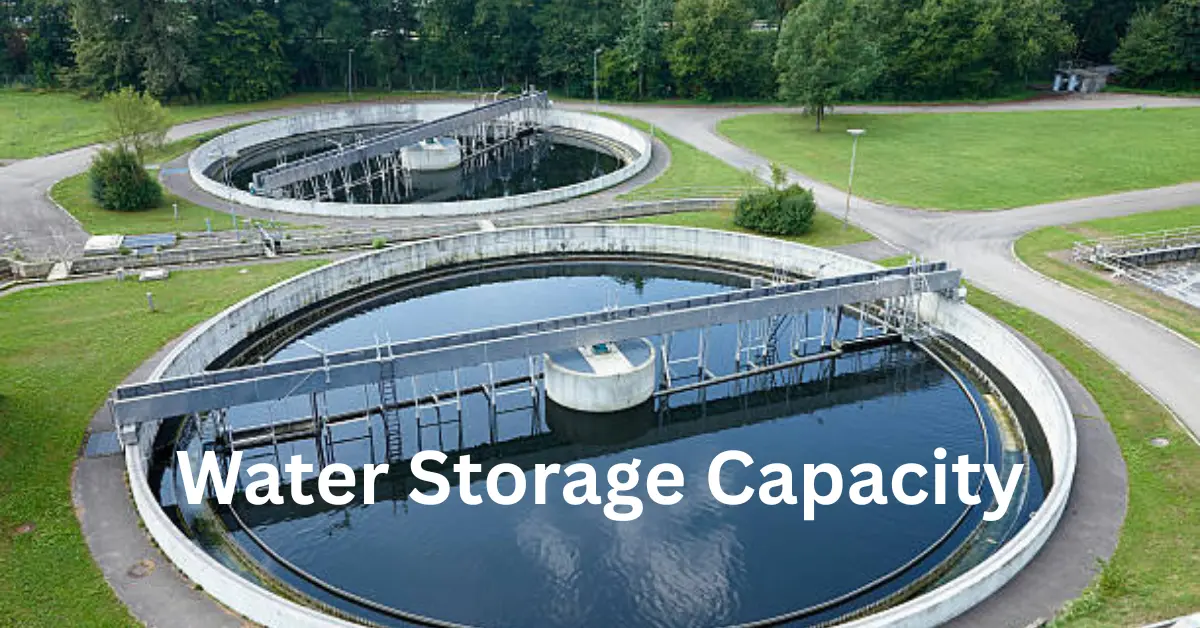
- Circular Tank: A round tank. Common for prefabricated water tanks, cement ring wells used for storage, and circular overhead tanks.
- Farm Pond (Trapezoidal): A farm pond dug into the ground typically has sloped sides wider at the top and narrower at the bottom. This trapezoidal shape is the most common design for earthen farm ponds worldwide. It requires both bottom dimensions and top dimensions to calculate correctly.
Unit of Measurement
Choose Metres or Feet depending on how you measured your structure. The tool converts all values to metres internally before calculating.
Dimensions
Depending on the tank type you select, the tool asks for the relevant dimensions:
- Rectangular Tank: Enter the Length and Width of the base.
- Circular Tank: Enter the Diameter (the full width across the centre).
- Farm Pond (Trapezoidal): Enter the Bottom Length, Bottom Width, Top Length, and Top Width. The bottom is the smallest, flat floor of the pond. The top is the wider opening at ground level.
Depth
The actual depth of the tank or pond from the bottom to the top edge. Measure the internal depth, not the external height of the embankment.
Usable Depth Factor
This is one of the most important and often overlooked inputs.
No tank or pond is ever used to 100% of its physical volume in practice. Farm ponds accumulate silt at the bottom over time. You need to maintain a freeboard a buffer of empty space at the top to prevent overflow during heavy rain. Pumps and outlet pipes cannot draw water from the very bottom.
The tool offers four options: 100%, 85%, 80% (recommended), and 75%. The 80% default is a well-established engineering standard for farm ponds, as recommended in water harvesting design guidelines. For clean cement tanks with no silt risk and controlled inflow, 85% to 90% is more appropriate.
Understanding Your Results
After clicking Calculate, the tool displays six outputs. Each one gives you a different, practical view of your storage capacity:
Gross Volume (m3)
This is the theoretical total volume of your tank or pond based on its physical dimensions before the usable depth factor is applied. Think of it as the absolute maximum the structure could hold if filled to the very brim with no safety margin.
Usable Storage Capacity (Litres)
This is the headline number. It is the actual, usable volume of water your tank can safely store your gross volume multiplied by the usable depth factor.
This is the number you use for all planning purposes. 1 cubic metre = 1,000 litres.
Usable Volume (Cubic Metres)
The same usable volume expressed in cubic metres. Useful for engineers, calculations involving flow rates, and any reporting that requires SI units.
Equivalent Water Tankers
This output expresses your storage in a unit that is immediately intuitive for most farmers: how many 10,000-litre water tankers would it take to fill your tank?
For example, a storage capacity of 180,000 litres equals 18 tankers. If you ever need to refill your tank from an external source, this tells you exactly how many tanker trips to arrange.
Approximate Irrigation Capacity (Acre-Inch)
This is the most strategically useful output for crop planning.
An acre-inch is the volume of water needed to apply one inch (25.4 mm) of water across one acre of land equal to approximately 101,940 litres or 101.94 cubic metres.
If your usable storage is 200,000 litres, that equals approximately 1.96 acre-inches. That means you can apply roughly 2 inches of irrigation across 1 acre, or 1 inch across 2 acres, from your current storage.
This directly connects your storage capacity to your irrigation needs. Combined with the Crop Water Requirement Calculator on moralinsights.com, you can plan your entire irrigation season based on your actual water availability.
Smart Tip
The tool also displays a contextual tip based on your storage size. Small storage gets advice on plastic lining to prevent seepage. Medium storage gets guidance on drip irrigation compatibility. Large storage gets recommendations on HDPE lining and shade nets to reduce evaporation practical, actionable suggestions tailored to your specific situation.
Key Features and the Science Behind the Calculations
Three Different Volume Formulas
The tool uses the correct geometric formula for each tank type not a single approximation for all shapes.
- Rectangular: Volume = Length x Width x Depth. The simplest and most straightforward formula.
- Circular: Volume = Pi x Radius squared x Depth. Where radius = diameter / 2. This is the standard cylinder volume formula.
- Trapezoidal (Farm Pond): The tool uses the Prismatoid formula: Volume = (Depth / 6) x (Bottom Area + 4 x Mid-section Area + Top Area). This is the most accurate formula for trapezoidal ponds and is the standard used in civil and agricultural engineering for earthen pond volume calculations.
The Prismatoid Formula for Farm Ponds
Most basic online calculators use a simple average of top and bottom areas multiplied by depth for trapezoidal ponds. This introduces a measurable error, particularly for ponds with steep or irregular side slopes.
The Prismatoid formula also known as the Prismoidal formula is the internationally accepted standard for calculating earthen pond volumes, as referenced in FAO Irrigation and Drainage Paper 39 and standard civil engineering references. By using this formula, this calculator gives you a significantly more accurate result for your farm pond than most other free tools available online.
Unit Conversion Built In
All feet measurements are automatically converted to metres (1 foot = 0.3048 metres) before the calculation. You never have to do unit conversion manually.
Usable Depth Factor
The 80% default usable depth factor is based on standard agricultural engineering practice for earthen farm ponds. It accounts for silt accumulation, freeboard requirements, and pump intake positioning giving you a realistic, practical capacity figure rather than a theoretical maximum.
Who Benefits Most from This Calculator?
- Smallholder Farmers with Farm Ponds: Farm ponds are the backbone of water storage for millions of smallholder farmers across Asia, Africa, and Latin America. Knowing the exact capacity of your pond is the starting point for any rational water management plan.
- Farmers Installing Cement or Plastic Tanks: Before building or buying a water storage tank, use this calculator to verify that the planned dimensions will give you the storage volume you actually need for your crops and livestock.
- Rainwater Harvesting Projects: NGOs, development organizations, and government agencies implementing rainwater harvesting projects use pond and tank capacity calculations to design systems that match the rainfall and demand of a specific site.
- Irrigation System Designers: The acre-inch output directly connects storage capacity to irrigation system design, making this tool useful for anyone planning a drip or sprinkler system that depends on stored water.
- Agricultural Engineers and Students: The use of the Prismatoid formula for trapezoidal ponds makes this tool academically sound and suitable for use in agricultural engineering coursework and professional practice.
- Livestock Farmers: Cattle, buffalo, and other large livestock require significant daily water volumes. Knowing your storage capacity helps ensure you have adequate water during dry periods for both irrigation and animal drinking.
Step-by-Step: How to Use the Water Tank & Farm Pond Capacity Calculator
Let me walk you through two complete examples one for a cement rectangular tank and one for a trapezoidal farm pond.
Example 1: Rectangular Cement Tank
You have a cement tank on your farm. You measured it and it is 10 metres long, 6 metres wide, and 2.5 metres deep. You want to know the usable storage capacity.
- Open the calculator on moralinsights.com.
- Select Rectangular / Square Tank from the Tank / Pond Type dropdown.
- Select Metre as the unit.
- Enter Length as 10 and Width as 6.
- Enter Depth as 2.5.
- Set Usable Depth Factor to 85% (since this is a clean cement tank with minimal silt risk).
- Click Calculate Capacity.
Result: Gross Volume = 150 m3. Usable Capacity = 127,500 litres (127.5 m3). Equivalent to 12.75 tankers. Irrigation capacity = 1.25 acre-inch.
With 127,500 litres, and a drip system using 8,000 litres per day, this tank gives you approximately 16 days of irrigation supply.
Example 2: Trapezoidal Farm Pond
You have an earthen farm pond. The bottom measures 12 metres long by 8 metres wide. The top (at ground level) measures 18 metres long by 14 metres wide. The depth is 3 metres.
- Select Farm Pond (Trapezoidal) from the dropdown. The form expands to show top length and top width fields.
- Enter Bottom Length as 12 and Bottom Width as 8.
- Enter Top Length as 18 and Top Width as 14.
- Enter Depth as 3.
- Keep Usable Depth Factor at 80% (the recommended default for earthen ponds).
- Click Calculate Capacity.
The Prismatoid formula calculates: Bottom Area = 96 m2. Top Area = 252 m2. Mid-section Area = 172 m2. Gross Volume = (3/6) x (96 + 688 + 252) = 518 m3. Usable Volume = 518 x 0.80 = 414.4 m3 = 414,400 litres.
That is more than 41 tankers worth of water. At 1 acre-inch per 101.94 m3, your pond provides approximately 4.07 acre-inches of irrigation capacity enough to apply a 4-inch irrigation over 1 acre, or 1 inch across 4 acres.
For guidance on farm pond design standards and specifications, refer to the FAO Water Harvesting Guidelines and the USDA Natural Resources Conservation Service (NRCS) Pond Design Standards, which provide detailed engineering standards for farm ponds and water storage structures globally.
Related Tools on MoralInsights.com
Use this calculator as part of a complete on-farm water management plan with these companion tools:
- Rainwater Harvesting Calculator — Calculate how much rainwater your catchment area can collect to fill your pond or tank.
- Crop Water Requirement Calculator — Find out how much water your crop needs per season and compare it against your storage capacity.
- Irrigation & Fertigation Calculator — Calculate your daily water requirement and drip system runtime based on your available storage.
- Drip Irrigation Layout Calculator — Design a drip irrigation system scaled to your actual water storage capacity.
- Universal Sprinkler Spacing, Rate & Runtime Calculator — Plan a sprinkler system matched to your farm pond or tank storage volume.
- Irrigation Scheduling Calendar — Build a full-season irrigation calendar based on your storage and crop water needs.
- Soil Moisture Depletion Calculator — Determine when to irrigate next so you use your stored water as efficiently as possible.
- Borewell Yield Estimator — If you rely on a borewell to fill your tank, use this tool to estimate your borewell’s sustainable yield.
Frequently Asked Questions
Why is the recommended usable depth factor 80% and not 100%?
A farm pond is never fully usable in practice. Over time, silt and sediment accumulate at the bottom, reducing the effective depth. You also need to maintain a freeboard a gap of empty space at the top to prevent overflow during unexpected heavy rainfall. Additionally, pumps and outlet pipes have a minimum submergence requirement and cannot draw water from the very last few centimetres. The 80% factor accounts for all of these realities and gives you a conservative, reliable estimate of your actual usable storage.
What is an acre-inch and why does the calculator show it?
An acre-inch is the volume of water required to cover one acre of land to a depth of one inch equal to approximately 101,940 litres. It is the standard unit used in irrigation planning to express water availability and crop water requirements. By expressing your storage capacity in acre-inches, the calculator directly answers the question: how much irrigation can this tank actually support? If your crop needs 2 acre-inches of water per irrigation cycle, and your tank holds 3 acre-inches, you know you have one full cycle plus a reserve.
What is the Prismatoid formula and why does the calculator use it for farm ponds?
The Prismatoid formula: Volume = (Depth / 6) x (Bottom Area + 4 x Mid-section Area + Top Area) is the most accurate method for calculating the volume of a shape that tapers from a larger top to a smaller bottom, like a farm pond. Simpler methods that just average the top and bottom areas introduce an error of 5 to 15% depending on the slope of the sides. For a large farm pond holding hundreds of thousands of litres, that error translates into a significant miscalculation. The Prismatoid formula eliminates that error and is the standard used in agricultural engineering and civil construction.
Can I use this tool for overhead water tanks on buildings?
Yes, absolutely. If you have a rectangular or circular overhead water tank on a building or farm structure, simply enter its dimensions and select the appropriate shape. The usable depth factor can be set to 85% or 90% for clean overhead tanks since silt accumulation is not a concern, but a small buffer is still recommended to prevent overflow from inlet pipe pressure variations.
My pond has an irregular shape. Can I still use this tool?
The tool works best for the three standard shapes: rectangular, circular, and trapezoidal. If your pond is irregular, the best approach is to divide it into two or more sections that approximate a known shape, calculate each section’s volume separately, and add the results. Alternatively, use the trapezoidal option with average top and bottom dimensions as a reasonable approximation for mildly irregular ponds.
Conclusion
Water storage is the foundation of drought-resilient farming. And yet, the number that defines your storage your actual, usable capacity in litres is a number that most farmers simply do not have.
The Water Tank & Farm Pond Capacity Calculator on moralinsights.com changes that. With just a few measurements and a few clicks, you get your exact usable storage volume, your irrigation capacity in acre-inches, and a practical tip on how to get the most from your storage all in seconds, for free, from any device in the world. Use it before you plant. Use it before you invest in irrigation. Use it every season as your water management starts here.
Disclaimer
The Water Tank & Farm Pond Capacity Calculator on moralinsights.com is intended for general planning and educational purposes only. Results are based on standard volumetric and engineering formulas. Actual storage capacity may vary due to factors including irregular pond shape, side slope variations, embankment thickness, silt accumulation, seepage losses, and construction tolerances. The acre-inch irrigation estimates are approximate and based on standard conversion factors. Always consult a qualified agricultural or civil engineer before constructing or modifying a farm pond or water storage structure. The author and moralinsights.com accept no liability for any losses arising from decisions made based on the results of this calculator.
About the Author
Lalita Sontakke is the founder of moralinsights.com, a global agriculture-focused digital platform offering 53+ free tools and calculators to help farmers, agronomists, and water management professionals worldwide make smarter, data-driven decisions. Her mission is simple: make precision farming accessible to every farmer in the world, free of charge.
Leave a Reply