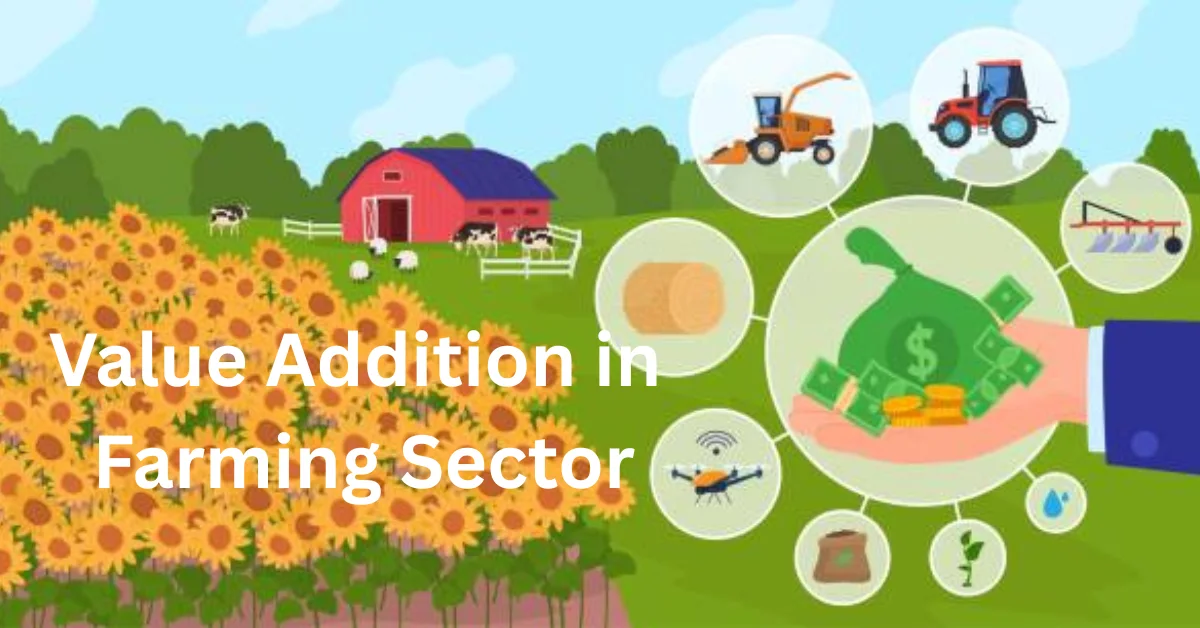
Value Addition in Farming Sector

Value Addition in Farming Sector: Transforming Agriculture from Subsistence to Prosperity

Value Addition in Farming Sector: “Agriculture is our wisest pursuit, because it will in the end contribute most to real wealth, good morals, and happiness.” – Thomas Jefferson

Value Addition in Farming Sector

In a nation where agriculture remains the primary livelihood for nearly 58% of the population yet contributes only about 18% to GDP, the paradox of Indian farming is stark and sobering. Farmers toil relentlessly, yet their economic rewards remain disproportionately meager. The solution to this agrarian distress lies not merely in higher production but in a fundamental transformation—moving from mere cultivation to value addition, from growing crops to creating prosperity. Value addition in the farming sector represents the bridge between subsistence agriculture and sustainable affluence, between rural poverty and rural prosperity.

Understanding Value Addition: Beyond the Farm Gate

Value addition in agriculture refers to the process of increasing the economic value of agricultural produce through processing, packaging, branding, quality enhancement, and marketing. It encompasses everything that happens after the crop leaves the field—cleaning, grading, processing, preserving, packaging, branding, and delivering products that command higher prices and reach wider markets.

The significance becomes apparent when we consider that a farmer selling raw tomatoes earns ₹10-15 per kilogram, while processed tomato ketchup sells for ₹200-300 per kilogram. Similarly, raw milk fetches ₹30-40 per liter, but packaged flavored milk retails at ₹60-80 per liter. The differential represents not just processing costs but the value captured by intermediaries—value that rightfully should accrue to farmers.

Value addition transforms agriculture from a primary sector activity into an integrated value chain involving manufacturing, services, and innovation. It addresses multiple dimensions of agricultural sustainability—economic viability, employment generation, reduction of post-harvest losses, nutritional security, and environmental sustainability.

Economic Imperative: Enhancing Farm Income

The foremost justification for value addition is economic. Despite the Green Revolution’s success in achieving food security, Indian farmers remain among the poorest sections of society. Land fragmentation has reduced average holding sizes to less than 1.1 hectares, making scale economies difficult. Dependence on monsoons, price volatility, and exploitative market structures perpetuate indebtedness and distress.

Value addition offers a pathway out of this trap. When farmers or farmer producer organizations (FPOs) engage in processing—whether making pickles, jams, fruit juices, or packaged vegetables—they capture a larger share of the consumer rupee. Studies indicate that value-added agricultural products can generate 3-5 times higher returns compared to raw produce.

The success of cooperatives like Amul demonstrates this potential magnificently. What began as a cooperative to eliminate middlemen in milk procurement has become a ₹60,000 crore enterprise, benefiting 3.6 million farmer-members. Amul doesn’t merely collect milk; it processes it into dozens of products—butter, cheese, ice cream, paneer, chocolates—each commanding premium prices. The farmers receive fair prices, and the value addition ensures year-round income stability despite seasonal variations in milk production.

Similarly, Lijjat Papad, a women’s cooperative, transformed simple home-based papad making into a nationwide brand employing over 43,000 women. These examples illustrate how value addition combined with collective action can fundamentally alter economic equations for small producers.

Employment Generation: Rural Industrialization

India’s development challenge is intimately linked to agricultural transformation. With limited land expansion possibilities and mechanization reducing labor requirements in farming, the question looms: where will employment come from for the millions dependent on agriculture?

Value addition provides a compelling answer. Agro-processing industries are labor-intensive, geographically dispersed, and can be scaled to different sizes—from household enterprises to large factories. Every step of processing—cleaning, grading, cutting, cooking, packaging, quality control—requires human intervention.

The food processing industry in India currently employs approximately 13 million people directly and supports millions more indirectly. Yet it processes barely 10% of agricultural produce, compared to 60-70% in developed countries. Expanding this sector could absorb surplus agricultural labor while creating value.

Women particularly benefit from agro-processing opportunities. Activities like pickle-making, spice grinding, dairy processing, weaving, and handicraft production provide employment that can be balanced with household responsibilities. The Self-Help Group (SHG) movement has demonstrated how value addition at the grassroots level empowers women economically and socially. The Kudumbashree initiative in Kerala, where women’s collectives engage in food processing and marketing, has transformed livelihoods for lakhs of families.

Youth employment, critical for demographic dividend realization, can find opportunities in agri-tech startups, cold chain management, quality control, digital marketing of agricultural products, and agro-tourism. Value addition thus becomes an instrument of inclusive growth.

Reducing Post-Harvest Losses: A Moral and Economic Necessity

India loses an estimated ₹92,000 crore worth of agricultural produce annually due to post-harvest losses—approximately 16% of total production. For perishables like fruits and vegetables, losses can exceed 30-40%. These losses represent not just economic waste but a moral failure in a country where millions remain undernourished.

Value addition directly addresses this challenge. Processing and preservation—through canning, freezing, drying, pickling, fermentation—extend shelf life and reduce wastage. When tomatoes flood markets during peak harvest, prices crash to ₹2-3 per kilogram. Processing excess tomatoes into puree, ketchup, or dried tomatoes stabilizes income and prevents losses.

The cold chain infrastructure is integral to value addition. Currently, India has cold storage capacity for only 10% of perishable production. Investments in refrigerated transport, controlled atmosphere storage, and pack-houses can dramatically reduce losses while enabling farmers to time their market entry strategically.

Minimal processing—cleaning, grading, cutting, and packaging fresh produce—adds value while reducing losses. Pre-cut vegetables and fruits, washed and ready-to-cook products cater to urban consumers’ convenience preferences while compensating farmers better than raw produce sales.

Nutritional Security and Health: Value Beyond Price

Value addition isn’t merely economic; it encompasses nutritional enhancement and health benefits. Fortification of staple foods with micronutrients addresses hidden hunger. Millet processing into ready-to-eat products promotes traditional grains with superior nutritional profiles compared to rice and wheat.

Organic farming combined with certification and branding creates premium market segments. Consumers increasingly seek pesticide-free, sustainably grown produce—willingness to pay premium prices exists. Organic value chains connecting conscious consumers with sustainable farmers represent win-win propositions.

Traditional food preservation techniques—fermentation, sun-drying, oil preservation—not only add value but also enhance nutritional quality. Encouraging such methods preserves cultural heritage while meeting modern health-conscious consumer demands.

Environmental Sustainability: Waste to Wealth

Agriculture generates massive organic waste—crop residues, vegetable waste, dairy by-products. When burned or left to rot, these contribute to pollution and greenhouse gas emissions. Value addition through bio-conversion transforms waste into resources.

Stubble, instead of being burned (contributing to air pollution), can be processed into bio-fuel, animal feed, or used in mushroom cultivation. Fruit and vegetable waste can become organic fertilizers through composting or animal feed. Dairy by-products like whey can be processed into protein supplements.

The bioeconomy approach—extracting maximum value from biological resources while minimizing waste—aligns agricultural prosperity with environmental stewardship. It represents a paradigm shift from linear “take-make-waste” models to circular systems where every output becomes an input elsewhere.

Challenges: The Rocky Road to Value Addition

Despite evident benefits, value addition in Indian agriculture faces formidable challenges:

Infrastructure Deficit: Inadequate cold storage, processing facilities, and transportation infrastructure constrain value addition. The National Cold Chain Development initiative aims to address this, but progress remains slow. Most processing units are concentrated near urban centers rather than production zones.

Scale and Standardization: Small landholdings make aggregation difficult. Without critical mass, setting up processing units becomes unviable. Standardizing quality across numerous small producers presents challenges—consistency required by modern retail and export markets is hard to achieve.

Capital and Credit: Processing requires upfront investment in equipment, facilities, and working capital. Small farmers lack access to institutional credit for such ventures. While schemes like NABARD’s Agriculture Infrastructure Fund exist, awareness and accessibility remain limited.

Skill Gap: Value addition requires skills beyond traditional farming—understanding processing techniques, quality standards, packaging, branding, and marketing. Most farmers lack these competencies. Extension services remain focused on production rather than post-harvest management.

Market Linkages: Creating brands, accessing retail chains, understanding consumer preferences, and managing distribution require sophistication beyond individual farmer capabilities. Without reliable market linkages, farmers hesitate to invest in processing.

Regulatory Complexities: Food safety standards (FSSAI licensing), labor laws, taxation, environmental clearances create bureaucratic hurdles. While necessary for consumer protection, these can overwhelm small producers unfamiliar with compliance requirements.

Power and Water: Consistent electricity supply and water availability are prerequisites for processing. Rural areas often face shortages, making operations unreliable.

Policy Interventions and the Way Forward

Recognizing value addition’s potential, government initiatives have proliferated, though implementation effectiveness varies:

PM Formalisation of Micro Food Processing Enterprises (PM-FME) scheme aims to enhance competitiveness of micro-enterprises through credit linkage, technical upgradation, and marketing support. The ₹10,000 crore allocation demonstrates policy priority, but ground-level execution requires strengthening.

Formation of Farmer Producer Organizations (FPOs): The government’s target of 10,000 new FPOs addresses the scale challenge. Collective marketing, processing, and branding become viable when farmers aggregate. However, FPOs need sustained handholding—business planning, governance, market linkages—for success.

Agriculture Export Zones (AEZs) and Mega Food Parks create clusters with shared infrastructure reducing individual investment burdens. Infrastructure including cold storage, processing units, quality testing labs becomes accessible to small processors.

GI Tags (Geographical Indication) for products like Darjeeling Tea, Alphonso Mango, Nagpur Orange create brand differentiation enabling premium pricing. Expanding GI coverage and ensuring benefits reach actual producers requires attention.

Technology Integration: Digital platforms connecting farmers directly to consumers (e-NAM, FPO portplacing), blockchain for traceability, IoT for cold chain monitoring, and AI for quality sorting represent frontier areas. Public-private partnerships can accelerate adoption.

Skilling and Capacity Building: Integrating food processing skills in rural vocational training, establishing food processing entrepreneurship programs, and strengthening agricultural extension services to cover post-harvest management would build human capital.

Credit and Insurance: Expanding institutional credit specifically for agro-processing, creating risk insurance products for price volatility, and establishing venture capital for agri-startups would ease financial constraints.

APMC Reforms: Though contentious, reforming Agricultural Produce Market Committees (APMCs) to allow direct farmer-processor/retailer linkages eliminates intermediaries, enabling value capture by producers. The Model APMC Act provides a template, but state-level implementation is critical.

Women-Centric Initiatives: Given women’s predominance in post-harvest activities, targeted support for women-led processing enterprises—simplified credit access, technical training, marketing support—would empower economically marginalized sections.

Global Lessons and Indian Context

Countries like Israel, Netherlands, and Thailand transformed agriculture through value addition despite resource constraints. Israel’s drip irrigation technology coupled with high-value horticulture exports demonstrates technology-driven value creation. Netherlands, despite small geographical size, is the world’s second-largest agricultural exporter by value through greenhouse farming, precision agriculture, and value-added products.

Thailand’s success in processed food exports—canned fruits, frozen seafood, packaged rice—resulted from deliberate policy combining infrastructure investment, quality standards enforcement, and export promotion. India can adapt these models while addressing its unique challenges—scale, diversity, institutional capacity.

Conclusion: From Fields to Fortune

Value addition in farming represents more than an economic strategy; it embodies a vision of dignified rural livelihoods and sustainable prosperity. It transforms farmers from price-takers to value-creators, from commodity producers to brand owners, from vulnerable individuals to empowered collectives.

The journey from subsistence farming to value-added agriculture is neither quick nor easy. It requires infrastructure investment, skill development, institutional strengthening, policy coherence, and above all, empowering farmers with knowledge, capital, and market access. Yet, the destination—an agriculture sector that rewards effort fairly, provides year-round employment, reduces environmental burden, and contributes substantially to national economy—justifies the effort.

As we commemorate the Green Revolution’s legacy in achieving food security, the next agricultural revolution must focus on farmer prosperity through value addition. The soil has given abundantly; now it’s time to ensure that abundance translates into affluence for those who toil upon it.

In the words of Norman Borlaug, father of the Green Revolution: “Food is the moral right of all who are born into this world.” To this, we must add: prosperity is the moral right of all who produce that food. Value addition is the pathway to honoring that right, transforming agriculture from a way of survival into an engine of prosperity, ensuring that those who feed the nation are themselves well-fed, well-compensated, and well-respected.

The future of Indian agriculture—and indeed rural India—lies not in merely growing more but in growing smarter, processing better, and marketing strategically. Value addition is not an option; it is an imperative for sustainable agricultural transformation and inclusive national development.


Essay Writing Framework – Value Addition Topic

Structure Breakdown:

Introduction (120 words)

  • Powerful quote establishing theme
  • Statistical context highlighting the paradox
  • Clear thesis statement
  • Definition and scope of value addition

Body Section 1: Economic Dimension (200 words)

  • Farm income enhancement
  • Examples: Amul, Lijjat Papad
  • Statistical evidence
  • Multiplier effect

Body Section 2: Employment Generation (150 words)

  • Rural industrialization potential
  • Women empowerment
  • Youth employment
  • SHG examples

Body Section 3: Reducing Losses (150 words)

  • Scale of post-harvest losses
  • Processing solutions
  • Cold chain importance
  • Market stabilization

Body Section 4: Nutrition and Environment (150 words)

  • Nutritional enhancement
  • Organic value chains
  • Waste to wealth conversion
  • Sustainability angle

Body Section 5: Challenges (180 words)

  • Infrastructure gaps
  • Capital constraints
  • Skill deficit
  • Market linkages
  • Regulatory hurdles

Body Section 6: Policy and Solutions (180 words)

  • Government schemes
  • FPO model
  • Technology integration
  • Credit and insurance
  • Global lessons

Conclusion (170 words)

  • Synthesis of main arguments
  • Vision for future
  • Moral imperative
  • Inspiring call to action
  • Powerful closing quote

What Makes This Score High in UPSC:

  1. Multidimensional Analysis: Not just economic but social, environmental, ethical
  2. Evidence-Based Arguments: Statistics, examples, case studies
  3. Administrative Perspective: Policy awareness, governance challenges
  4. Balanced Critique: Acknowledges challenges while proposing solutions
  5. Original Thinking: Beyond textbook arguments
  6. Clear Structure: Easy to follow, logical progression
  7. Language Quality: Formal yet accessible, varied vocabulary
  8. India-Centric: Focus on Indian context with global learning
  9. Forward-Looking: Solutions and vision for future
  10. Emotional Connect: Empathy for farmers, moral arguments

Practice Tips for Similar Topics:

For Agricultural Essays:

  • Always include farmer perspective (economic reality)
  • Discuss both production and post-production
  • Link to broader development goals (employment, nutrition, sustainability)
  • Mention specific government schemes
  • Use cooperative success stories (Amul, Lijjat, Kudumbashree)
  • Address environmental sustainability
  • Include women and youth dimensions

For Value Addition Specifically:

  • Define clearly at the start
  • Use before-after price comparisons
  • Discuss entire value chain
  • Address infrastructure challenges
  • Mention FPOs and cooperatives
  • Include processing industries data
  • Link to food security and nutrition

General Essay Strategy:

  • Read widely: Economic Survey, NITI Aayog reports, newspapers
  • Develop examples bank: Successful models, schemes, statistics
  • Practice structure: Introduction-Body-Conclusion framework
  • Time management: 90 minutes per essay, plan for 10 minutes
  • Revise: Write, get feedback, improve
  • Stay current: Update with latest schemes and data

Related Topics to Practice:

  1. “Cooperative farming: A solution to agricultural distress”
  2. “Food processing industry: India’s next growth engine”
  3. “From farm to fork: Ensuring food security and farmer prosperity”
  4. “Women in agriculture: The invisible backbone”
  5. “Organic farming: Balancing tradition and modernity”
  6. “Agricultural exports: Opportunities and challenges”
  7. “Technology in agriculture: Boon or bane for small farmers”

Remember: UPSC essay evaluates not just what you know but how you think. Show depth, breadth, balance, and vision. This essay demonstrates all four!

Best wishes for your UPSC preparation! 🌾📝✨

Go to Home Page

Go to UPSC Govt. Site

Leave a Comment