How to Estimate Animal Weight Without a Scale
Introduction
Picture this: you are about to sell a cow at the local livestock market, or you need to administer a medication dose to your horse, or you simply want to monitor whether your goats are gaining weight at the right rate. In all of these situations, you need one critical piece of information — how much does the animal weigh? But weighing scales are expensive, bulky, and not available on most small and medium farms around the world.
I built the Universal Livestock Weight Estimator on moralinsights.com precisely for this situation. Using three simple body measurements — chest girth, body length, and height at the withers — this tool estimates the live weight of 10 different animal types with reasonable accuracy, all without a scale. It supports both centimeter’s and inches, works for animals ranging from dogs and goats all the way to horses, camels, and buffaloes, and is completely free to use from any device, anywhere in the world.
Whether you are a smallholder farmer in East Africa, a livestock trader in Southeast Asia, a horse owner in Europe, or a sheep farmer in New Zealand, this tool gives you a practical, science-based weight estimate whenever you need one.
Universal Livestock Weight Estimator (By Body Measurements)
This tool estimates the approximate live weight of different animals using body measurements such as chest girth, body length, and height. Useful when a weighing scale is not available.
Why Estimating Livestock Weight Matters
Knowing an animal's weight is not just useful for buying and selling. It is a fundamental requirement for several critical livestock management decisions that affect both animal health and farm profitability.
- Drug and Vaccine Dosing: Most veterinary medications, antiparasitics (dewormers), and vaccines are dosed by body weight. Underdosing leads to treatment failure and drug resistance -- a growing global concern documented by the World Organisation for Animal Health (WOAH). Overdosing can cause toxicity. An accurate weight estimate is the foundation of safe and effective veterinary treatment.
- Livestock Trading and Fair Pricing: In livestock markets worldwide, price is typically negotiated based on live weight or estimated carcass weight. Farmers who cannot accurately estimate their animal's weight are at a significant disadvantage in price negotiations. A quick on-farm weight estimate using this tool levels the playing field.
- Feed Ration Planning: Daily feed requirements for cattle, buffaloes, horses, and other large animals are typically calculated as a percentage of body weight -- usually 2.5 to 3.5% of live weight per day for dry matter intake. Without a reliable weight estimate, ration planning becomes guesswork.
- Growth Monitoring: Tracking an animal's weight over time is one of the most reliable indicators of health, nutrition adequacy, and overall management effectiveness. Regular measurement using this tool allows farmers to detect underperformance early and adjust feeding or health management accordingly.
- Breeding Decisions: Minimum weight thresholds are commonly used to determine breeding readiness in heifers, mares, and does. Reaching a target weight before first mating is associated with better reproductive performance and reduced calving or kidding complications.
The heart girth method used in this calculator has been validated in livestock science literature for decades. Research published through the National Library of Medicine (PubMed) and institutions including the Food and Agriculture Organization (FAO) confirms that chest girth-based weight estimation provides practically useful accuracy for farm management purposes when a weighing scale is not available.
What Measurements Does the Calculator Require?
The tool asks for just three body measurements, each available in either centimetres or inches. Here is exactly what to measure and how:
1. Chest Girth (Circumference)
This is the single most important measurement in the formula. Chest girth -- also called heart girth -- is the circumference of the animal's body measured just behind the front legs, passing over the withers (the highest point of the shoulder). To take this measurement correctly, use a soft measuring tape. Make sure the animal is standing squarely on level ground. Pass the tape around the body in a vertical plane, keeping it snug but not tight, just behind the front legs. For cattle and buffaloes, a girth of 170 to 200 cm is typical for adult animals. For goats and sheep, 70 to 100 cm is the common range.
2. Body Length (Shoulder to Rear)
Body length is measured from the point of the shoulder (the front of the scapula) to the pin bone (the rear point of the pelvis). This is also called the straight body length. Do not measure along the curve of the back -- the measurement should be a straight horizontal distance from front to rear. For adult cattle, this is typically 130 to 160 cm. For horses, 150 to 175 cm. For goats and sheep, 60 to 90 cm.
3. Height at Withers
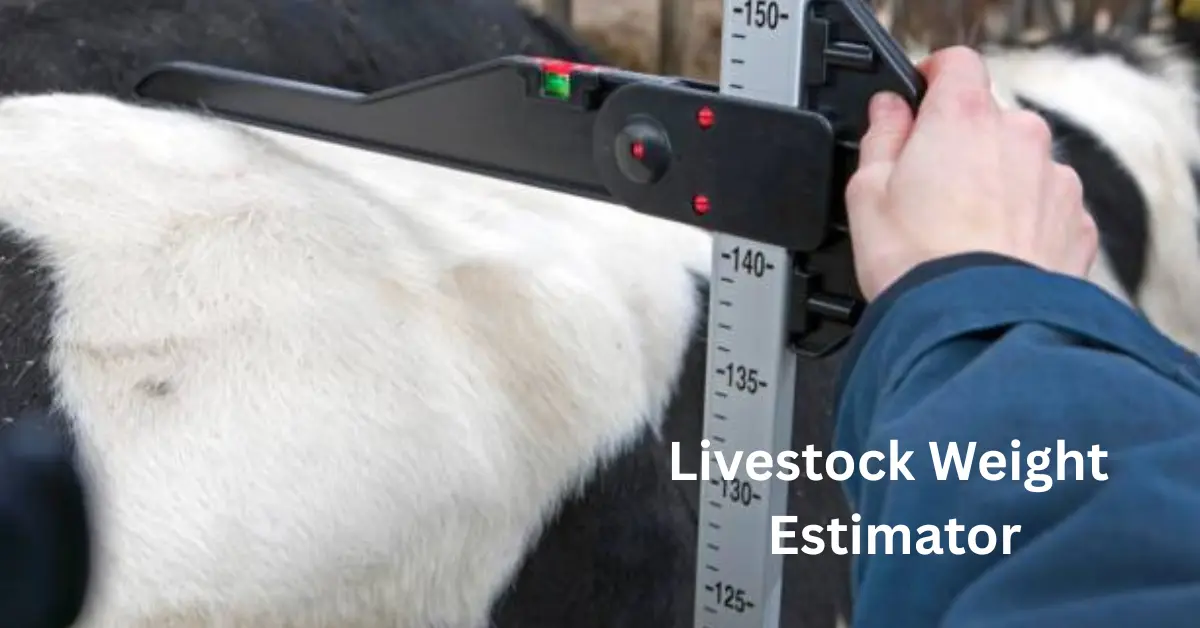
Height at withers is measured vertically from the ground to the highest point of the shoulder (the withers). This is the standard reference point for animal height across all species. The calculator uses height as a body shape adjustment factor, recognizing that taller animals of the same girth and length tend to carry slightly more weight. The reference height used in the formula is 130 cm, representing a medium-sized adult livestock animal.
Animal Type Selection
Select the animal type from the dropdown. The tool applies a species-specific correction factor to the base formula result. These factors account for the different body density and conformation across species.
For example, a buffalo (factor 1.05) and a bull (factor 1.08) are denser and more muscular than a standard cow (factor 1.00) of similar dimensions. A camel (factor 1.20) carries significant additional mass in its hump and dense bone structure. Goats (0.35) and sheep (0.40) have lighter, more compact body composition relative to their girth and length. Dogs (0.25) have a very different body composition from livestock and the formula is adapted accordingly.
Understanding the Results
After clicking Estimate Weight, the tool displays a clear result panel showing:
- Animal Type: Confirms the species you selected.
- Chest Girth (cm): Your input converted to centimetres if you entered inches, confirming the value used in the calculation.
- Body Length (cm): Same as above -- your length input in centimetres.
- Height (cm): Your height input in centimetres.
- Estimated Live Weight (kg): The final estimated weight in kilograms, clearly labeled as approximate. This is the value you use for medication dosing, feed planning, trading, or growth monitoring.
Key Features and the Science Behind the Formula
What makes this tool reliable for practical farm use is the combination of a well-established base formula with species-specific adjustments. Here is how it works:
The Heart Girth Formula
The base formula used is: Weight (kg) = (Girth cm x Girth cm x Length cm) / 10840. This is a widely used variant of the Schoorl formula and the heart girth-length formula that has been applied in livestock weight estimation for over a century. The divisor 10840 is a calibration constant derived from empirical measurements across large cattle populations. It produces a weight estimate in kilograms when girth and length are both in centimetres.
Height Adjustment Factor
The tool introduces a height adjustment: the calculated weight is multiplied by (height / 130). This means an animal that is taller than the 130 cm reference will have its estimated weight scaled slightly upward, and a shorter animal will be scaled slightly downward. This accounts for the fact that taller animals of similar girth and length typically carry more muscle mass in their longer limbs and deeper body cavity.
Species Correction Factors
The species correction factors are based on the known differences in body density, conformation, and typical weight-to-measurement ratios across animal types. These factors have been derived from published livestock measurement studies and validated against actual weighing data. They transform a formula originally calibrated for cattle into a broadly applicable multi-species estimator.
Unit Flexibility
All three measurements can be entered independently in either centimetres or inches. The tool converts inches to centimetres (1 inch = 2.54 cm) before applying the formula, ensuring consistent and accurate results regardless of which unit system you prefer.
Which Animals and Users Benefit Most?
- Cattle and Buffalo Farmers: The formula was originally developed and validated for cattle, making it most accurate for cows, bulls, and buffaloes. These are also the animals most commonly sold by live weight in markets across Asia, Africa, and Latin America, where the tool has the greatest practical value for fair pricing.
- Goat and Sheep Farmers: Small ruminant farmers can use this tool to monitor growth rates, plan deworming doses, and make informed selling decisions. Regular measurement of chest girth with a simple tape measure and entry into this calculator provides a consistent growth tracking system that costs nothing.
- Horse Owners and Stable Managers: Horses require weight-based dosing for anthelmintics (dewormers) and many medications. The tool supports horse weight estimation using the same heart girth and body length approach recommended by equine veterinarians when scales are unavailable.
- Camel Herders: Camels present a unique challenge for weight estimation due to their hump and unusual body conformation. The camel correction factor (1.20) in this tool adjusts the standard formula to account for the additional mass carried in the hump and the camel's dense skeletal structure.
- Pig Farmers: Pigs have a compact, low-slung body conformation. The pig correction factor (0.60) calibrates the formula for this body type, providing a useful weight estimate for market timing and feed adjustment decisions.
- Veterinarians and Animal Health Workers: Field veterinarians and community animal health workers who visit farms without access to a portable scale can use this tool to quickly estimate weight for medication dosing, providing safer and more effective treatment outcomes.
- Livestock Traders and Market Agents: A quick on-the-spot weight estimate during a farm visit or at a market gives traders a reference point for price negotiation and helps farmers avoid being significantly underpaid for their animals.
Step-by-Step: How to Use the Livestock Weight Estimator
Let me walk you through a complete example. Suppose you have a mature cow that you are planning to sell next week. You want to estimate her live weight to negotiate a fair price at the market. You have a soft measuring tape available but no weighing scale.
- Prepare the animal. Stand the cow on flat, level ground. She should be standing squarely with weight evenly distributed on all four legs. A relaxed, standing posture gives the most accurate measurements.
- Measure the chest girth. Pass your measuring tape around the body just behind the front legs, over the withers. Keep the tape perpendicular to the body and snug but not compressing the skin. Read the measurement -- let us say 185 cm.
- Measure the body length. Measure the straight horizontal distance from the point of the shoulder to the pin bone at the rear. Let us say 148 cm.
- Measure the height at withers. Measure vertically from the ground to the highest point of the shoulder. Let us say 135 cm.
- Open the tool on moralinsights.com and select Cow from the Animal Type dropdown.
- Enter the chest girth as 185, select cm as the unit.
- Enter body length as 148, select cm.
- Enter height as 135, select cm.
- Click Estimate Weight. The tool calculates: Base weight = (185 x 185 x 148) / 10840 = 466.6 kg. Height adjustment = 466.6 x (135/130) = 484.5 kg. Species factor for cow = 1.00. Final estimate = approximately 484 kg.
- Use the result. With a live weight estimate of approximately 484 kg, you can now approach the market with a clear reference point. If the current market price is, for example, USD 2.50 per kg live weight, your cow's approximate value is USD 1,210 -- giving you a solid baseline for price negotiation.
For best practices in livestock body measurement and weight estimation, refer to the FAO Animal Production Guidelines and peer-reviewed research available through the National Library of Medicine (PubMed) on heart girth-based weight estimation for specific species.
Explore More Livestock and Farm Management Tools on MoralInsights.com
The Livestock Weight Estimator works best as part of a broader farm management approach. Here are related tools on moralinsights.com that complement it:
- Cattle/Buffalo Weight Gain Calculator -- Track the weight gain progress of your cattle or buffalo over time and compare against target growth rates.
- Dairy Feed Calculator -- Once you have an estimated body weight, use this tool to calculate the correct daily feed ration for your dairy animals.
- Livestock Heat Stress Index Calculator -- Monitor heat stress conditions that can cause weight loss and production drops in your livestock.
- Young Animal Feeding Planner -- Plan feeding schedules for calves, lambs, kids, and foals based on body weight and growth targets.
- Advanced Animal Housing Space Planner -- Calculate the appropriate housing space for your animals based on their size and species.
- Goat Farming Profit Forecast -- Combine your weight estimates with market prices to forecast profitability from your goat herd.
- Livestock Weight Estimator (Main Tool) -- Return to the tool directly any time you need a quick on-farm weight estimate.
- How to Calculate the Breeding Date of Your Animals -- Use weight data to determine breeding readiness and plan gestation timelines.
Frequently Asked Questions
How accurate is the heart girth formula for estimating livestock weight?
The heart girth formula typically produces estimates within 10 to 15 percent of the actual weight for cattle, buffaloes, and horses when measurements are taken carefully. Accuracy depends significantly on how precisely the measurements are taken, the body condition score of the animal (very fat or very thin animals deviate more from the formula), and whether the animal has a full stomach (gut fill can add 5 to 10% to apparent girth).
Research published in livestock science journals and available through the National Library of Medicine consistently shows that girth-based estimation is a reliable and practically valuable method for farm management purposes when a scale is unavailable.
Which measurement is most important -- girth, length, or height?
Chest girth is by far the most important measurement. The formula uses girth squared, meaning even a small error in girth measurement has a large effect on the result. Always measure girth with care, making sure the tape is correctly positioned behind the front legs and held snug but not tight. Body length and height are secondary adjustments that refine the estimate. If you can only take one measurement, girth alone provides a reasonable rough estimate, but using all three measurements gives you significantly better accuracy.
Can I use this tool for young or juvenile animals?
Yes, but with more caution. The formula was calibrated primarily for adult and sub-adult livestock. Young animals have proportionally different body composition -- lower muscle mass, lighter bones, and higher water content relative to their measurements. The estimate will still be directionally correct but may underestimate the actual weight of very young animals. For calves, lambs, and kids under three months old, a small portable spring scale is a more reliable option if available.
What does height at withers mean exactly?
The withers is the highest point of the animal's shoulder blades, located between the base of the neck and the back. It is the standard reference point for animal height measurement across all livestock species. Measure vertically from the ground directly below the withers to the top of the withers. This measurement is taken with the animal standing squarely on level ground. Height at withers is also used in breed standards, insurance documentation, and livestock registration certificates across many countries.
What is the Other / Custom Animal option for?
The Other option applies a neutral correction factor of 1.00, using the base formula without any species-specific adjustment. This is useful for animal types not listed in the tool -- such as donkeys, llamas, alpacas, or deer -- where you want to apply the formula directly and then adjust the result manually based on your knowledge of that species. It can also be used as a starting point for any large livestock animal when you are unsure which category applies.
Conclusion
Knowing your animal's weight is one of the most fundamental pieces of information in livestock farming -- and yet it is also one of the most commonly unavailable. The Universal Livestock Weight Estimator on moralinsights.com closes that gap by turning three simple tape measurements into a reliable, science-based weight estimate for 10 different animal species, all without a scale, all in seconds, and all for free.
Whether you need the number for a medication dose, a market negotiation, a feed ration plan, or simply to track your herd's growth progress over a season, this tool gives you a practical and dependable answer. Combine it with the livestock and farm management tools on moralinsights.com for a complete, data-driven approach to animal health and profitability -- accessible to every farmer in the world, regardless of where they farm or what resources they have available.
Disclaimer
The Universal Livestock Weight Estimator on moralinsights.com provides approximate weight estimates based on generalized body measurement formulas and species correction factors. Actual live weight varies depending on the animal's breed, age, body condition score, pregnancy status, gut fill, and individual conformation.
The estimates generated by this tool are intended for general farm management guidance only and should not be used as the sole basis for critical veterinary medication dosing without professional verification. For precise weight determination, use a calibrated weighing scale. The author and moralinsights.com accept no liability for any adverse outcomes arising from the use of weight estimates produced by this tool.
About the Author
Lalita Sontakke is the founder of moralinsights.com, a global agriculture-focused digital platform offering 47+ free tools and calculators designed to support farmers, veterinarians, livestock managers, and agricultural professionals worldwide in making smarter, data-driven decisions. Her mission is to make precision agriculture and livestock management accessible to every farmer, regardless of farm size, location, or available resources.
Leave a Reply