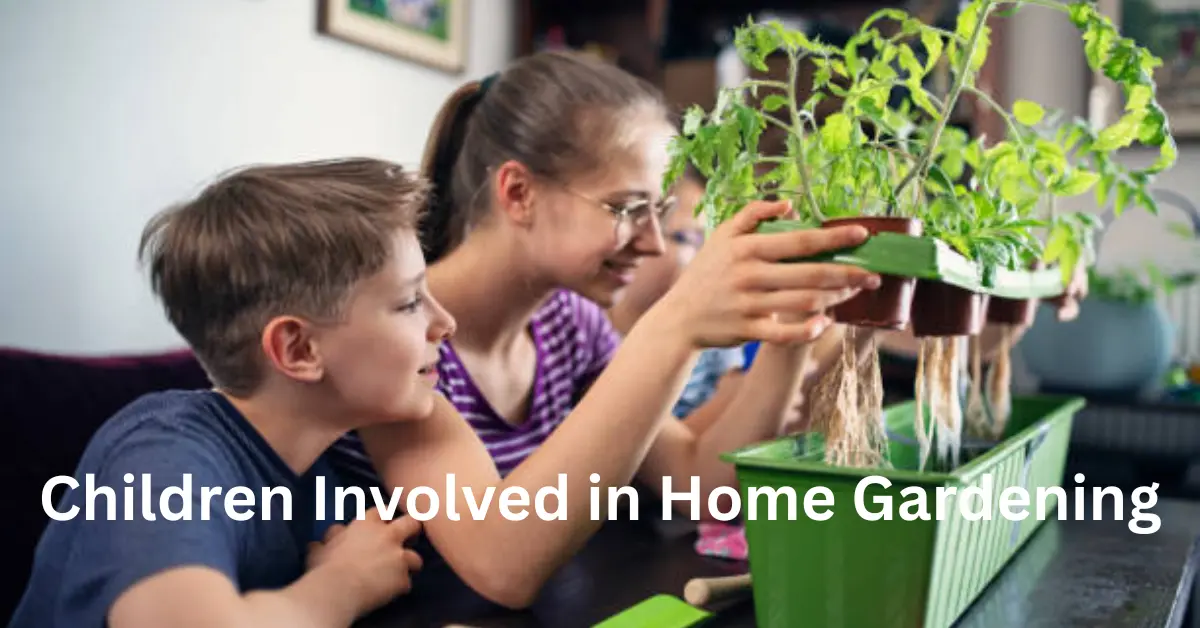
How to Get Your Children Involved in Home Gardening — and Why It Changes Everything
The Joys, the Benefits, and the Simple Activities That Turn Any Child Into a Passionate Young Gardener
🌱 Introduction: The Day Everything Changed
It happened quietly, the way the best things often do. A mother placed a small pot of soil on the kitchen table, handed her four-year-old a few fenugreek seeds, and said: bury these, water them every morning, and let us see what happens.
Within three days, tiny green shoots appeared. The child’s face — the wonder, the ownership, the pride — told the whole story. She had made something grow. Something that would be on the dinner table in two weeks, harvested by her own small hands.
That moment, replayed in millions of homes around the world, is what gardening with children is really about. Not just teaching them where vegetables come from. Not just giving them something to do on weekends. But giving them an experience of genuine agency — of planting, nurturing, waiting, and harvesting — that builds something deep and lasting inside them.
This guide is for every parent, grandparent, and caregiver who wants to share the garden with the children in their life. It covers the science of why gardening is so good for children, the right activities for every age group, the best crops to grow together, and how to handle the inevitable muddy hands, impatient questions, and accidental waterings that come with gardening alongside children.
Because here is the truth: a child who grows food thinks differently about food, about nature, about patience, and about their own capability. And a parent who gardens with their child discovers a connection that no screen, no toy, and no structured activity can quite replicate.
❤️ Parent Note: You do not need a garden to do this. A single pot of soil, a packet of seeds, and a curious child are all you need. The most profound gardening experiences children remember as adults often happened in the smallest spaces.
🔬 What Science Tells Us: Why Gardening Is Extraordinary for Children
The benefits of children gardening are not folklore or parental intuition — they are backed by a growing body of research across psychology, nutrition, education, and child development. Here is what studies consistently show:
Children Who Grow Food Eat Better
This is the most consistently documented finding in children’s gardening research. Children who participate in growing vegetables are measurably more willing to taste, try, and enjoy vegetables they have grown themselves — including vegetables they previously refused at the dinner table. The ownership effect is powerful: a child who grew the tomato, watched it turn red, and picked it with their own hands approaches that tomato with pride and curiosity rather than reluctance.
🔬 Science Says: Multiple studies in school gardening programmes found that children who participated in growing vegetables showed a significant increase in vegetable consumption compared to children who did not participate. Some studies found increases of 30–40% in vegetable variety willingness among child gardeners.
Gardening Builds Emotional Resilience
A garden is one of the few environments in modern childhood where outcomes are genuinely uncertain and not immediately controllable. Seeds do not always germinate. Plants sometimes die despite careful attention. Pests appear without warning. These experiences — navigating disappointment, trying again, adjusting and persisting — build emotional resilience that translates directly into how children handle challenges in school, friendships, and later life.
It Reduces Stress and Supports Mental Health
Contact with soil, plants, and living growing things has measurable effects on the nervous system of both children and adults. Research consistently links time spent in nature and gardening with lower cortisol levels, reduced anxiety, improved attention, and better sleep. For children who spend the majority of their day indoors with screens, a regular gardening session is not just pleasant — it is genuinely restorative.
🔬 Science Says: Mycobacterium vaccae, a naturally occurring bacterium found in healthy garden soil, has been shown to trigger the release of serotonin in the brain when absorbed through skin contact. This is one reason why gardening — and even simply handling soil — produces a genuine mood-lifting effect in both children and adults.
It Teaches Real Mathematics and Science
Measuring soil. Counting seeds. Observing germination timelines. Tracking plant height over days and weeks. Calculating how much water a plant needs. Gardening is applied science and mathematics in its most natural, engaging form. Children learn these concepts through direct experience rather than abstract instruction, which research shows produces deeper, longer-lasting understanding.
It Creates Lasting Family Memories
Ask adults to recall their most vivid positive memories from childhood and a surprising proportion involve nature, gardens, and growing things. The sensory richness of gardening — the smell of soil, the texture of leaves, the satisfaction of pulling a radish from the ground — embeds itself in memory in a way that very few other childhood activities can match.
👶 Age-by-Age Guide: The Right Gardening Activities for Every Child
Children’s capacity and interest in gardening evolves significantly with age. Matching activities to developmental stage keeps children engaged, successful, and enthusiastic rather than frustrated or bored. Here is a practical guide to what works best at each stage:
🌸 Ages 2–4: The Sensory Explorers
- Digging and filling pots with soil — the tactile experience is the whole point at this age
- Watering with a small can — they love the control and the splashing
- Pushing large seeds into prepared holes (beans, peas, sunflowers work perfectly)
- Pulling radishes — fast-growing, the right size for small hands, enormously satisfying
- Smelling herbs — mint, basil, and lemon grass fascinate toddlers
- Collecting fallen leaves and flower petals for ‘garden play’
🌿 Ages 5–7: The Curious Observers
- Sowing seeds and marking them with hand-decorated plant labels
- Keeping a simple picture diary of plant growth with drawings and stickers
- Measuring plant height with a ruler each week and recording in a notebook
- Learning to identify weeds versus crop seedlings
- Composting — adding kitchen scraps and watching them disappear over weeks
- Harvesting leafy greens with small scissors — giving them real responsibility
- Simple soil experiments: comparing plants in good soil versus poor soil
🌻 Ages 8–11: The Capable Growers
- Planning and designing their own personal small garden bed or set of pots
- Reading seed packets and understanding germination times, spacing, and depth
- Learning to identify common garden pests and applying organic spray treatments
- Making home compost and understanding the green-brown balance
- Tracking a full growing season from seed to harvest in a detailed journal
- Calculating how much water their plants need using our Irrigation Calculator
- Growing a complete salad garden and preparing it for the family meal
🌾 Ages 12+: The Independent Gardeners
- Taking full ownership of a section of the family garden with a seasonal plan
- Experimenting with different varieties of the same vegetable and comparing results
- Learning about soil nutrition, pH, and fertilizing — using our Soil pH and Fertilizer tools
- Growing crops to sell or share — at school, with neighbours, at local markets
- Exploring sustainability topics: composting, water harvesting, carbon footprints
- Documenting their garden journey on video or a personal blog
- Teaching younger siblings or cousins the basics of growing food
🎯 Key Principle: Always let children do more than you think they can handle. Children rise to real responsibility. A five-year-old given genuine ownership of three pots will tend them with more care and pride than a twelve-year-old given a token role in someone else’s garden.
🥕 The Best Crops to Grow With Children
Not all plants are equally engaging for young growers. The best crops for children share certain qualities: they grow fast enough to hold a child’s attention, they produce results that are visually exciting, and they are satisfying to harvest and eat. Here are the top crops for family gardening:
| Crop | Ready In | Why Kids Love It | What Children Learn |
| Radish | 3–4 weeks | Fast! Pull from ground | Patience, root vegetables, harvesting |
| Sunflowers | 8–12 weeks | They grow taller than children! | Measuring growth, seed saving, pollination |
| Cherry Tomatoes | 8–10 weeks | Bright colours, pick and eat fresh | Fruiting plants, watering, staking |
| Beans (Climbing) | 6–8 weeks | Fast growth, love climbing trellis | Vertical growing, plant structure, pods |
| Coriander | 3 weeks | Strong smell, use in cooking same week | Herbs, kitchen connection, harvesting |
| Peas (Sugar Snap) | 8–10 weeks | Eat straight from the pod in the garden | Sweet reward, patience, pod formation |
| Spinach | 3–4 weeks | Fast visible results, easy to harvest | Leafy greens, nutrition, cut-and-grow |
| Pumpkin | 12–16 weeks | Dramatic size, exciting to measure weekly | Long-term commitment, scale, cooking |
❤️ Parent Note: Let children choose at least one crop entirely on their own — even if you think it is impractical. Ownership of choice creates ownership of responsibility. A child who chose to grow pumpkins will move heaven and earth to care for those pumpkins.
🎓 10 Powerful Life Lessons a Garden Teaches Children
Beyond nutrition and nature connection, gardening teaches children lessons that no classroom, no textbook, and no digital device can deliver as effectively. Here are ten of the most important:
1. Patience and delayed gratification — A garden does not produce results on demand. Children learn to wait, to trust the process, and to understand that some of the best things in life cannot be rushed.
2. Responsibility and follow-through — Plants depend on consistent care. A child who owns their pots learns quickly that skipping watering has real consequences — and that responsibility is not optional.
3. Resilience and handling failure — Plants die. Pests arrive. Harvests disappoint. A garden teaches children to face these outcomes, understand what went wrong, and try again — one of the most valuable skills in adult life.
4. Where food actually comes from — In an age of packaged food and supermarket shelves, many children have no connection to how their food is produced. Growing a tomato from seed builds a foundational understanding of food origins that shapes eating habits for life.
5. The value of work and effort — A vegetable earned through planting, watering, weeding, and waiting tastes better than any bought alternative. Children experience directly that effort creates real, tangible, delicious results.
6. Scientific observation and curiosity — Why did this plant grow taller than that one? Why did the aphids come? What happens if we change the soil? A garden is an endless source of genuine scientific questions and observable experiments.
7. Environmental awareness — Composting kitchen scraps, harvesting rainwater, protecting beneficial insects — these are not abstract environmental lessons. Children who garden live these practices daily.
8. Generosity and sharing — A productive garden produces more than one family can eat. Children who grow food learn naturally to share surplus with neighbours, bring produce to school, and give as well as receive.
9. Connection to seasons and natural cycles — Modern indoor life largely disconnects children from seasonal rhythms. A garden re-establishes this connection — children learn that different things are possible at different times, and that the world has its own calendar.
10. Pride and healthy self-confidence — Few things build a child’s confidence as reliably as genuine accomplishment. Growing something from seed to harvest — something real, visible, and edible — creates a form of pride that is grounded, honest, and lasting.
🛠️ Practical Tips for Gardening With Children — Making It Work in Real Life
The principles are wonderful. The reality involves muddy shoes, overwatered pots, accidentally pulled seedlings, and impatient questions about why nothing has happened yet. Here is how to make the experience genuinely enjoyable for both of you:
Give Children Their Own Space
Even if it is just two or three pots designated as theirs, having their own defined growing space is transformative for children’s engagement. They take ownership, they check on it voluntarily, and they feel the results personally. Sharing your garden bed with them is kind, but giving them their own is far more powerful.
Choose Crops That Match the Child’s Patience Level
A two-year-old will not wait twelve weeks for pumpkins to be ready. A radish that is ready to pull in three weeks is perfect. As children grow older and develop more patience, introduce slower crops. Always ensure at least one fast-growing plant in a young child’s collection — the early wins build the motivation to persist through longer projects.
Make Failure a Learning Conversation, Not a Disappointment
When a plant dies or a crop fails, resist the urge to fix it quietly or express frustration. Sit with the child, examine what happened together, form a theory, and decide what to try differently next time. This conversation — calm, curious, constructive — is worth more than any successful harvest.
Let Them Get Dirty
Soil on hands and knees is not a problem to manage — it is a sign that real gardening is happening. Children who are not allowed to get dirty in the garden are not really gardening. The physical, sensory contact with soil is a fundamental part of the experience and its benefits.
Connect the Garden to the Kitchen
The moment a child sees their spinach in tonight’s dal, their coriander on the family’s plate, or their cherry tomatoes in a salad they helped prepare, the garden becomes connected to everyday life in the most direct, satisfying way possible. Make a deliberate practice of using home-grown produce in cooking and involving children in that process.
💬 Conversation Starter: At dinner, when serving something from the garden, ask your child: ‘What was the hardest part of growing this?’ and ‘What would you do differently next time?’ These two questions build reflection, planning, and pride simultaneously.
Read more : How to Start a Home Garden, Seasonal Planting Guide, Seed Calculator tool, Soil pH Corrector tool, Irrigation Scheduling Calendar
❓ Frequently Asked Questions From Parents
Q: My child was enthusiastic at first but has lost interest. What do I do?
This is completely normal and happens to almost every child at some point. The most common cause is that the results are not coming fast enough for their developmental stage, or that they no longer feel genuine ownership of the project. Re-engage by letting them choose something new to plant entirely on their own, or by introducing a quick-result crop like coriander or radish alongside slower ones. Do not pressure them back — a gentle invitation works far better than obligation.
Q: My apartment has very little natural light. Can I still garden with my child?
Absolutely. Sprouts and microgreens require no direct sunlight at all and are ready in 5–7 days — perfect for impatient young gardeners. Grow jars of bean sprouts or lentil sprouts on any kitchen surface. For a slightly brighter option, mint and spring onions can manage with indirect light from a window. The act of growing, watering, and harvesting matters far more than the scale or the crops.
Q: How much time does gardening with children actually take each day?
The daily routine for a small children’s garden is genuinely minimal — 10 to 15 minutes of watering and observation is sufficient on most days. Weekend sessions of 30–45 minutes for planting, harvesting, or seasonal work are natural and enjoyable rather than burdensome. The beauty of home gardening is that it fits into the rhythm of daily life rather than requiring a dedicated time block.
Q: At what age can a child take full responsibility for their own garden?
With appropriate guidance, children from about age 8–9 can take genuine day-to-day responsibility for a small container garden. This means watering independently, observing for problems, and basic harvesting. Full seasonal planning and problem-solving develops through ages 10–12 with light parental support. The key is to hand over responsibility gradually and genuinely — not as a test, but as a true transfer of ownership that shows your trust in them.
🌿 Conclusion: Give Your Child a Garden — Give Them the World
There is a particular kind of adult — grounded, patient, curious about the natural world, confident in their own hands — who often traces these qualities back to a childhood spent growing things. To a grandmother’s vegetable patch. To a row of bean seedlings on a windowsill. To the day they pulled their first radish from the earth.
You do not need to create a perfect garden or follow a perfect programme. You need to put soil in a pot, seeds in a child’s hand, and give them the space and support to find out what happens next. The garden will teach them most of what they need to know.
Start this weekend. One pot. One child. One packet of seeds. The rest will grow on its own.
At MoralInsights.com, we are here to support your family’s growing journey every step of the way — with free tools, calculators, and practical guides designed for real families in real homes. Explore our full free farming toolbox and grow something wonderful together.
Plant seeds in children. Watch both grow. 🌱❤️
— Mrs. Lalita Sontakke, MoralInsights.com