Introduction
A borewell is one of the biggest investments a farmer makes.
You spend money on drilling, casing, and a pump. But once it’s done, most farmers still don’t know the answer to the most important question.
How much water can this borewell actually give me every day?
Without that number, you can’t plan your crops. You can’t size your storage tank. You can’t decide whether your borewell can support 2 acres or 5 acres.
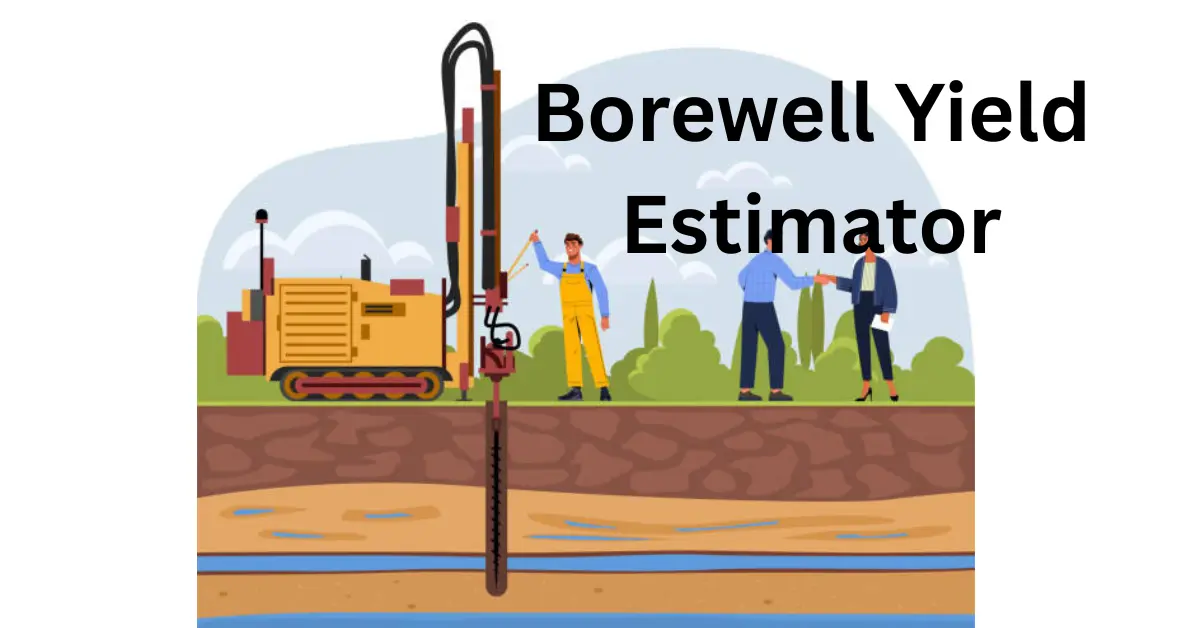
I built the Borewell Yield Estimator on moralinsights.com to answer that question.
It’s a four-tab tool that covers everything from estimating your borewell’s yield, to comparing your water supply against your crop’s demand, to analyzing how fast your aquifer recovers between pumping sessions.
You don’t need to be a hydrogeologist to use it. You just need a few measurements from your pump test or drilling report.
Let me walk you through the whole thing.
🌊 Borewell Yield Estimator
Estimate your borewell’s water yield (LPH / GPH), check if it meets your farm’s irrigation demand, calculate sustainable pumping hours, and assess aquifer recovery time. Supports metric and imperial units for global use.
Enter the results from your borewell drilling report or a field pump test to estimate actual water yield. If you don’t have a pump test, use the Drilling Log Method based on water-bearing zones encountered during drilling.
Compare your borewell’s water supply against your farm’s irrigation demand. Find out if your borewell is sufficient, how many hours to pump daily, and whether you need supplemental storage.
A recovery test measures how fast the water level rises after pumping stops. This helps estimate the aquifer recharge rate and safe sustainable yield — the amount you can pump without permanently depleting the aquifer.
Reference data for borewell planning, yield classification, and aquifer types.
Borewell Yield Classification
| Yield (LPH) | Yield (GPH) | Classification | Farm Suitability |
|---|---|---|---|
| < 500 | < 132 | Very Poor | Domestic use only |
| 500 – 2,000 | 132 – 528 | Poor | Small kitchen garden |
| 2,000 – 5,000 | 528 – 1,320 | Moderate | 0.5–1 acre drip irrigation |
| 5,000 – 10,000 | 1,320 – 2,642 | Good | 1–2 acres with drip |
| 10,000 – 20,000 | 2,642 – 5,283 | Very Good | 2–5 acres with drip |
| > 20,000 | > 5,283 | Excellent | 5+ acres, any system |
Typical Yield by Aquifer / Rock Type
| Rock / Aquifer Type | Typical Yield Range (LPH) | Depth Range | Notes |
|---|---|---|---|
| Hard Rock (Granite/Basalt) | 500 – 8,000 | 60–300 m | Yield depends on fractures. Variable. |
| Weathered / Saprolite Zone | 1,000 – 6,000 | 20–80 m | Often high yield but seasonal |
| Sand / Gravel Aquifer | 5,000 – 50,000+ | 10–100 m | Best yields. Consistent year-round. |
| Limestone / Karst | 2,000 – 30,000 | 30–200 m | High yield where cave systems exist |
| Alluvial / River Valley | 5,000 – 40,000 | 10–60 m | Excellent yields near rivers |
| Sandstone | 1,000 – 15,000 | 50–300 m | Good if well cemented |
| Shale / Clay | 200 – 2,000 | Varies | Poor yield, often poor quality |
Recovery Rate Classification
| Recovery in 60 min (%) | Classification | Recommended Rest Period |
|---|---|---|
| > 90% | Excellent Recharge | 1–2 hours |
| 70 – 90% | Good Recharge | 2–4 hours |
| 50 – 70% | Moderate Recharge | 4–6 hours |
| 30 – 50% | Slow Recharge | 6–12 hours |
| < 30% | Very Slow / Poor | 12–24 hours |
Standard Borewell Casing Sizes
| Use | Diameter (mm) | Diameter (inches) |
|---|---|---|
| Domestic / Small Farm | 100–115 mm | 4 – 4.5 inch |
| Medium Farm | 150 mm | 6 inch |
| Large Farm / Commercial | 200 mm | 8 inch |
| Municipal / Industrial | 250–300 mm | 10–12 inch |
Why Every Farmer Needs to Know Their Borewell Yield
Most farmers know their borewell depth. Very few know their borewell yield.
That’s a dangerous gap. Here’s why.
- You might be over-irrigating. If your pump delivers 9,000 litres per hour but your crop only needs 5,000 litres per day, you’re wasting water every single session. That depletes your aquifer faster than it can recover.
- You might be under-irrigating. If your crop needs 80,000 litres per day but your borewell can only supply 60,000 litres in 16 hours of pumping, your crops are silently stressed. Yield drops, fruit size shrinks, and quality suffers.
- You might damage your aquifer permanently. Pumping faster than the aquifer recharges is one of the leading causes of borewell failure. Once you deplete a hard rock fracture, it may not recover for years.
- You waste money on the wrong pump. Buying a 5 HP pump for a borewell that only yields 2,000 LPH is wasted investment. Knowing your yield helps you buy the right pump for your actual water supply.
According to the Food and Agriculture Organization of the United Nations (FAO), groundwater accounts for nearly 43 percent of all irrigation water used globally. Sustainable groundwater management starts with knowing what your borewell actually produces.
This tool gives you that knowledge. All four tabs work together to give you a complete picture of your groundwater situation.
What the Four Tabs Do
Tab 1: Yield Estimator
This tab calculates your borewell’s water yield in litres per hour.
You choose from three methods depending on what data you have.
It shows your yield in five unit formats simultaneously and classifies it from Very Poor to Excellent.
Tab 2: Demand vs Supply
This tab compares your borewell’s daily supply against your farm’s daily water need.
It tells you exactly how many hours to pump each day, suggests a pumping schedule, and checks whether your storage tank is adequate.
Tab 3: Recovery Test
This tab analyzes how fast your aquifer refills after pumping stops.
You enter water level readings at 15, 30, 60, and 120 minutes after the pump stops. The tool classifies your aquifer recharge quality and calculates your safe sustainable daily yield.
Tab 4: Reference Guide
A built-in reference library with yield classification standards, typical yields by rock and aquifer type, recovery rate classification, and standard casing sizes.
Keep this tab open while using the other three.
The Three Ways to Estimate Your Yield
Method 1: Pump Test (Most Accurate)
This is the gold standard. Run your pump for a set time, measure how much water comes out, and the math is simple.
Yield (LPH) = Total Litres Pumped divided by Test Duration in Hours.
If your pump ran for 60 minutes and delivered 9,000 litres, your yield is 9,000 LPH.
The more accurate your volume measurement, the more accurate your yield estimate. A flow meter is ideal. A calibrated tank also works well.
Method 2: Drawdown / Specific Capacity
This method uses specific capacity data from your driller’s report or a step test.
Specific capacity tells you how many litres per hour your borewell can deliver for every metre of drawdown. Multiply specific capacity by your available drawdown to get yield.
For example: specific capacity of 150 L/hr/m with 60 metres of available drawdown gives 9,000 LPH yield.
Method 3: Water Zone / Drilling Log
You don’t always have a pump test. Sometimes all you have is the driller’s report listing where water was struck.
This method uses rock type, zone thickness, and strike intensity to estimate yield.
Sand and gravel aquifers yield far more per zone metre than hard granite rock. The tool applies rock-type multipliers calibrated to typical hydrogeological data for each formation.
This method gives you an estimate, not a measurement. Use it for planning when you don’t have test data yet.
What Information Does the Calculator Need?
Tab 1 Inputs
- Borewell Depth: The total depth drilled, in metres or feet.
- Casing Diameter: The internal casing size in mm, inches, or cm. Supports 100 mm domestic to 300 mm industrial sizes.
- Static Water Level (SWL): The depth to water before the pump starts. This is your baseline resting water level.
- Pump Test Data: Test duration, total volume pumped, and dynamic water level during pumping.
- For Zone Method: Number of water-bearing zones, each zone’s depth and thickness, strike intensity (weak/moderate/strong/very strong), and rock type.
Tab 2 Inputs
- Borewell Yield: Your estimated LPH from Tab 1, or from your existing pump test data.
- Max Safe Pumping Hours: How many hours per day you can safely pump. 16 hours is the recommended default, allowing 8 hours of aquifer recovery overnight.
- Pump Efficiency: New pumps at 85 percent. Older pumps may be 65 percent. This accounts for mechanical losses.
- Storage Tank / Farm Pond: Your available on-farm storage in litres, cubic metres, or gallons.
- Daily Water Requirement: Your crop’s total daily water need. Use the ET Calculator or Irrigation and Fertigation Calculator on moralinsights.com to calculate this accurately.
- Irrigation System Type: Drip at 90 percent, sprinkler at 80 percent, furrow at 65 percent, flood at 55 percent. Your system’s efficiency affects how much water actually reaches the crop root zone.
Tab 3 Inputs
- Static Water Level before pumping.
- Dynamic Water Level at end of pumping.
- Total pumping duration and pumping rate.
- Water level readings at 15, 30, 60, and 120 minutes after the pump stops.
You take these readings with a water level meter or a simple weighted string with a marker. Many drillers will do this test for you and provide the data.
What Do Your Results Tell You?
Yield Results (Tab 1)
Your yield appears in five unit formats at once: LPH, LPM, m3/hr, GPH, and GPM.
You also see maximum daily yield at 24 hours of pumping, and recommended daily yield at 16 hours.
The yield classification tells you what your borewell can realistically support:
- Under 500 LPH: domestic use only.
- 500 to 2,000 LPH: small kitchen garden.
- 2,000 to 5,000 LPH: 0.5 to 1 acre under drip.
- 5,000 to 10,000 LPH: 1 to 2 acres with drip.
- 10,000 to 20,000 LPH: 2 to 5 acres.
- Above 20,000 LPH: 5 or more acres, any system.
Supply vs Demand Results (Tab 2)
You see your total daily supply and effective supply after pump efficiency losses.
The status clearly shows whether your borewell is Sufficient or Insufficient for your crop’s daily need.
The required pumping hours per day is the most actionable number here. It tells you exactly when to run your pump.
The storage assessment tells you how many days of water your tank or pond can hold. Less than one day is a risk. Two or more days gives you resilience during power cuts or pump downtime.
Recovery Test Results (Tab 3)
You see the percentage of drawdown recovered at each time interval after pumping stops.
The aquifer recharge class ranges from Excellent to Very Slow.
The estimated full recovery time is the key output. It tells you how long to rest between pumping sessions.
The sustainable daily yield is the most important number. It’s the volume you can pump every day without permanently depleting your aquifer.
What Makes This Tool Stand Out
Three Yield Methods in One Tool
Most borewell calculators online use only one method. This tool gives you three.
Use the Pump Test method if you have test data. Use Specific Capacity if you have a driller’s step test report. Use the Zone method if you only have a drilling log.
Whatever data you have, this tool works with it.
Yield Classification Built In
The tool doesn’t just give you a number. It tells you what that number means for your farm.
9,000 LPH looks like a big number. But is it enough for your 3-acre field? The classification and the Demand vs Supply tab answer that directly.
Aquifer Sustainability Check
The Recovery Test tab is something I built specifically because so many farmers pump beyond their aquifer’s capacity without realizing it.
Knowing your recovery rate tells you the maximum sustainable pumping intensity for your borewell. That knowledge protects your water source for years to come.
Storage Assessment
Your borewell yield and your crop’s water demand are only half the picture. Storage capacity changes everything.
A borewell that produces 6,000 LPH can support a much larger farm if you have a 100,000-litre storage pond. You pump overnight, fill the pond, and irrigate from the pond during the day.
Tab 2 calculates exactly how many days of demand your storage covers.
Global Units
Flow rates in LPH, LPM, m3/hr, GPH, and GPM. Depth in metres or feet. Volume in litres, gallons, or cubic metres. Area in acres, hectares, square metres, or Guntha.
The tool works for farmers in any country who measure things in any unit system.
Who Benefits Most from This Tool?
- Farmers Planning a New Borewell: Before you drill, use the Reference tab to understand what yields are typical for your rock type and depth. After drilling, use Tab 1 with your pump test data to confirm the actual yield.
- Farmers with Existing Borewells: If you’ve never done a formal pump test, this is the moment. A 30-minute pump test gives you data for Tab 1, and four water level readings after stopping give you the Recovery Test data for Tab 3.
- Farmers Experiencing Low Water: If your water level has been dropping season after season, Tab 3 tells you whether you’re pumping beyond your aquifer’s recovery rate.
- Farmers Planning Expansion: Thinking of doubling your crop area? Tab 2 tells you whether your current borewell can support the expanded demand, or whether you need a second borewell or a farm pond.
- Irrigation Engineers and Hydrogeologists: A quick desktop tool for preliminary yield estimation and sustainability checks before detailed site assessment.
- Agricultural Development Projects: NGOs and rural development programs working on irrigation infrastructure can use this tool to assess borewell potential and match it to community water demand.
Step-by-Step: How to Use the Borewell Yield Estimator
Here’s a complete example. Your borewell is 200 metres deep with a 150 mm casing. Static water level is 40 metres. You ran a pump test for 60 minutes and pumped 9,000 litres. The dynamic water level dropped to 70 metres during the test. Your farm is 2 acres under drip irrigation with a daily water demand of 80,000 litres. You have a 50,000-litre storage tank.
Step 1: Estimate Your Yield (Tab 1)
- Open the Borewell Yield Estimator on moralinsights.com.
- Stay on Tab 1.
- Select Pump Test Method.
- Enter Borewell Depth as 200 metres.
- Enter Diameter as 150 mm.
- Enter Static Water Level as 40 metres.
- Enter Test Duration as 60 minutes, Volume as 9,000 litres, DWL as 70 metres.
- Click Estimate Yield.
Result: Yield = 9,000 LPH. Drawdown = 30 metres. Classification: Good. At 16 hours pumping, daily yield = 144,000 litres.
Step 2: Check Supply vs Demand (Tab 2)
- Click Tab 2.
- Enter Yield as 9,000 LPH.
- Set Max Pumping Hours to 16.
- Set Pump Efficiency to 75%.
- Enter Storage as 50,000 litres.
- Enter Daily Demand as 80,000 litres.
- Select Drip Irrigation.
- Click Analyze Supply vs Demand.
Result: Effective daily supply = 9,000 x 16 x 0.75 = 108,000 litres. Demand = 80,000 litres. Status: Sufficient. Required pumping hours = 80,000 / (9,000 x 0.75) = 11.9 hours per day. Storage covers 50,000 / 80,000 = 0.6 days.
The tool will tell you to increase storage if possible and suggests a morning plus evening pumping schedule.
Step 3: Run a Recovery Test (Tab 3)
After your pump test, turn off the pump and record the water level every 15 minutes for at least one hour.
Say the readings are: 15 min at 65 m, 30 min at 55 m, 60 min at 48 m, 120 min at 43 m.
- Click Tab 3.
- Enter SWL as 40 m, DWL as 70 m.
- Enter pumping duration and pump rate.
- Enter the four water level readings.
- Click Analyze Recovery.
Result: Total drawdown = 30 m. Recovery at 60 min = 73%. Classification: Good Recharge. Recommended rest period: 2 to 4 hours between sessions. Full recovery estimated at approximately 110 minutes.
For global groundwater standards and borewell test methodology, refer to the FAO AQUASTAT groundwater resources portal and the United States Geological Survey (USGS) groundwater resources. For pump test analysis methodology, the National Ground Water Association (NGWA) provides internationally recognized well testing standards and guidelines.
Related Tools on MoralInsights.com
Use the Borewell Yield Estimator alongside these tools for complete water management planning:
- Water Storage Capacity Calculator — Calculate the exact capacity of your farm pond or storage tank to plan buffer storage for your borewell supply.
- Irrigation and Fertigation Calculator — Calculate your crop’s exact daily water requirement to use as the demand input in Tab 2.
- Evapotranspiration (ET) Calculator — Get a precise daily crop water demand figure based on your weather and crop data.
- Drip Irrigation Layout Calculator — Switching to drip irrigation can cut your water demand by 30 to 40 percent. Use this tool to design the layout before comparing against your borewell supply.
- Rainwater Harvesting Calculator — If your borewell yield is low, rainwater harvesting can supplement your supply. This calculator tells you how much you can collect.
- Irrigation Scheduling Calendar — Build your full-season irrigation schedule around your borewell’s sustainable daily yield.
- Crop Water Requirement Calculator — Calculate your crop’s seasonal water needs to check whether your borewell can support the full season before you plant.
Frequently Asked Questions
What is static water level and why does it matter?
Static water level is the depth to water in your borewell before any pumping starts. It’s your aquifer’s resting level.
It tells you how deep your pump needs to be installed. It also changes with the seasons. In summer and at the end of a dry spell, static water level drops. In the wet season, it rises.
Monitoring your static water level over time is one of the best ways to track whether your aquifer is being sustainably managed.
How do I measure the water level in my borewell?
The most common field method is a weighted string with a float or buzzer attached. When the float touches water, it signals. You measure the string length from the surface to get the depth.
Professional hydrogeologists use an electric water level meter, also called a dipper, which gives a precise reading in seconds.
For a rough estimate, lower a clean stone on a string and listen for the splash. Count the seconds and multiply by approximately 4.9 metres per second for a rough depth estimate.
What is aquifer recovery and why should I care?
When you pump water from a borewell, the water level drops. After you stop pumping, groundwater flows back in from the surrounding rock or soil and the level rises again. That process is called aquifer recovery.
If your aquifer recovers slowly, you must pump at a lower rate or leave longer rest periods between pumping sessions. Pumping faster than your aquifer recharges leads to progressive depletion of your water table.
The Recovery Test tab in this tool measures exactly how fast your aquifer recovers, and calculates the safe sustainable yield you can rely on long term.
My borewell yield is classified as Poor. What are my options?
A poor yield borewell below 2,000 LPH is not suitable for field crop irrigation on its own.
Your best options are to pump slowly into a large storage tank overnight and use that stored water for irrigation during the day. You can also explore rainwater harvesting to fill a farm pond as your primary source. In some cases, going deeper or drilling at a different location finds better fracture zones.
The Rainwater Harvesting Calculator on moralinsights.com can help you design a supplementary surface water collection system.
What is specific capacity and how do I find it?
Specific capacity is how much water your borewell delivers per metre of drawdown. It’s expressed in litres per hour per metre.
Your driller should provide this from a step test done after drilling. If they didn’t, a pump test with measured drawdown lets you calculate it yourself: divide your pumping rate in LPH by your drawdown in metres.
A specific capacity of 200 L/hr/m with 50 metres of available drawdown gives a theoretical yield of 10,000 LPH.
Conclusion
Your borewell is your farm’s lifeline. But it can only support your farm if you know what it can actually deliver.
The Borewell Yield Estimator on moralinsights.com gives you that knowledge. Tab 1 estimates your yield from the data you have. Tab 2 tells you whether that yield is enough for your farm and exactly how many hours to pump. Tab 3 tells you how fast your aquifer recovers so you can use your water sustainably for years.
And Tab 4 gives you the reference data to make sense of it all. Use it before you plant, use it when you expand, and use it every season to make sure your most important water source stays healthy and productive.
Disclaimer
The Borewell Yield Estimator on moralinsights.com provides water yield estimates and aquifer assessments based on standard hydrogeological principles, field test data, and empirical rock-type yield parameters. All results are approximate and intended for planning and advisory purposes only.
Actual borewell yield and aquifer performance vary significantly with local geology, seasonal groundwater fluctuations, well construction quality, pump installation depth, and regional aquifer characteristics. The Zone Method estimates are based on generalized rock-type yield ranges and should not be treated as equivalent to a formal pump test. Sustainable yield estimates from the Recovery Test are based on simplified linear recovery assumptions.
Always consult a licensed hydrogeologist or certified well driller for site-specific assessments before major investment decisions. Do not pump beyond the sustainable yield identified by the Recovery Test as this may cause permanent aquifer damage. The author and moralinsights.com accept no liability for water supply failures or investment losses arising from decisions made based on this tool.
About the Author
Lalita Sontakke is the founder of moralinsights.com, a global agriculture-focused platform offering 47+ free tools and calculators for farmers, irrigation engineers, agronomists, and agricultural professionals worldwide. Her mission is to make science-based farm management accessible to every farmer, free, practical, and available from any device, anywhere in the world.
Leave a Reply