Introduction
Most pesticide application errors happen before the spray even starts.
The wrong amount of water. Too much chemical per tank. Too little chemical per acre. Wrong nozzle for the job. And spraying into wind that carries everything away from the crop.
These are not careless mistakes. They’re planning mistakes. And they’re extremely common because most farmers have no practical way to calculate these numbers quickly before a spray operation.
How much total water do I need for 5 acres of grapes? How many tank refills will that require? How long will it take with my tractor boom sprayer? Should I use a flat fan or hollow cone nozzle? Is the wind speed safe to spray right now?
The Advanced Spray Calculator on moralinsights.com answers all of these questions in one calculation.
You enter your crop, field area, equipment type, tank size, boom width, spray speed, chemical dosage, and current weather conditions. The tool calculates total water needed, total chemical required, number of tank refills, field coverage rate, estimated spray time, recommended nozzle type, correct tank mix order, and a weather suitability check.
Plan the spray session before you fill the first tank. Get the numbers right before you open the chemical container.
Advanced Spray Planner (Water, Chemical, Speed, Nozzle & Weather)
Plan accurate spraying by considering crop type, equipment, tank size, speed, weather and dosage. The tool calculates total water, chemical, tank refills, coverage rate, time required, and gives smart recommendations.
1) Inputs
Why Spray Planning Is as Important as Crop Protection Chemistry
The chemistry of your pesticide or fungicide is only one part of the equation. The application is the other half.
According to the Food and Agriculture Organization of the United Nations (FAO) International Code of Conduct on Pesticide Management, incorrect application is one of the primary causes of pesticide treatment failure worldwide. This includes incorrect water volume, wrong nozzle selection, spraying in unsuitable weather, and incorrect chemical dosage per unit area.
Here’s what poor spray planning costs farmers:
- Under-dosing causes treatment failure. Too little chemical per litre of water, or too little water per acre, means the active ingredient doesn’t reach the crop canopy at the concentration needed to control the pest or disease. The spray session costs labour, fuel, and equipment time but achieves nothing. The pest or disease continues unchecked.
- Over-dosing causes crop damage and chemical waste. Too much chemical per litre causes phytotoxicity. Leaf burn, fruit damage, and reduced yield follow. Over-dosing also wastes expensive chemical and increases the environmental load in the field and surrounding water bodies.
- Wrong water volume reduces coverage. Tall orchard crops like grapes and pomegranates require significantly more water per acre than low field crops like wheat or rice to achieve adequate canopy penetration. Using the same water rate for both leaves the upper canopy of the orchard unprotected.
- Wrong nozzle causes drift and poor coverage. A hollow cone nozzle for herbicide application creates fine droplets that drift onto non-target plants. A flat fan nozzle for fungicide application in a dense orchard canopy doesn’t penetrate effectively. Nozzle selection is not a minor detail: it determines where the chemical actually goes.
- Spraying in wrong weather wastes everything. Spraying at wind speeds above 10 km/h causes drift that removes 20 to 40 percent of the applied material from the target crop. High temperatures and low humidity cause spray droplets to evaporate before they contact the leaf surface. These weather-related losses can be completely avoided with a simple pre-spray check.
Research published through the USDA Agricultural Research Service confirms that spray application efficiency and coverage uniformity are as important as pesticide chemistry in determining treatment outcome.
What the Advanced Spray Calculator Calculates
This is not a simple dosage calculator. It’s a complete spray session planner covering eight different outputs from a single set of inputs.
Total Water Required
The total litres of water needed for the entire spray session.
The calculation starts with your base water rate per acre, then adjusts it for crop height and equipment type. Tall orchard and vine crops get a 30 percent higher water rate than low field crops because the larger canopy volume requires more spray solution to achieve adequate coverage. Drone sprayers get a 40 percent lower water rate because drone application uses ultra-low-volume technology with smaller droplets and higher concentration.
Knowing the total water in advance tells you whether your water source is adequate for the job, how many water refill trips you’ll need for the sprayer, and whether you need to arrange water delivery to the field.
Total Chemical Required
Total chemical in millilitres or grams for the complete spray session.
Chemical required = total water x dosage per litre. This is the number you use to check whether you have enough chemical in stock before starting. Running out of chemical mid-way through a spray session is a common problem that leads to inconsistent field coverage, with the early part of the field sprayed at full rate and the remainder under-dosed or skipped.
Number of Tank Refills
Total water divided by tank size, rounded up to the next whole number.
Each tank refill is a stop. The operator must return to the water and chemical source, refill the tank, and remix the chemical. For large fields this can add significant time to the total operation. Knowing the number of refills in advance helps you plan field layout for the most efficient refill pattern.
Field Coverage Rate
The hectares per hour your equipment can cover at the entered speed and boom width.
Coverage rate (ha/hour) = spray speed (km/h) x boom width (metres) / 10.
A tractor with a 6-metre boom at 5 km/h covers 3 hectares per hour. The same job with a backpack sprayer with a 1.5-metre boom at 3 km/h covers only 0.45 hectares per hour. Understanding coverage rate is essential for planning spray session timing and labour allocation.
Estimated Time to Spray
Total field area divided by coverage rate. This is the actual spraying time, not including refills, setup, or travel to and from the field.
Add approximately 10 to 15 minutes per tank refill to your estimated spray time for a realistic total session duration. Knowing this in advance helps you decide whether to start the spray session in the morning to finish before midday heat or to schedule a two-day operation.
Recommended Nozzle Type
The tool recommends two nozzle types based on your spray purpose:
- Flat Fan Nozzle for Herbicides: Flat fan nozzles produce a uniform fan-shaped spray pattern that covers a wide strip with even distribution. They produce medium to large droplets that land on soil and low-growing weeds with minimal drift. Essential for herbicide applications where drift to adjacent crops would cause serious damage.
- Hollow Cone Nozzle for Insecticides and Fungicides: Hollow cone nozzles produce fine droplets that wrap around leaf surfaces, reaching the underside of leaves where many pests and fungal diseases establish. The rotational spray pattern gives better penetration into dense canopies. Essential for contact insecticides and protective fungicides that must cover all leaf surfaces.
Tank Mix Order
The correct sequence for adding chemicals to the spray tank: Water first, then wettable powders and water-dispersible granules, then granular formulations, then suspension concentrates and emulsifiable concentrates, then adjuvants and stickers last.
This sequence matters because adding concentrated liquids directly to each other before dilution can cause emulsion breakdown, chemical reaction, or precipitation. Always add to water in this order for stable, uniform spray solution.
Weather Suitability Check
Three possible outcomes based on your entered wind speed, humidity, and temperature:
- Go: Green signal when wind is below 10 km/h, humidity is 40 percent or above, and temperature is 35 degrees or below. Spray conditions are suitable.
- Caution: Orange warning when humidity is below 40 percent or temperature is above 35 degrees. Spray droplets may evaporate before contacting leaves. Consider rescheduling to early morning or evening.
- Stop: Red warning when wind speed exceeds 10 km/h. Do not spray. Drift will carry significant amounts of chemical off-target, wasting product and potentially damaging neighbouring crops or contaminating water bodies.
What Does the Calculator Ask You to Enter?
Crop Name and Type
Select from nine crop presets or choose Custom for any other crop. Each preset auto-fills the base water rate per acre and the crop height type:
- Grapes: 500 L per acre, tall crop type. High water rate because grapevine canopies are dense and multi-layered.
- Pomegranate and Apple: 450 L per acre, tall crop. Heavy-canopy orchards need high water volume for penetration.
- Cotton: 250 L per acre, low crop. Moderate water rate.
- Soybean, Rice, Maize, Vegetables: 200 L per acre, low crop. Standard rate for most agronomic crops.
- Wheat: 150 L per acre, low crop. Lowest water rate because wheat is a narrow-leaved crop with low canopy volume.
Field Area and Unit
Enter your field area in acres or hectares. The tool converts hectares to acres internally for the water calculation, and uses hectares for the coverage rate calculation.
Equipment Type
Three equipment options with different multipliers applied to the water rate:
- Backpack Sprayer: Standard multiplier (1.0x). Manual application at walking speed with a hand-held wand.
- Tractor-Mounted Boom Sprayer: 1.1x water rate multiplier. Tractor sprayers have wider coverage but may need slightly more water for good canopy penetration at higher speeds.
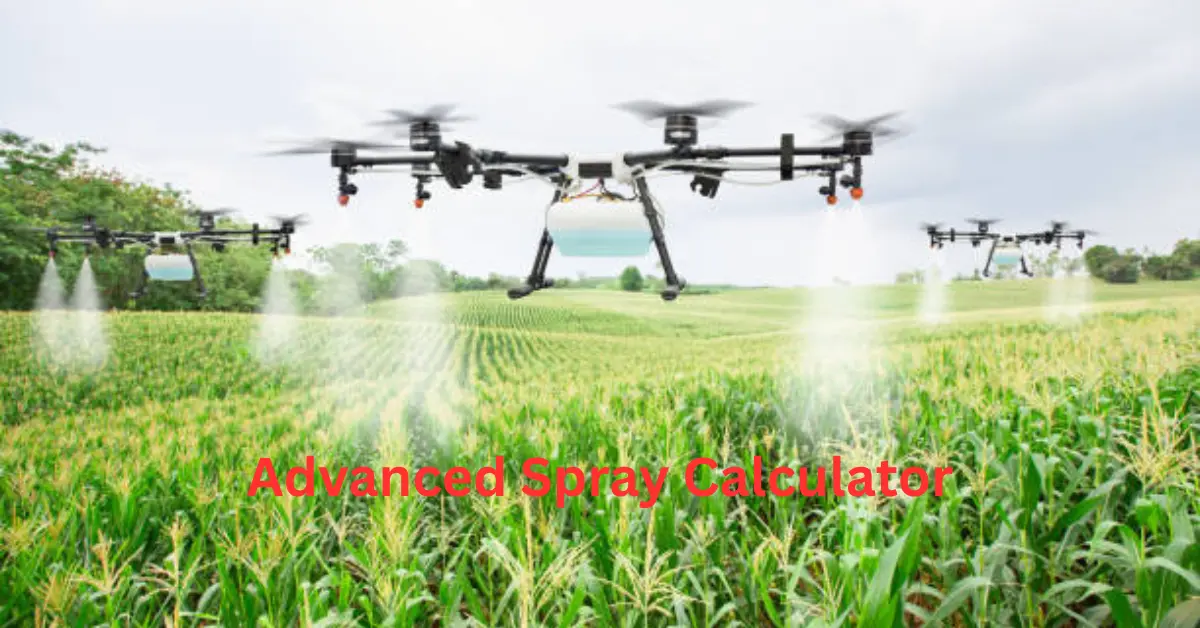
- Drone Sprayer: 0.6x water rate multiplier. Drone sprayers use ultra-low-volume application with concentrated spray and fine droplets from above. They apply significantly less water per area than ground-based equipment while achieving comparable coverage through droplet technology.
Tank Size, Boom Width, and Spray Speed
- Tank Size: Your sprayer tank capacity in litres. Used to calculate number of tank refills.
- Boom Width: The spray width covered in a single pass in metres. 1.5 m for a hand-held boom, 3 to 6 m for a tractor boom, 2 to 4 m for a drone.
- Spray Speed: Ground speed during spraying in km/h. Walking speed for backpack: 3 to 4 km/h. Tractor: 4 to 6 km/h. Drone: 3 to 5 km/h depending on crop.
Dosage, Base Water, and Spray Purpose
- Dosage (ml or g per litre): From the product label. This is the concentration of chemical per litre of spray solution.
- Base Water per Acre: Auto-filled from crop preset. Can be overridden for any specific situation or product label requirement.
- Spray Purpose: Insecticide/Fungicide or Herbicide. Determines the nozzle recommendation.
Weather Conditions
- Wind Speed (km/h): Current or forecast wind speed at field level. The safe spraying limit is 10 km/h.
- Humidity (%): Relative humidity. Below 40 percent increases droplet evaporation before leaf contact.
- Temperature (degrees Celsius): Above 35 degrees accelerates droplet evaporation and may cause phytotoxicity in heat-stressed crops.
What Makes This Calculator Practically Useful
Crop-Specific Water Rate Presets
The difference between the 150 L per acre wheat rate and the 500 L per acre grape rate is not arbitrary. It reflects the fundamentally different canopy architecture of a narrow-leaved cereal versus a dense multi-layered grapevine canopy.
Using a flat water rate for all crops is one of the most common spraying mistakes. The auto-fill presets remove the need for the farmer to know these rates by memory.
Equipment-Specific Adjustments
Drone spraying technology is fundamentally different from ground application. Drones apply spray from above at very low volumes with much finer atomization. Using the same water rate for drone and tractor application would mean the drone tank runs out far too quickly or the operator applies far more water than the drone technology is designed for.
The 0.6x multiplier for drone application reflects this real operational difference.
Coverage Rate and Time Calculation
Coverage rate is a practical planning number that most farmers have never calculated for their own equipment.
A backpack sprayer with 1.5-metre boom at 3 km/h covers 0.45 hectares per hour. At that rate, 5 hectares takes 11 hours of actual spraying time, which is more than one full working day. A tractor with 6-metre boom at 5 km/h covers 3 hectares per hour and completes the same job in 1.7 hours.
Knowing this number in advance shapes every decision about the spray operation: when to start, how many operators needed, whether to rent a tractor, and whether to split the job over two days.
Weather Check Built Into the Same Calculation
The weather check requires no separate step. You enter weather conditions alongside the operational inputs and the suitability check appears automatically with your results.
This integration is important because weather conditions change quickly. A spray plan made in the morning may need adjustment by mid-morning if wind picks up. Having the weather check and all operational numbers in the same result makes it easy to update the plan when conditions change.
Tank Mix Order Guidance
The tank mix order is information that most farmers either don’t know or forget under time pressure.
Adding a concentrated emulsifiable concentrate directly to another concentrated liquid in the tank without prior dilution in water is a common cause of spray mix incompatibility. The correct order prevents this. Including it in every result ensures it’s visible every time the calculator is used.
Who Benefits Most from This Calculator?
- Fruit and Orchard Farmers Managing Dense Canopy Crops: Grapes, pomegranates, mangoes, and apple orchards require significantly more water and more careful nozzle selection than field crops. The crop-specific presets give you the right starting water rate for each orchard crop without needing to look up extension recommendations separately.
- Farmers Switching from Backpack to Tractor Spraying: When upgrading equipment, coverage rate and time savings are often not calculated until after the purchase. Use this calculator before the decision to quantify exactly how much time per hectare the new equipment saves over the existing method.
- Drone Spraying Service Providers: Commercial drone spraying operators need to quote time and tank refill requirements accurately for pricing jobs. The coverage rate and tank refill calculation from this tool provides the basis for those quotes.
- Farmers Mixing Multiple Products in One Tank: The tank mix order guidance is particularly important for farmers applying combined products. Fungicide and insecticide combinations, or nutritional add-ins with protectants, require the correct addition sequence to avoid incompatibility.
- Agronomists and Crop Protection Advisors: A field planning tool for generating spray session specifications during farm visits. The printable result gives the farmer a clear operational plan to follow without needing to remember every detail.
- New Farmers Making Their First Spray Applications: The nozzle recommendation, tank mix order, and weather check provide guidance that experienced farmers know intuitively but that new farmers often have to learn through costly mistakes.
Step-by-Step: How to Use the Advanced Spray Calculator
Here’s a complete example. You have 3 acres of grapes with black rot appearing. You’re using a 200-litre tractor boom sprayer with a 4-metre boom at 4 km/h. You plan to apply a fungicide at 2 ml per litre. Current weather: wind 6 km/h, humidity 65 percent, temperature 27 degrees.
- Open the Advanced Spray Calculator on moralinsights.com.
- Select Grapes as Crop Name. Water auto-fills to 500 L per acre. Crop type auto-fills to Tall.
- Enter Area as 3, keep Acres.
- Select Tractor Mounted Sprayer as Equipment.
- Enter Tank Size as 200 litres.
- Enter Boom Width as 4 metres.
- Enter Spray Speed as 4 km/h.
- Enter Dosage as 2 ml per litre.
- Base water stays at 500 L per acre (auto-filled).
- Select Insecticide/Fungicide as Spray Purpose.
- Enter Wind 6, Humidity 65, Temperature 27.
- Click Calculate.
Here’s what the results show:
- Area = 3 acres.
- Adjusted water = 500 x 1.3 (tall crop) x 1.1 (tractor) = 715 L per acre.
- Total water = 3 x 715 = 2,145 L.
- Total chemical = 2,145 x 2 = 4,290 ml of fungicide.
- Tank refills = 2,145 / 200 = 10.7, rounded up to 11 tanks.
- Coverage rate = 4 x 4 / 10 = 1.6 ha per hour.
- Field area in ha = 3 x 0.4047 = 1.21 ha. Time = 1.21 / 1.6 = 0.76 hours = approximately 45 minutes of spraying time.
- Nozzle: Hollow Cone (correct for fungicide in grape canopy).
- Weather: Green. Wind 6 km/h is safe, humidity and temperature are acceptable.
Before you start: check you have at least 4,290 ml of fungicide in stock. Arrange 2,145 litres of water accessible to the field. Plan 11 tank refills. Expect approximately 45 minutes of spraying plus 10 to 15 minutes per refill for a total session of roughly 3.5 to 4 hours.
For guidance on pesticide application standards and nozzle selection for different spray types, the FAO International Code of Conduct on Pesticide Management and the USDA ARS Pesticide Application Technology program provide internationally recognized guidelines. For weather-based spray timing, the NASA POWER climate portal provides free hourly weather data for any farm location worldwide.
Related Tools on MoralInsights.com
Use the Advanced Spray Calculator alongside these tools for a complete crop protection and water management program:
- Foliar Spray Nutrient Dosage Calculator — When adding micronutrient foliar sprays to your spray tank, use this tool to calculate the correct nutrient dose and adjust for crop growth stage.
- Liquid Fertilizer Dilution Calculator — Calculate the correct dilution ratio for any liquid fertilizer added to your spray tank, including the tank-by-tank mixing table for multi-tank operations.
- Crops Micronutrient Deficiency Guide and Correction Calculator — Identify which micronutrient deficiency your crop is showing and get the correct foliar spray concentration to add to your spray session.
- Crop Risk Temperature Calculator — Check whether temperature conditions are safe for spraying before entering your weather data in this spray calculator.
- Irrigation Scheduling Calendar — Time your spray sessions relative to irrigation events. Spraying just before irrigation reduces spray effectiveness as rainfall washes off the chemical.
- Filtration System Size and Selection Calculator — Ensure your water source is properly filtered before use in a sprayer. Particles in spray water cause nozzle blockage and uneven coverage.
- Crop-wise Fertilizer Calculator — Plan your complete fertilizer program including the foliar top-dressing schedule that can be combined with your spray sessions.
Frequently Asked Questions
Why do tall orchard crops need more water per acre than field crops?
The canopy volume is dramatically different. A wheat crop has narrow leaves in a flat horizontal canopy less than 1 metre tall. A mature grapevine trained on a trellis has leaves on multiple levels from ground to 1.5 metres or more, with fruit hidden inside the canopy.
To coat all leaf surfaces with spray solution, including the inner canopy and the underside of leaves where diseases establish, the total volume of spray solution must be much higher in orchard crops. Under-watering in orchards leaves protected internal canopy completely untreated.
This is why the water rate for grapes (500 L per acre) is more than three times the water rate for wheat (150 L per acre) in this calculator.
What wind speed is safe for spraying?
The internationally accepted guideline from most pesticide product labels and regulatory agencies is a maximum of 10 km/h for ground-based spraying. The calculator flags wind above this threshold with a stop warning.
For drone spraying, many operators apply a lower maximum of 5 to 7 km/h because drones fly at lower heights where turbulence causes less predictable spray distribution and drift is more significant.
The safest time to spray for wind is early morning, typically 6 to 9 AM, when winds are calmest. This also avoids the high temperatures that develop later in the day.
What does the coverage rate number mean for planning my spray?
Coverage rate in hectares per hour tells you how fast your equipment works. It’s the most useful number for scheduling your spray day.
If your coverage rate is 1.5 ha per hour and you have 6 hectares to spray, you need approximately 4 hours of active spraying time. Add 15 minutes per tank refill and you can estimate the total working time for the day.
Coverage rate also helps you compare equipment options. If a tractor sprayer has 4 times the coverage rate of a backpack sprayer, the labour cost saving from renting the tractor may easily exceed the rental cost for large fields.
Can I add multiple chemicals to the same tank?
Yes, in many cases. Tank mixing is common practice for combining insecticide and fungicide in one pass to save labour and time. However, not all chemicals are compatible with each other.
Before tank mixing, check each product label for compatibility statements. Many labels specifically list which products can and cannot be mixed. If unsure, perform a jar test: mix small quantities of each product in a jar in the intended ratio. If the mixture separates, curdles, produces heat, or turns gel-like, the products are incompatible and must be applied separately.
Always follow the tank mix order in this calculator’s results: water first, then powders, then liquids. This sequence prevents incompatibility reactions that would render the spray mixture ineffective.
My backpack sprayer has no boom. How do I enter boom width?
For backpack sprayers used with a single hand-held nozzle and wand, estimate the effective spray width per pass. A single hollow cone or flat fan nozzle held at standard height covers approximately 0.5 to 1.0 metres per pass.
Enter 0.5 to 1.0 metres as your boom width for a single-nozzle hand application. The coverage rate will reflect how slow manual application actually is, which helps you appreciate the time investment required for large fields with a backpack sprayer.
For a hand-held boom bar with 2 or 3 nozzles, enter the total width of the boom bar. A typical 2-nozzle hand boom covers 1.0 to 1.2 metres.
Conclusion
A spray session that goes wrong is expensive on every dimension: wasted chemical, wasted labour, wasted fuel, and a field that’s still unprotected against the pest or disease you were trying to control.
The Advanced Spray Calculator on moralinsights.com puts all the planning numbers you need in one calculation before you open the chemical container. Total water, total chemical, tank refills, coverage rate, spray time, nozzle type, tank mix order, and a weather suitability check. Fill in your crop, field, equipment, and weather. Get the complete spray session plan. Then fill the tank with confidence.
Disclaimer
The Advanced Spray Calculator on moralinsights.com provides spray planning estimates based on standard agronomic formulas and general crop protection guidelines. Results are for planning purposes only. Actual water volumes required may vary with specific spray equipment calibration, nozzle type and size, application pressure, actual travel speed, crop growth stage, and local conditions. Chemical dosage calculations are based entirely on user-entered dosage rates and do not account for specific product formulations, label restrictions, or local regulatory requirements. Always read and follow the product label, which is the binding legal document for pesticide use. The weather suitability check uses simplified threshold values and does not replace local weather monitoring or professional spray advisory services. Nozzle recommendations are general guidance only and may not apply to all spray equipment configurations or specific product requirements. The author and moralinsights.com accept no liability for crop damage, spray drift incidents, or pesticide misuse arising from spray operations planned based on this calculator.
About the Author
Lalita Sontakke is the founder of moralinsights.com, a global agriculture-focused platform offering 47+ free tools and calculators for farmers, agronomists, and agricultural professionals worldwide. Her mission is to make precision farm management accessible to every farmer, free, practical, and available from any device, anywhere in the world.