Introduction
Overstocking a fish pond is one of the most common and most costly mistakes in aquaculture.
Too many fish competing for oxygen and food means slow growth, high mortality, poor water quality, and a harvest that disappoints. Understocking means you’re leaving money in the water. Your infrastructure, feed, and labour costs are the same, but your harvest biomass and revenue are a fraction of what they could be.
Getting stocking density right is the foundation of every profitable aquaculture operation.
But stocking density is not a single number. It depends on your species, your culture system, your pond or tank volume, your water quality, your survival rate, and your FCR.
Fisheries Stocking Density Calculator calculate the ideal fish stocking density for your pond, along with daily feed requirement, expected harvest weight, water quality parameters, and profit per season. Free fish farming calculator for catla, rohu, tilapia, pangasius, and 15+ species. Plan before you stock.
The Pro Aquaculture Planner: Fisheries Stocking Density Calculator on Precision Agriculture Calculators to put all of these variables together in one calculation.
You enter your pond dimensions, select your species and culture system, input your biology and economics, and add your current water quality readings. The tool calculates how many fish to stock, how much feed to order for the full cycle, your expected harvest biomass, revenue, profit, ROI, break-even biomass, a monthly production schedule, and a water quality check against species-specific optimal ranges.
It covers 13 species across 4 culture systems in both metric and imperial units.
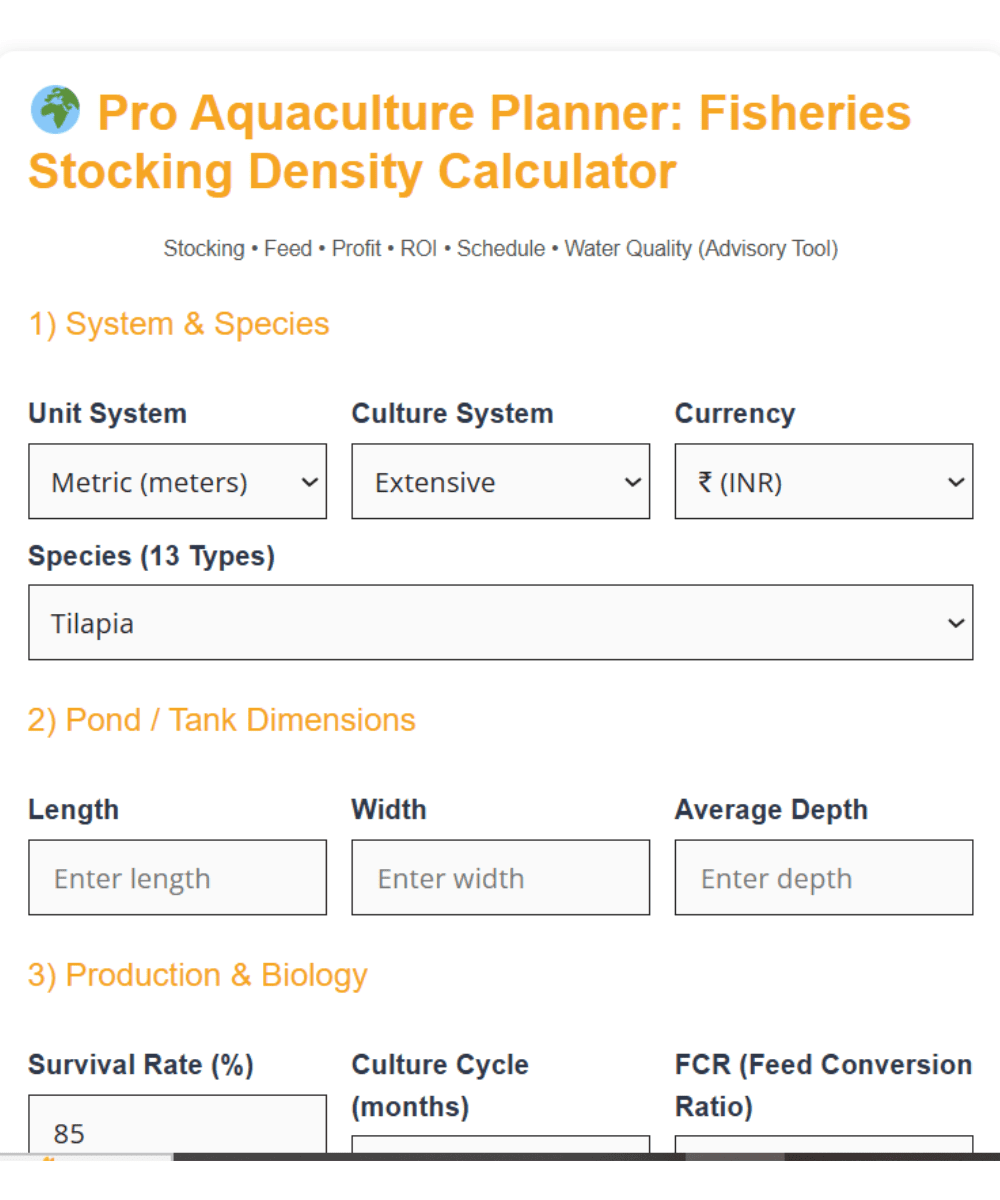
🌍 Pro Aquaculture Planner: Fisheries Stocking Density Calculator
Stocking • Feed • Profit • ROI • Schedule • Water Quality (Advisory Tool)
1) System & Species
2) Pond / Tank Dimensions
3) Production & Biology
4) Economics
5) Water Quality (Your Current Values)
Why Stocking Density Planning Matters So Much
Aquaculture is the fastest-growing food production sector in the world.
According to the Food and Agriculture Organization of the United Nations (FAO), aquaculture now provides more than half of all fish consumed globally, and global aquaculture production is continuing to grow. As wild fish catches plateau, the world’s growing demand for fish protein will increasingly depend on farmed fish.
But profitability in aquaculture is deeply sensitive to stocking density decisions. Here’s what goes wrong when stocking density is wrong:
- Overstocking causes oxygen depletion. Too many fish in a given water volume quickly consume dissolved oxygen. When DO drops below critical thresholds (below 4 mg/L for most species, below 5 mg/L for sensitive species like salmon and trout), fish stop feeding, become susceptible to disease, and begin dying.
- Overstocking creates ammonia toxicity. Fish excrete ammonia through their gills. In an overstocked pond, ammonia levels rise faster than natural or managed biological processes can neutralize it. Chronic ammonia stress causes liver damage, poor growth, and immune suppression.
- Overstocking worsens FCR. Feed conversion ratio deteriorates significantly in overcrowded conditions. Fish that are stressed, oxygen-deprived, or competing aggressively eat less efficiently. The same feed produces less biomass.
- Understocking wastes carrying capacity. A well-managed intensive pond can carry many times the biomass of an extensively managed one. Not knowing your pond’s potential carrying capacity for your species and culture system means leaving significant production and profit unrealized.
These principles are documented across fisheries science literature and in the FAO Fisheries and Aquaculture Technical Papers on sustainable aquaculture. The Fisheries Stocking Density Calculator on Precision Agriculture Calculators translates these principles into a practical pre-stocking plan for any farmer.
The 13 Species Covered and Their Default Parameters
Each species has a base stocking density (animals per cubic metre at semi-intensive management) and a typical harvest weight. These values come from widely published aquaculture extension guidelines.
Freshwater Species
- Tilapia: Base density 5 per m3. Harvest weight 0.8 kg. Temperature range 22 to 30 degrees Celsius. One of the most resilient and widely farmed fish globally. Tolerates a wide pH range.
- Common Carp: Base density 4 per m3. Harvest weight 1.2 kg. Temperature range 20 to 30 degrees Celsius. Widely farmed in Asia and Europe in pond polyculture systems.
- Catfish: Base density 6 per m3. Harvest weight 1.0 kg. Temperature range 24 to 32 degrees Celsius. Tolerates low dissolved oxygen better than most species.
- Trout: Base density 8 per m3. Harvest weight 0.6 kg. Temperature range 10 to 18 degrees Celsius. Requires minimum 6 mg/L dissolved oxygen. Cold-water species farmed in mountain streams and raceways.
- Rohu: Base density 4 per m3. Harvest weight 1.0 kg. One of the three major Indian major carps farmed extensively across South and Southeast Asia.
- Catla: Base density 3 per m3. Harvest weight 1.5 kg. Surface feeder. Most commonly farmed as part of composite carp culture with Rohu and Mrigal.
- Mrigal: Base density 4 per m3. Harvest weight 1.0 kg. Bottom feeder. Completes the vertical feeding zone utilization in Indian major carp polyculture systems.
- Pangasius: Base density 8 per m3. Harvest weight 1.2 kg. Highly productive and tolerant of crowding. Major export species in Vietnam and Southeast Asia.
Marine and Brackish Species
- Shrimp: Base density 20 per m3 (stocking counted by individual animals not by weight). Harvest weight approximately 30 grams. Temperature range 26 to 32 degrees Celsius. pH range 7.5 to 8.5.
- Salmon: Base density 7 per m3. Harvest weight 2.5 kg. Temperature range 8 to 15 degrees Celsius. Requires minimum 7 mg/L DO. Cold-water marine species.
- Seabass: Base density 6 per m3. Harvest weight 1.5 kg. Farmed in marine cages and brackish water ponds across Southeast Asia, the Mediterranean, and the Middle East.
- Grouper: Base density 5 per m3. Harvest weight 2.0 kg. High-value marine species farmed in cages in Southeast Asia and the Pacific.
- Crab: Base density 10 per m3. Harvest weight 0.5 kg. Farmed in mangrove ponds and brackish enclosures.
The Four Culture Systems and Their Density Multipliers
The culture system you use determines how much biomass your water body can sustainably support. The calculator applies a multiplier to the base stocking density for each culture system.
- Extensive (0.6x multiplier): Relies primarily on natural productivity of the water body (algae, plankton, natural feed organisms). Minimal supplementary feeding. Low stocking density, low input, low output per area unit. Common in traditional village pond farming and rice-fish culture.
- Semi-Intensive (1.0x multiplier): The baseline system. Supplementary feeding combined with natural productivity. Moderate stocking density. Most common system for smallholder and medium-scale farmers worldwide.
- Intensive (1.6x multiplier): Almost entirely dependent on formulated feed. Higher stocking density requires active aeration (paddlewheel aerators, diffusers) to maintain dissolved oxygen. Requires stronger water quality management.
- RAS or Biofloc (2.5x multiplier): Recirculating Aquaculture Systems or biofloc technology. Highest stocking densities achievable through continuous water treatment, biofiltration, and microbial management. High capital cost but maximum production per unit volume. Used in land-based indoor and greenhouse farms.
What Does the Calculator Ask You to Enter?
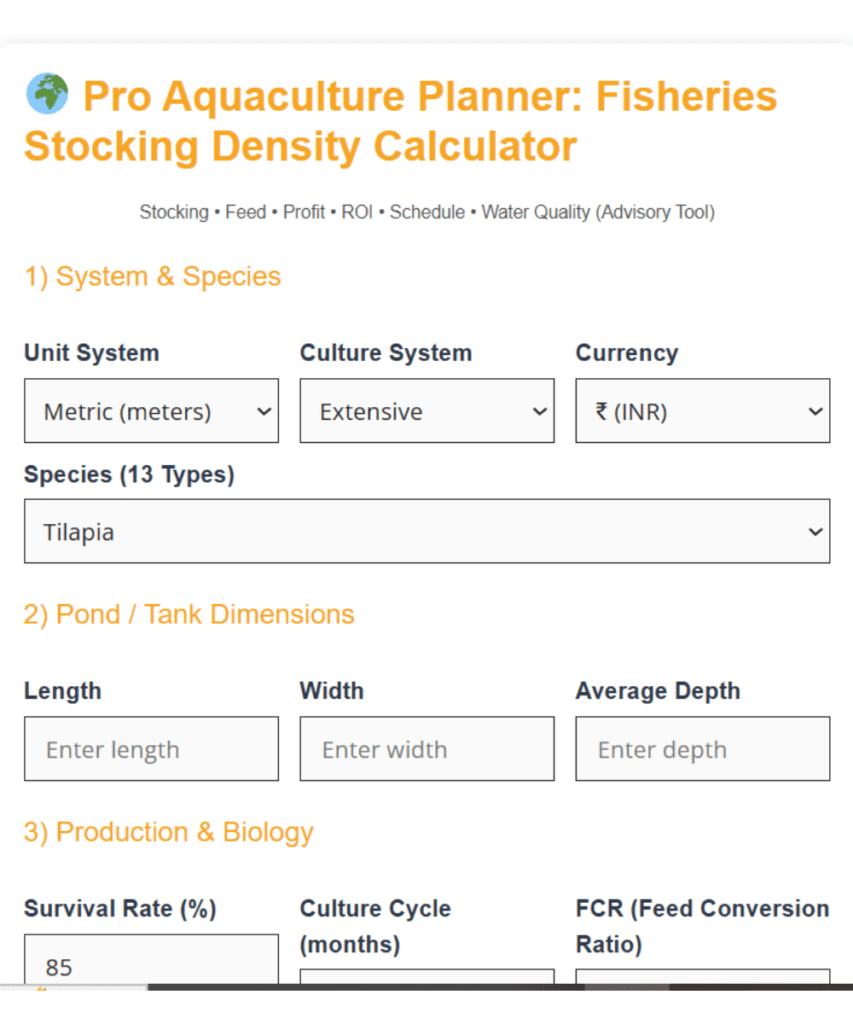
System and Species Setup
- Unit System: Metric (metres) or Imperial (feet). The calculator converts feet to metres internally for all calculations.
- Culture System: Extensive, semi-intensive, intensive, or RAS/biofloc.
- Currency: INR, USD, or EUR for all financial outputs.
- Species: Select from the 13 species listed above. Each selection loads the species-specific base density, harvest weight, and water quality parameter ranges.
Pond or Tank Dimensions
Length, width, and average depth. The calculator multiplies these to get pond volume in cubic metres. Pond volume is the fundamental input that determines how many fish can be stocked.
For irregular ponds, use average length, width, and depth. For circular tanks, enter diameter as length, and the same value as width (or use an equivalent rectangular area).
Production and Biology
- Survival Rate (%): Expected percentage of stocked fish that survive to harvest. Default 85 percent. Adjust based on your experience, species, and management capability. For beginners, 75 to 80 percent is realistic. For experienced intensive managers, 85 to 95 percent is achievable.
- Culture Cycle (months): Duration from stocking to harvest. Default 6 months. Varies by species, target market size, and season.
- FCR (Feed Conversion Ratio): Kilograms of feed required per kilogram of fish biomass produced. Default 1.5. High-quality feeds and well-managed intensive systems can achieve FCR of 1.2 to 1.4. Extensive systems with low-quality feed may have FCR of 2.0 to 2.5.
Economics
- Feed Cost per kg: Purchase price of your compound aquaculture feed per kilogram.
- Sale Price per kg: Farmgate or market price per kilogram of live or dressed fish at harvest.
- Other Costs: All non-feed costs for the full production cycle: seed (fingerlings or juveniles), labour, aeration electricity, medication, pond preparation, and depreciation. Enter the total for the full cycle.
Water Quality
Enter your current temperature, dissolved oxygen, and pH readings.
The tool compares these against the species-specific optimal ranges and flags any parameters that are out of range with a warning. Green means your water is suitable. Red means there’s a problem that needs attention before or during stocking.
What Do Your Results Show You?
Stocking and Harvest Summary
Water volume in cubic metres. Number of animals to stock. Expected harvest count after survival percentage. Target harvest biomass in kilograms. Total feed required for the full cycle calculated from harvest biomass and FCR.
These numbers are your operational plan. Stocking count determines your fingerling or juvenile purchase order. Total feed requirement determines your feed procurement for the full cycle. Harvest biomass is your production target.
Financial Summary
Revenue from harvest (harvest biomass x sale price). Feed cost (total feed x feed cost per kg). Other costs as entered. Total cost. Net profit. ROI percentage. And break-even biomass.
Break-even biomass is particularly useful. It tells you the minimum harvest you need to cover all your costs. If your expected harvest biomass is 1,800 kg and your break-even is 1,200 kg, you have a 600 kg buffer against survival rate shortfall.
If your expected harvest is only marginally above break-even, your operation has very little tolerance for unexpected mortality or feed price increases.
Monthly Production Schedule
A month-by-month table showing estimated cumulative biomass and feed input for each month of the production cycle.
The model uses a simplified linear growth assumption. Real fish growth is S-shaped (slow early, fast mid-cycle, slowing before harvest). The linear model gives a reasonable planning baseline for feed procurement and cash flow planning.
Use this table to plan monthly feed purchases and avoid storing too much feed at once. Aquaculture feed degrades in storage, especially in humid tropical conditions.
Water Quality Check
A green OK or red warning for each of the three parameters you entered.
Each species has different tolerance ranges. A temperature of 28 degrees Celsius is excellent for tilapia, adequate for catfish, and fatal for trout. The species-specific check catches these incompatibilities before they cause losses.
What Makes This Calculator Comprehensive
Culture System Multiplier
Most simple stocking calculators apply a flat density recommendation for a species without accounting for how management intensity changes the carrying capacity.
This tool applies a science-based multiplier for each culture system. An RAS or biofloc system can support more than four times the biomass per cubic metre compared to extensive management. Knowing this multiplier lets you plan the right stocking density for your actual system.
FCR-Based Feed Calculation
Feed requirement is calculated from harvest biomass and FCR rather than a flat per-fish daily rate. This is the correct approach used by commercial aquaculture operators.
FCR x target harvest biomass = total feed for the cycle. If your FCR is 1.5 and you plan to harvest 2,000 kg, you need 3,000 kg of feed for the full cycle. This is the number to use for your feed supplier order and cash flow planning.
Break-Even Biomass
This is one of the most practical financial outputs in the tool. It tells you the minimum harvest weight needed to cover all costs.
Every kilogram harvested above break-even is profit. Every kilogram below break-even is a loss. Knowing this number before you stock means you can make an informed decision about whether the risk-return profile of the planned operation is acceptable.
Species-Specific Water Quality Ranges
Each of the 13 species has its own temperature, dissolved oxygen, and pH requirements loaded into the tool. Shrimp require pH 7.5 to 8.5 and temperature 26 to 32 degrees. Trout require temperature 10 to 18 degrees and DO above 6 mg/L. Catfish tolerates lower DO (minimum 4 mg/L) than most species.
Checking your water against these ranges before stocking prevents the costly mistake of introducing fish into water that cannot support them.
Who Benefits Most from This Tool?
- New Fish Farmers Planning Their First Pond: Before digging the pond, use this tool to understand what stocking density, harvest volume, feed requirement, and financial return to expect. Many first-time fish farmers overstock significantly and lose their first batch to oxygen depletion or disease stress.
- Smallholder Pond Farmers in Asia and Africa: Tilapia, carp, catfish, rohu, catla, and mrigal are farmed by millions of smallholders across the developing world in ponds of 0.1 to 1 hectare. This tool is designed for exactly this scale. The species coverage, simple inputs, and financial outputs match the real decisions these farmers make.
- Commercial Shrimp and Marine Fish Farmers: Shrimp, seabass, grouper, and crab have specific marine or brackish water requirements. The species-specific water quality check helps these farmers verify their pond conditions before stocking each cycle.
- RAS and Biofloc Technology Operators: Indoor recirculating aquaculture systems operate at the highest stocking densities. The 2.5x culture factor for RAS/biofloc gives these operators a realistic starting point for their stocking plan.
- Agricultural Extension Workers and Fisheries Officers: A quick planning tool for use during farm advisory visits. Enter the farmer’s pond dimensions and species, and immediately show the expected production and financial outcomes.
- Agricultural Finance and Microfinance Officers: Loan officers assessing aquaculture project proposals can use this calculator to quickly validate stocking plans, feed requirements, and projected returns against the borrower’s claimed figures.
Step-by-Step: How to Use the Fisheries Stocking Density Calculator
Here’s a complete example. You have a semi-intensive tilapia pond measuring 20 metres x 10 metres x 1.5 metres deep. Survival rate 85 percent. 6-month cycle. FCR 1.5. Feed costs 0.50 per kg. Sale price 1.80 per kg. Other costs for the full cycle total 500 in local currency.
- Open the Pro Aquaculture Planner.
- Select Metric as unit system.
- Select Semi-Intensive as culture system.
- Select Tilapia as species.
- Enter Length 20, Width 10, Depth 1.5.
- Enter Survival Rate 85, Months 6, FCR 1.5.
- Enter Feed Cost 0.50, Sale Price 1.80, Other Costs 500.
- Enter your current temperature, DO, and pH readings.
- Click Calculate Plan.
Here’s what the results show:
- Water volume = 20 x 10 x 1.5 = 300 m3.
- Tilapia base density = 5 per m3. Semi-intensive multiplier = 1.0x. Stocking density = 5 per m3.
- Animals to stock = 300 x 5 = 1,500 tilapia fingerlings.
- Expected harvest = 1,500 x 0.85 = 1,275 fish.
- Harvest biomass = 1,275 x 0.8 kg = 1,020 kg.
- Total feed = 1,020 x 1.5 = 1,530 kg for the full 6-month cycle.
- Revenue = 1,020 x 1.80 = 1,836 in local currency.
- Feed cost = 1,530 x 0.50 = 765. Other costs = 500. Total costs = 1,265.
- Net profit = 1,836 minus 1,265 = 571 in local currency.
- ROI = 571 / 1,265 x 100 = 45.1 percent.
- Break-even biomass = 1,265 / 1.80 = 703 kg. You need to harvest at least 703 kg to cover costs.
If your current water is 28 degrees Celsius (within tilapia range), DO 5.5 mg/L (above the 5 mg/L minimum), and pH 7.2 (within 6.5 to 8.5 range), all three water quality checks show green OK.
For global aquaculture stocking guidelines, species-specific production data, and sustainable intensification standards, refer to the FAO Fisheries and Aquaculture Technical Papers and the FAO State of World Fisheries and Aquaculture (SOFIA) report. For species-specific water quality thresholds and feed formulation guidelines, the Network of Aquaculture Centres in Asia-Pacific (NACA) publishes comprehensive technical guides for all major Asian aquaculture species.
Related Tools
Use the Fisheries Stocking Density Calculator alongside these tools for a complete aquaculture and livestock farm plan:
- Water Storage Capacity Calculator — Calculate the water volume of your existing or planned pond before using that volume in the stocking calculator.
- Rainwater Harvesting Calculator — Plan your pond water supply and refilling strategy using seasonal rainfall data.
- Advanced Animal Housing Space Planner — For RAS and indoor aquaculture systems, plan your tank layout and space requirements alongside this stocking density calculator.
Frequently Asked Questions
What is FCR and what is a good value for my fish species?
FCR stands for Feed Conversion Ratio. It is the kilograms of feed required to produce one kilogram of fish biomass gain.
A lower FCR is better. An FCR of 1.2 means 1.2 kg of feed produces 1 kg of fish. An FCR of 2.5 means 2.5 kg of feed for the same result.
Typical FCR ranges by species: tilapia 1.2 to 1.8, catfish 1.5 to 2.0, salmon 1.0 to 1.3, shrimp 1.5 to 2.0, carp 1.5 to 2.5. Well-formulated high-protein feeds, correct feeding frequency, and good water quality all improve FCR.
Why is dissolved oxygen the most critical water quality parameter?
Fish cannot store oxygen. They extract it from water continuously through their gills. When DO drops, fish stop feeding first, then become stressed, then die. This happens surprisingly quickly in a densely stocked pond.
Most commercial fish species need DO above 5 mg/L. Sensitive species like trout and salmon need above 6 to 7 mg/L. DO below 3 mg/L causes rapid mass mortality in almost all species.
DO drops fastest at night and on overcast days when algae are not photosynthesizing. Early morning is when you are most likely to see a dangerous DO dip. Monitor DO at dawn, especially in intensively stocked ponds during hot weather.
How does polyculture (multiple species together) affect the stocking calculation?
This calculator plans for single-species stocking. For polyculture systems like Indian major carp (rohu, catla, mrigal together), run the calculation separately for each species and use the stocking numbers as proportional targets adding up to your total density target.
Traditional composite carp culture in India typically stocks catla at 20 percent, rohu at 40 percent, and mrigal at 40 percent of total stocking density. Each species occupies a different depth zone, allowing higher overall biomass than single-species culture.
My pond is irregularly shaped. How do I calculate volume?
For irregular ponds, measure the approximate average length, width, and depth using a measuring tape or GPS tool.
For a rough estimate, divide the pond into two or three roughly rectangular sections, calculate the volume of each, and add them together. Enter the resulting total volume as an equivalent rectangular pond.
Alternatively, measure the water surface area using GPS, multiply by average depth. Enter the surface area as length x width that gives you that product.
What survival rate should I use for my first fish crop?
For your first production cycle, use a conservative survival rate of 70 to 75 percent in your calculation. First-time fish farmers typically experience higher mortality due to handling stress during stocking, acclimatization issues, and learning curve mistakes in feeding and water quality management.
As you gain experience and improve your management, your actual survival rate will improve. Use your historical data to set the survival rate in subsequent cycles rather than relying on the default.
Conclusion
Profitable aquaculture starts with the right stocking plan. Too many fish and your water quality collapses. Too few and you leave production capacity unused. The Pro Aquaculture Planner on Precision Agriculture Calculators gives you the stocking number, the feed plan, the financial projection, and the water quality check all in one calculation before you commit a single fingerling.
It covers 13 species, 4 culture systems, both metric and imperial units, and gives you a month-by-month production schedule so you can plan feed procurement and cash flow across the full cycle. Use it before every new stocking cycle and build your aquaculture operation on a foundation of calculated decisions rather than guesswork.
Disclaimer
The Pro Aquaculture Planner: Fisheries Stocking Density Calculator on Precision Agriculture Calculators provides stocking, production, and financial estimates based on standard aquaculture parameters, species-specific base densities, and culture system multipliers.
Results are advisory estimates only and should not be relied upon as the sole basis for investment or production decisions. Actual performance depends on species genetics, feed quality, water management, disease control, local climate conditions, management skill, and market prices. Base stocking densities and harvest weights used in this calculator are representative averages and may differ significantly from your specific species strain, local conditions, or culture system design. FCR, survival rate, and growth rate are highly variable in practice.
Water quality parameter ranges are general species averages and local populations may have adapted to different conditions. Always consult a qualified fisheries expert or aquaculture extension officer before investing in aquaculture infrastructure or large-scale stocking. The author and Precision Agriculture Calculators accept no liability for financial losses or production failures arising from aquaculture decisions made based on this calculator.