Introduction
Most farmers irrigate when the soil looks dry or when a fixed schedule says it’s time.
Both approaches waste water. And more importantly, both can stress the crop.
Irrigating too early keeps the root zone constantly wet, discouraging deep root growth and creating conditions for root diseases. Irrigating too late causes water stress during critical growth stages that can permanently reduce yield.
The right approach is to irrigate based on how fast your crop actually uses water and how much water your soil can hold between irrigations.
Create a complete irrigation schedule for your crop with our free Irrigation scheduling calendar calculator. Enter crop type, soil type, field size, and sowing date to get a day-by-day watering plan with exact duration, interval, and water quantity per irrigation. Works for drip, sprinkler, and furrow systems
That’s the science behind irrigation scheduling. And we built the Irrigation Scheduling Calendar on Precision Agriculture Calculators to make it practical for any farmer with any crop on any soil.
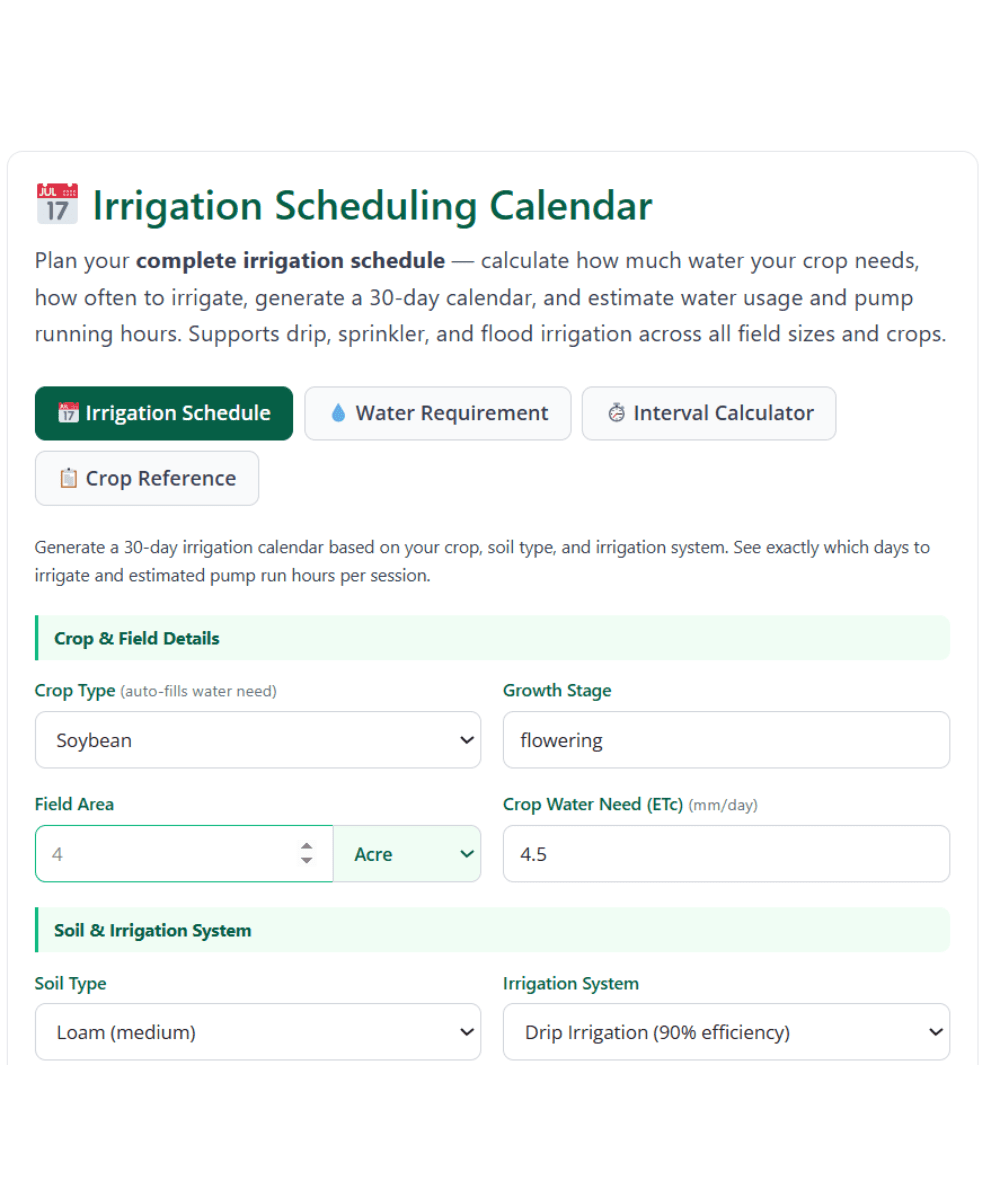
This is a four-tab tool. Tab 1 generates a complete 30-day irrigation calendar showing exactly which days to irrigate, how many litres to apply, and how long to run your pump. Tab 2 calculates your seasonal water budget. Tab 3 finds the optimal interval between irrigations. Tab 4 is a reference library of crop water requirements and soil data.
Print the calendar and post it at your pump house. Follow it every day. Watch your water bill drop and your crop performance improve.
Irrigation Schedule Report
Irrigation Scheduling Calendar
📅 Irrigation Scheduling Calendar
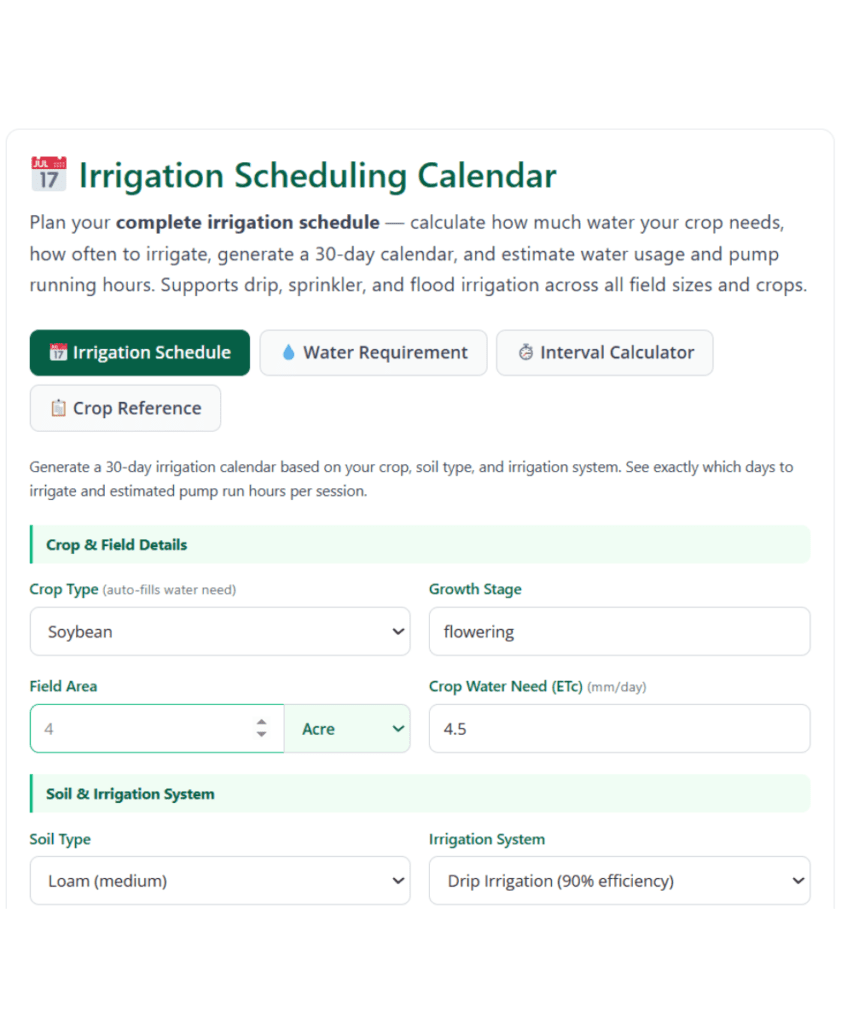
Plan your complete irrigation schedule — calculate how much water your crop needs, how often to irrigate, generate a 30-day calendar, and estimate water usage and pump running hours. Supports drip, sprinkler, and flood irrigation across all field sizes and crops.
Generate a 30-day irrigation calendar based on your crop, soil type, and irrigation system. See exactly which days to irrigate and estimated pump run hours per session.
Calculate seasonal and monthly irrigation water requirements for your crop and field. Includes rainfall credit and efficiency-adjusted gross water need.
Find the optimal irrigation interval for any crop-soil combination. Calculates the days between irrigations so you never over- or under-water your crop.
Crop water requirements, soil water holding capacity, and irrigation efficiency reference data.
Crop Water Requirements (ETc) — Peak Season
| Crop | ETc (mm/day) | Season (days) | Total (mm) | Irrigation |
|---|---|---|---|---|
| Tomato | 4.5–6.5 | 120–180 | 540–1170 | Drip preferred |
| Chili / Capsicum | 3.5–5.5 | 150–210 | 525–1155 | Drip / sprinkler |
| Onion | 3.0–5.0 | 120–150 | 360–750 | Drip / furrow |
| Potato | 4.0–6.0 | 90–120 | 360–720 | Sprinkler / furrow |
| Watermelon | 4.5–7.0 | 85–100 | 383–700 | Drip |
| Wheat | 4.0–6.0 | 120–150 | 480–900 | Furrow / flood |
| Maize / Corn | 4.5–6.5 | 95–120 | 428–780 | Furrow / sprinkler |
| Rice (Paddy) | 5.5–8.0 | 90–150 | 495–1200 | Flood / AWD |
| Cotton | 4.0–6.0 | 170–200 | 680–1200 | Furrow / drip |
| Sugarcane | 4.5–7.0 | 300–365 | 1350–2555 | Drip / furrow |
| Banana | 4.0–6.0 | 300–365 | 1200–2190 | Drip |
| Grape | 3.0–5.0 | 150–180 | 450–900 | Drip |
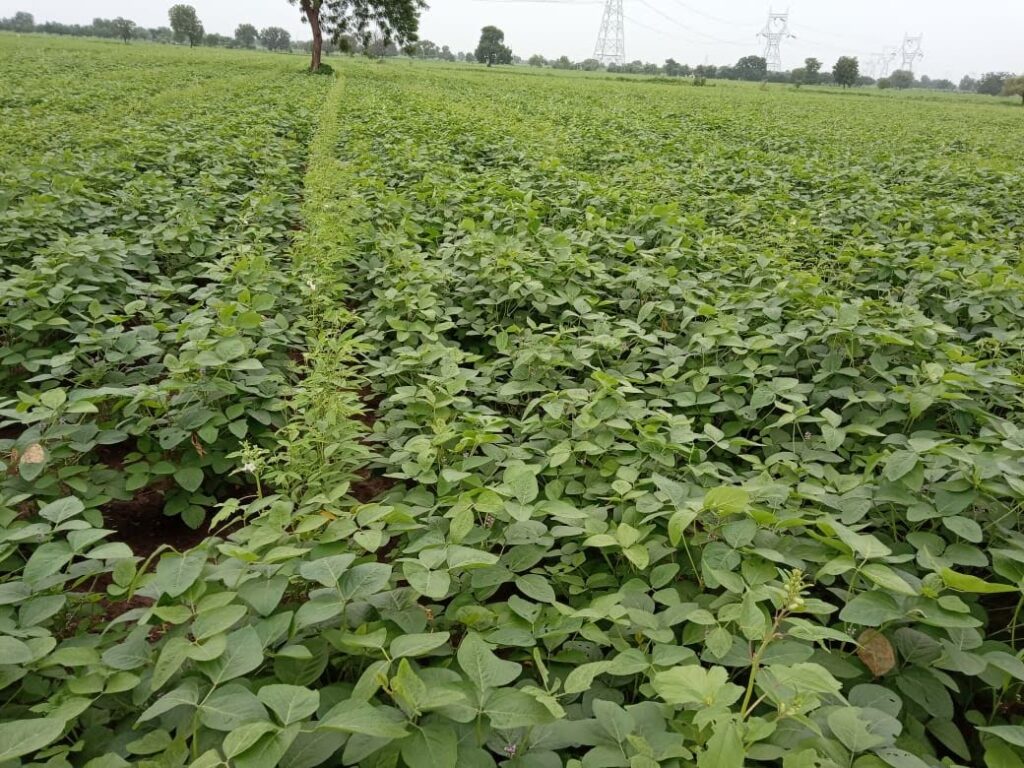
| Soybean | 3.5–5.5 | 90–120 | 315–660 | Furrow / sprinkler |
| Sunflower | 4.0–6.0 | 90–110 | 360–660 | Furrow / drip |
Soil Water Holding Capacity
| Soil Type | AWC (mm/m) | MAD (%) | RAW (mm/m) | Irrigation Interval Guide |
|---|---|---|---|---|
| Sandy | 50–70 | 40% | 20–28 | Every 1–2 days |
| Sandy Loam | 80–100 | 40–45% | 32–45 | Every 2–3 days |
| Loam | 110–150 | 50% | 55–75 | Every 3–5 days |
| Clay Loam | 140–180 | 50–55% | 70–99 | Every 5–7 days |
| Clay | 180–220 | 55–60% | 99–132 | Every 7–10 days |
Irrigation System Efficiency & Application Rates
| System | Efficiency | Application Rate | Best For |
|---|---|---|---|
| Drip Irrigation | 85–95% | 1–4 L/hr/emitter | Vegetables, fruits, row crops |
| Micro Sprinkler | 80–90% | 20–150 L/hr | Orchards, wide-spaced crops |
| Sprinkler (overhead) | 70–80% | 4–12 mm/hr | Field crops, lawns |
| Furrow Irrigation | 50–65% | Variable | Row crops, field crops |
| Flood / Basin | 40–55% | Variable | Rice, orchards, pasture |
| Subsurface Drip | 90–98% | 0.5–2 L/hr/emitter | Row crops, high-value crops |
Irrigation Timing Best Practices
| Practice | Recommendation |
|---|---|
| Best time to irrigate | Early morning (5–8 AM) or evening — reduces evaporation by 20–30% |
| Avoid midday irrigation | Evaporation losses up to 40% in summer midday heat |
| Drip start/stop rule | Start 15 min after irrigation begins; stop 15 min before end |
| Frequency for sandy soil | Daily or alternate days — low water holding capacity |
| Deficit irrigation | 70–80% ETc replacement acceptable for many field crops |
| Critical growth stages | Never stress: germination, flowering, fruit set, grain fill |
Why Irrigation Scheduling Matters More Than Most Farmers Think
Water is becoming the most critical constraint in agriculture worldwide.
According to the Food and Agriculture Organization of the United Nations (FAO), agriculture accounts for approximately 70 percent of all freshwater withdrawals globally. In many countries, that figure is above 80 percent. And a large fraction of that water is wasted through over-irrigation and inefficient scheduling.
Here’s what poor irrigation scheduling costs you:
- Water waste from over-irrigation. Flood and furrow irrigation systems without proper scheduling typically apply 40 to 60 percent more water than the crop actually needs. That excess water leaches nutrients below the root zone, waterlogging the soil and reducing oxygen availability for roots.
- Yield loss from under-irrigation at the wrong time. Missing an irrigation during flowering, fruit set, or grain fill causes irreversible yield loss. A single missed irrigation at the wrong stage can reduce tomato yield by 15 to 25 percent.
- Pumping costs for unnecessary irrigations. Every unnecessary irrigation run costs fuel or electricity. A farmer running a pump for 3 extra hours per week across a 120-day season wastes 360 pump-hours of energy.
- Soil structure damage from waterlogging. Frequent over-irrigation compacts the soil and reduces aeration. Beneficial soil microbes decline. Root depth decreases. The crop becomes increasingly dependent on surface water rather than developing a deep, drought-tolerant root system.
Research published through the USDA Agricultural Research Service (ARS) consistently shows that properly scheduled irrigation reduces water use by 20 to 40 percent compared to traditional fixed-schedule or appearance-based methods, with equal or better crop yields.
The Irrigation Scheduling Calendar on Precision Agriculture Calculators puts that science into a practical daily plan you can follow without any special equipment.
The Science Behind the Calendar: ETc, RAW, and Irrigation Interval
Three numbers drive the entire irrigation scheduling calculation.
ETc: Crop Evapotranspiration
ETc is the rate at which your crop uses water, measured in millimetres per day. It combines evaporation from the soil surface and transpiration from the crop leaves.
A tomato crop at peak vegetative growth in warm weather uses about 5.5 mm of water per day. Rice in its heading stage uses 6 to 8 mm per day. Grapes in berry development use about 3.5 mm per day.
ETc is the daily demand your crop makes on soil water. Your irrigation system must keep pace with this demand without falling too far behind or supplying too far ahead.
AWC: Available Water Capacity
AWC is how much plant-available water your soil can hold per metre of depth, measured in millimetres. Sandy soils hold 50 to 70 mm per metre. Loam soils hold 110 to 150 mm per metre. Heavy clay soils hold 180 to 220 mm per metre.
Multiplied by your crop’s root depth, AWC gives you the total water storage in the root zone. A crop with 0.5 metre roots on loam soil has about 65 mm of stored water available.
MAD: Management Allowed Depletion
MAD is the fraction of available water you allow the soil to deplete before irrigating. Irrigating at 50 percent MAD means you water when half the stored water has been used.
Irrigating too early (low MAD like 30 percent) wastes water and keeps the root zone constantly wet. Waiting too long (high MAD like 70 percent) risks crop water stress.
For most vegetable crops, 40 to 50 percent MAD is the right target. Field crops and deep-rooted trees can tolerate 50 to 60 percent MAD.
The Interval Formula
Readily Available Water (RAW) = AWC x Root Depth x MAD fraction.
Irrigation Interval (days) = RAW divided by daily ETc.
This is the core formula behind the tool. On a loam soil with 0.5 metre roots (RAW = 65 mm) and a tomato crop using 5.5 mm per day, the interval is 65 / 5.5 = approximately 12 days.
On sandy soil (RAW = 30 mm) with the same crop, the interval drops to 30 / 5.5 = approximately 5 days. Same crop, very different schedule, because the soil is different.
What the Four Tabs Cover
Tab 1: Irrigation Schedule with 30-Day Calendar
This is the most practical tab. It generates a complete 30-day calendar with every irrigation day marked in blue and every rest day shown clearly.
You see pump run hours per session, water volume per irrigation event, total water for the full schedule period, and the gross depth to apply each time accounting for your irrigation system’s efficiency.
Print this calendar and tape it to the wall at your pump house. Your pump operator follows it without needing to do any calculation.
Tab 2: Seasonal Water Requirement
Use this tab to plan your total water budget before the season starts.
Enter your crop, field area, peak ETc, season duration, monthly rainfall, and system efficiency. The tool calculates daily, weekly, monthly, and seasonal water volumes, plus water per hectare and per acre.
This number tells you whether your water source (borewell, canal, tank) can supply enough water for the full season. If the seasonal volume exceeds your available supply, you can adjust now by switching to a more efficient irrigation system or choosing a less water-demanding crop.
Tab 3: Interval Calculator
A focused calculation for finding the right interval between irrigations based on your specific crop-soil combination.
Enter ETc, soil type, AWC, MAD, root depth, and effective daily rainfall. The tool calculates the optimal interval in days, irrigation depth per event, weekly irrigation frequency, and a stress risk rating.
This tab is useful when you want to verify a schedule, compare interval options, or quickly check what interval a new crop on your soil should have.
Tab 4: Crop Reference
A built-in reference library covering 14 common crops with their ETc ranges, season lengths, and recommended irrigation systems.
Also includes a soil water holding capacity table with MAD values and interval guides, an irrigation system efficiency and application rate table, and a best practices guide for irrigation timing.
What Does the Calculator Ask You to Enter?
Tab 1 Key Inputs
- Crop Type: 20 crops available with auto-fill of ETc and growth stage. Or enter custom values for any crop.
- Field Area: Acres, hectares, square metres, or Guntha.
- Crop Water Need (ETc): Auto-filled from crop selection or entered manually in mm per day. For best accuracy, get your local reference ETo from a weather station and multiply by the crop’s Kc coefficient.
- Soil Type: Sandy, Sandy Loam, Loam, Clay Loam, or Clay. Auto-fills AWC and MAD values for each type.
- Irrigation System: Six options from subsurface drip (95 percent efficiency) to flood irrigation (45 percent efficiency). Efficiency determines the gross depth calculation.
- System Flow Rate: Your pump or system discharge in LPH, LPM, m3/hour, or GPM. Used to calculate pump run hours per irrigation event.
- Root Depth: Metres, centimetres, or feet. This combines with AWC to calculate the water storage in your crop’s root zone.
- MAD Percentage: Management Allowed Depletion. Default 50 percent for most crops. Auto-filled when you select soil type.
- Start Date and Schedule Duration: The calendar starts from your chosen date. Duration options are 14, 21, 30, or 60 days.
Tab 2 Key Inputs
- Crop Duration: Total season length in days. Auto-filled for selected crops.
- Effective Rainfall: Monthly rainfall in mm. The tool applies a 75 percent effectiveness factor and credits the equivalent daily rainfall against your ETc.
- System Efficiency: Percentage. Determines gross water requirement from net crop demand.
Tab 3 Key Inputs
All the same soil and crop parameters as Tab 1, but focused purely on the interval calculation without the calendar or volume outputs.
Useful for a quick interval check when planning or comparing options.
What Do Your Results Show You?
Tab 1: The Schedule Summary
Six headline results appear before the calendar.
Net irrigation depth is the millimetres of water your soil needs per event at your MAD threshold. Gross depth adds the efficiency correction. If your drip system is 90 percent efficient, you need to apply more water at the head than actually reaches the root zone.
Irrigation interval is displayed prominently: every 3 days, every 7 days, every 12 days. This is the central number around which the calendar is built.
Water volume per event in cubic metres and litres tells you exactly how much water you’re applying each time. Pump run hours per event tells your pump operator how long to run the system.
Total irrigation events and total water for the full period give you the complete schedule summary.
The 30-Day Calendar
This is the standout feature of the tool.
A grid laid out in days of the week, with each date shown. Blue tiles marked with a water droplet symbol show irrigation days. Grey tiles show rest days.
The calendar is immediately printable. One click on the Print or Save Schedule button opens a print-ready modal with the full calendar, all key parameters, and your pump run time.
Post it at the pump house. Your team follows it exactly.
Tab 2: Seasonal Water Budget
Daily, weekly, monthly, and seasonal water volumes all shown. Plus water per hectare and water per acre.
The seasonal total in cubic metres is the most important number for water source planning. Compare it to your borewell yield, tank capacity, or canal allocation to verify you have enough supply for the full season.
Tab 3: Interval and Stress Risk
The interval result with a stress risk rating. Green means the soil buffer is comfortable and stress is unlikely. Yellow means moderate risk and you should check soil moisture every other day. Red means daily irrigation is needed and every missed day risks stress.
What Makes This Calculator Stand Out
Soil-Type-Specific AWC and MAD Auto-Fill
Most irrigation calculators ask you to enter AWC as a raw number without guidance. This tool auto-fills the AWC and MAD when you select your soil type.
Sandy soil auto-fills AWC 60 mm/m and MAD 40 percent. Loam fills AWC 130 mm/m and MAD 50 percent. Clay fills AWC 200 mm/m and MAD 60 percent.
You can override these defaults if you have measured soil data. But for most farmers without a detailed soil physical analysis, the auto-filled values give a solid starting point.
Efficiency-Adjusted Gross Depth
The net irrigation depth is what the crop needs. The gross depth is what you actually have to apply accounting for the fact that no irrigation system delivers 100 percent of its water to the root zone.
Flood irrigation at 45 percent efficiency needs more than twice the gross water application compared to subsurface drip at 95 percent efficiency for the same net crop requirement.
This distinction is critical for pump run hour calculations and for understanding the true water cost of your irrigation system choice.
Pump Run Hour Calculation
Enter your pump or system flow rate and the tool tells you exactly how long to run the pump each irrigation day.
This is the number your pump operator needs. Not millimetres. Not cubic metres. Just hours and minutes.
Printable Calendar with One Click
The print modal generates a clean, formatted report with the irrigation calendar, all key parameters in a summary strip, and your practical tip, all ready to print as PDF or paper.
Print it at the start of the season. Replace it with a new calculation if your crop stage or weather changes significantly.
Effective Rainfall Credit
Tab 2 and Tab 3 both accept rainfall input and credit it against the daily ETc demand. If your crop needs 5 mm per day and you receive 2 mm per day effective rainfall, the net irrigation demand is only 3 mm per day.
This can substantially extend the irrigation interval during the rainy season and reduce your total seasonal water requirement.
Who Benefits Most from This Tool?
- Drip and Sprinkler Irrigation Farmers: Pressurized systems deliver precise amounts of water. Scheduling precision is essential to get the most from your infrastructure investment. Tab 1 gives you the exact pump run time for every irrigation session.
- Farmers Paying for Water by Volume: Canal allocations, tanker deliveries, and metered borewell supplies all cost money per cubic metre. Tab 2’s seasonal water budget helps you plan your purchase or allocation before the season starts.
- High-Value Vegetable and Fruit Farmers: Tomato, capsicum, onion, watermelon, strawberry, and grape all have critical water-sensitive growth stages where incorrect scheduling causes significant yield and quality loss. This tool ensures those stages never get missed.
- New Farmers Setting Up Irrigation Systems: Before installing a pump or drip system, use Tab 2 to calculate the seasonal water volume you need and Tab 3 to understand what interval your soil and crop combination requires.
- Farm Managers and Pump Operators: The printable 30-day calendar with pump run hours is designed for pump operators who need clear daily instructions without having to understand the calculation behind them.
- Agronomists and Agricultural Extension Workers: A professional irrigation planning tool for generating crop-specific schedules during farm advisory visits.
Step-by-Step: How to Use All Three Calculation Tabs
Tab 1 Example: 30-Day Calendar for 2-Acre Tomato Field
You have a 2-acre tomato field on loam soil with a drip system flowing at 9,000 LPH. Your crop is in the vegetative stage. You want a 30-day schedule starting today.
- Open the Irrigation Scheduling Calendar.
- Stay on Tab 1.
- Select Tomato from the crop dropdown.
- ETc auto-fills to 5.5 mm/day. Stage auto-fills to Vegetative.
- Enter Field Area as 2, select Acre.
- Select Loam as Soil Type. AWC auto-fills 130, MAD auto-fills 50.
- Select Drip Irrigation (90% efficient).
- Enter Flow Rate as 9000 LPH.
- Root Depth auto-defaults to 0.5 m. MAD is 50%.
- Set Start Date to today. Duration 30 days.
- Click Generate Irrigation Schedule.
Results: RAW = 130 x 0.5 x 0.50 = 32.5 mm. Interval = 32.5 / 5.5 = 5 days. Gross depth per event = 32.5 / 0.90 = 36.1 mm. Field area = 2 acres = 8,094 m2. Volume per event = 0.0361 x 8,094 = 292 m3 = 292,000 litres. Pump run hours = 292,000 / 9,000 = approximately 32.4 hours per irrigation event.
The 30-day calendar marks days 1, 6, 11, 16, 21, 26, and 31 as irrigation days. Click Print to get the calendar ready to post at the pump house.
Tab 2 Example: Seasonal Water Budget for 1-Hectare Wheat
You’re planning a wheat crop on 1 hectare. Season is 130 days. Average monthly rainfall is 40 mm. You use furrow irrigation at 55 percent efficiency.
- Click Tab 2.
- Select Wheat. ETc auto-fills 5.0, days auto-fill 130.
- Enter Field Area as 1 hectare.
- Enter Effective Rainfall as 40 mm per month.
- Enter System Efficiency as 55%.
- Click Calculate Water Requirement.
Results: Rainfall credit = 40/30 = 1.33 mm/day. Net daily need = 5.0 minus 1.33 = 3.67 mm/day. Gross daily = 3.67 / 0.55 = 6.67 mm/day. Daily volume = 0.00667 x 10,000 = 66.7 m3/day. Seasonal total = 66.7 x 130 = 8,671 m3.
That tells you that your borewell or canal allocation needs to supply at least 8,671 cubic metres across the wheat season. If your source can only supply 6,000 cubic metres, you have a deficit and need to plan accordingly.
Tab 3 Example: Quick Interval Check for Onion on Sandy Loam
You’re growing onion on sandy loam soil. ETc is 4 mm/day. Root depth 0.3 m. No significant rainfall.
- Click Tab 3.
- Enter Daily ETc as 4.
- Select Sandy Loam. AWC auto-fills 90, MAD auto-fills 40%.
- Enter Root Depth as 0.3 metres.
- Enter Effective Rainfall as 0.
- Click Calculate Irrigation Interval.
Results: Storage = 90 x 0.3 = 27 mm. RAW = 27 x 0.40 = 10.8 mm. Net depletion = 4 mm/day. Interval = 10.8 / 4 = 2 days. Depth per event = 4 x 2 = 8 mm. Frequency = 3.5 times per week.
Stress risk: Moderate. The shallow root zone on sandy soil means onion needs irrigation every 2 days. Any gap of 3 or more days risks yield loss.
For global standards on irrigation scheduling, ETc calculation, and crop coefficient data, the FAO Irrigation and Drainage Paper 56 (Penman-Monteith method) is the definitive international reference. Local ETc data can be obtained from the NASA POWER climate data portal which provides free daily ETo estimates for any location worldwide.
Related Tools
Use the Irrigation Scheduling Calendar alongside these tools for a complete water management system:
- Evapotranspiration (ET) Calculator — Calculate your reference ETo using Penman-Monteith or Hargreaves method, then use the Kc value for your crop to get a precise ETc for this scheduling calculator.
- Rainwater Harvesting Calculator — Know how much rainwater you can collect and store to supplement irrigation supply during the dry season.
- Mulching Sheet Calculator — Mulching reduces ETc by 20 to 30 percent by cutting surface evaporation. Calculate your mulch requirement and use the reduced ETc in this scheduling tool.
- Soil Moisture Depletion Calculator — Monitor how fast your soil moisture is depleting between irrigations to verify and refine the schedule generated by this tool.
Frequently Asked Questions
What is ETc and how do I find the right value for my crop?
ETc (Crop Evapotranspiration) is how much water your crop uses per day. It equals ETo (reference evapotranspiration from weather data) multiplied by Kc (the crop coefficient for the current growth stage).
The simplest way to get a good ETc is to check the crop reference table in Tab 4 of this tool. These are peak-season values for common crops. For early vegetative stages, ETc is typically 70 to 80 percent of the peak value shown.
For more precision, get your local daily ETo from a weather station or use the NASA POWER portal linked in this article. Multiply by the crop Kc from FAO Paper 56 for your growth stage.
My pump run hours seem very high. Is the calculation correct?
Check your flow rate unit. The most common error is entering flow rate in LPM (litres per minute) but selecting LPH (litres per hour) in the dropdown, or vice versa.
Also verify your field area. Pump hours scale directly with area. A 5-acre field needs approximately 5 times the pump hours of a 1-acre field for the same depth of irrigation.
If both inputs are correct and the hours are genuinely high, your system may be undersized for your field. You may need a higher-capacity pump or a longer irrigation window to deliver the required volume in a reasonable time.
How should I adjust the schedule during rainy periods?
When significant rainfall occurs, delay your next scheduled irrigation.
A simple rule: if you receive more than 20 mm of effective rainfall, skip the next scheduled irrigation. If you receive 10 to 20 mm, extend the interval by one day beyond what the calendar shows.
For precise adjustment, use Tab 3 with the effective rainfall field entered to recalculate the interval during the rainy period. Update your schedule for the next 2 weeks based on the new interval.
What is MAD and how do I choose the right value?
MAD stands for Management Allowed Depletion. It’s the fraction of available soil water you let deplete before the next irrigation.
At 50 percent MAD, you irrigate when half the available water in the root zone has been used. At 40 percent MAD, you irrigate earlier (more frequent, less stress). At 60 percent MAD, you wait longer (less frequent, slightly more stress risk).
For most vegetable crops at flowering or fruit fill, use 40 to 50 percent MAD. For field crops in the vegetative stage, 50 to 55 percent MAD is fine. For established trees, 55 to 60 percent MAD is acceptable.
Can I use this tool for paddy rice irrigation?
Yes, with one important note. Paddy rice is typically grown under flooded conditions (standing water of 5 to 10 cm), which is completely different from the soil-water-deficit approach this tool uses.
For traditional flooded paddy, the relevant metric is water replacement: how much water to add daily to maintain the standing water layer as it seeps into the soil and evaporates. This is typically 5 to 10 mm per day in most soils.
Alternatively, Alternate Wetting and Drying (AWD) is a modern paddy irrigation technique that uses a deficit approach similar to the one in this tool. For AWD paddy scheduling, the tool works well. Use an ETc of 6 to 8 mm per day and a MAD of 50 percent as a starting point for AWD paddy.
Conclusion
Irrigation scheduling is not complicated. It requires three numbers: how fast your crop uses water, how much your soil can store, and how much you allow it to deplete before the next irrigation. The Irrigation Scheduling Calendar on Precision Agriculture Calculators does that calculation for you and turns it into a practical daily plan.
Tab 1 gives you a 30-day calendar you can print and follow. Tab 2 gives you your seasonal water budget for planning and procurement. Tab 3 gives you the optimal interval for any crop-soil combination. Stop guessing when to irrigate. Start scheduling based on soil science and watch your water efficiency and crop performance improve at the same time.
Disclaimer
The Irrigation Scheduling Calendar on Precision Agriculture Calculators provides irrigation schedules, water requirement estimates, and pump run time calculations based on standard soil water balance principles and crop evapotranspiration values.
ETc values used in the crop auto-fill are representative peak-season estimates and may differ from actual local values depending on weather conditions, crop variety, and management practices. Actual crop water requirements should be calculated using local reference ETo data from an agro-meteorological station and crop-specific Kc values from FAO Irrigation and Drainage Paper 56 or equivalent regional guidelines.
AWC and MAD values are typical ranges for each soil texture class and may differ from your specific soil. Always supplement calculated schedules with actual soil moisture monitoring using a tensiometer or soil moisture sensor for precise irrigation management. The author accept no liability for crop water stress, yield losses, or water waste arising from irrigation decisions made based on this calculator.