Introduction
Soil pH is the single most important soil health number.
It controls whether nutrients are available to your crop, whether beneficial soil bacteria thrive, and whether the fertilizer you apply actually gets absorbed or sits uselessly locked in the soil.
Most farmers know their soil pH from a soil test report. But knowing the number is only half the problem.
The harder question is: what do I apply, and how much?
That’s where most farmers get stuck. Liming recommendations vary by soil type. Sandy soil needs far less lime than heavy clay to change pH by the same amount. Using the wrong quantity means either wasting money on over-application or seeing no result from under-application.
Calculate the exact amount of agricultural lime or sulphur needed to correct your soil pH for any crop. Free online soil pH corrector calculator for acidic and alkaline soils. Enter current pH, target pH, soil type, and field area to get lime or sulphur dose in kg per acre.
The Soil pH Corrector Calculator on Precision Agriculture Calculators to solve this precisely.
You enter your current pH, select your target crop, choose your soil type, and the tool calculates the exact quantity of amendment needed. It covers both directions: raising acidic soil pH with lime, and lowering alkaline soil pH with sulphur or aluminium sulphate.
It also shows you a crop suitability table so you can see which common crops will grow successfully at your current pH versus your target pH. And it gives you four amendment options with quantities so you can choose based on what’s available in your area.
🧪 Soil pH Corrector Calculator
Find out exactly how much lime, gypsum, sulphur, or other amendment your soil needs to reach the ideal pH for your selected crop. Supports all global area and weight units.
Why Soil pH Is the Foundation of Crop Nutrition
Think of soil pH like a key that unlocks your soil’s nutrition.
At the wrong pH, nutrients get locked in forms that plant roots cannot absorb. You can apply all the fertilizer in the world and still have deficient crops if the pH is wrong.
According to the Food and Agriculture Organization of the United Nations (FAO), soil pH affects the availability of every essential plant nutrient. Most nutrients are most available between pH 6.0 and 7.0.
Here’s what happens outside that range:
- Below pH 5.5 (strongly acidic): Phosphorus becomes locked in iron and aluminium compounds. Aluminium and manganese become toxic at high concentrations. Calcium and magnesium become scarce. Beneficial nitrogen-fixing bacteria can’t survive. Most crops show stunted growth and yellowing despite adequate fertilizer application.
- Below pH 6.0 (moderately acidic): Phosphorus availability drops significantly. Molybdenum deficiency appears. Legumes struggle to fix nitrogen. This pH range is the most common problem on old, intensively cropped, or high-rainfall soils worldwide.
- Above pH 7.5 (moderately alkaline): Iron, manganese, zinc, boron, and copper availability drops sharply. Interveinal chlorosis (yellowing between leaf veins) is common. Phosphorus ties up with calcium. Most vegetable crops underperform.
- Above pH 8.5 (strongly alkaline): Multiple micronutrient deficiencies occur simultaneously. Soil structure often deteriorates due to sodium presence. This is the sodic soil problem that gypsum addresses, as covered in the Gypsum Requirement Calculator on Precision Agriculture Calculators.
Research compiled by the USDA Natural Resources Conservation Service (NRCS) confirms that correcting soil pH to the optimal range for the target crop often produces yield improvements of 15 to 30 percent, often without any increase in fertilizer input.
That’s why pH correction is often the highest-return soil investment a farmer can make.
How the Calculator Works
The science behind soil pH correction is well established.
To raise pH, you apply a liming material containing calcium carbonate (CaCO3). The calcium carbonate neutralizes soil acidity through a chemical reaction.
To lower pH, you apply elemental sulphur, which soil bacteria convert to sulphuric acid over several weeks. Aluminium sulphate works faster because it acidifies soil directly without needing bacterial conversion.
The quantity of amendment needed depends on three things:
- How much you need to change the pH. A 0.5 unit change needs much less material than a 2 unit change.
- Your soil’s buffering capacity. Sandy soils have low buffering capacity and change pH easily. Heavy clay soils resist pH change and need much more amendment. Peat soils have the highest buffering capacity of all.
- How deep you’re incorporating the amendment. Treating 30 cm deep requires twice as much material as treating 15 cm deep because there’s twice the soil volume to change.
The calculator applies these three factors together using a standard soil science formula to give you a precise, field-ready recommendation.
What Does the Calculator Ask You to Enter?
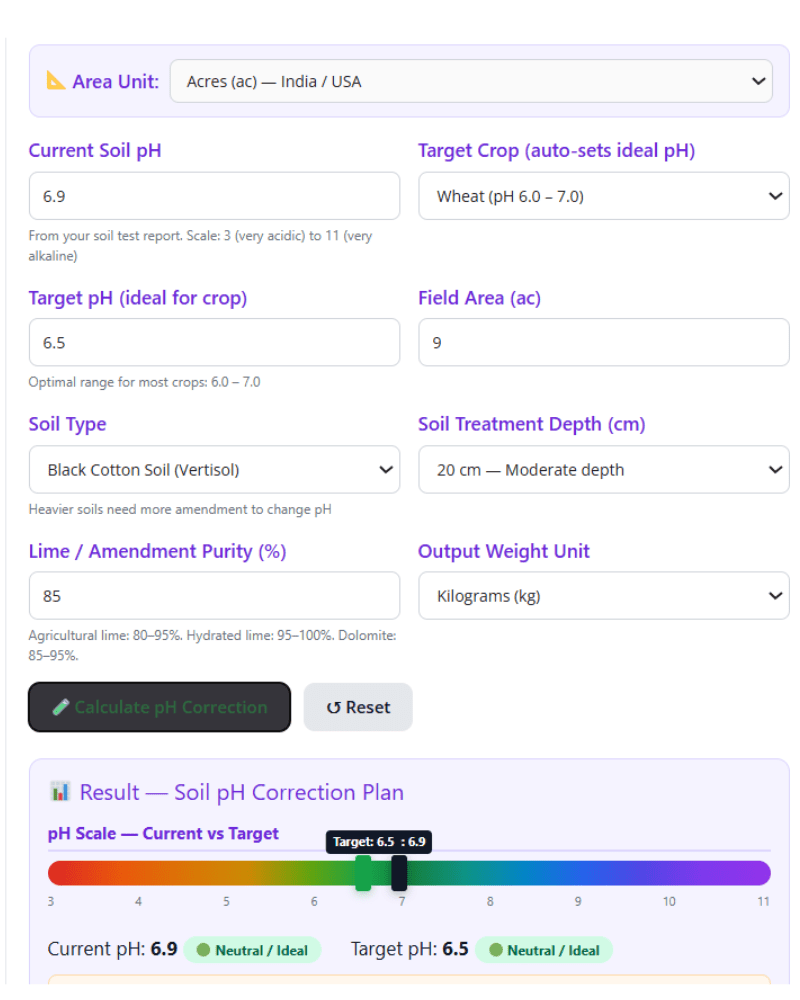
Current Soil pH
This comes from your soil test report. The normal agricultural range is pH 3.0 (very strongly acidic, like peat bogs) to pH 11.0 (very strongly alkaline, like some sodic soils).
For most agricultural soils worldwide, the current pH will fall between 4.5 and 9.0.
Target Crop
Select your crop from a list of over 35 crops including cereals, pulses, vegetables, fruits, and plantation crops.
When you select a crop, the target pH field fills automatically with the ideal pH for that crop. Wheat needs pH 6.0 to 7.0, so the target fills 6.5. Blueberries need pH 4.0 to 5.0, so the target fills 4.5. Tea needs pH 4.5 to 5.5.
You can override this value if you have a specific target pH in mind.
Field Area and Area Unit
Six area units: acres, hectares, square metres, square feet, Guntha, and Bigha. The calculator converts everything to hectares internally for the formula.
Soil Type
This is the most important input after pH. Soil type determines the buffering capacity, which directly controls how much amendment you need.
Seven soil types are supported with their specific buffering values:
- Sandy Soil: Buffering capacity 1.5 tonnes per hectare per pH unit. Easy to change pH but also easy to over-lime.
- Sandy Loam: 2.2 tonnes per hectare per pH unit.
- Loam Soil: 3.0 tonnes per hectare per pH unit. The most common default.
- Clay Loam: 4.2 tonnes per hectare per pH unit.
- Heavy Clay: 5.5 tonnes per hectare per pH unit. Needs significantly more lime than sandy soils.
- Black Cotton Soil (Vertisol): 6.5 tonnes per hectare per pH unit. These soils are extremely resistant to pH change.
- Peat or High Organic Matter Soil: 8.0 tonnes per hectare per pH unit. The hardest to change. Very large lime doses are needed.
Treatment Depth
How deep are you incorporating the amendment? Four options: 10 cm for surface lawns, 15 cm standard topsoil (the default), 20 cm moderate depth, and 30 cm full plough depth.
The dose scales proportionally with depth. A 30 cm treatment needs twice as much amendment as a 15 cm treatment.
Amendment Purity and Weight Unit
Agricultural lime from different suppliers varies in purity from 80 to 95 percent. The tool adjusts the total quantity for your actual purity.
Output weight can be in kilograms, metric tonnes, pounds, quintals, or 50 kg bags.
What Do Your Results Show You?
Visual pH Scale with Two Pins
A colour-coded pH bar shows where your current pH sits and where you’re trying to get to.
The current pH pin is black. The target pH pin is green. The bar runs from red (strongly acidic at pH 3) through green (neutral at pH 7) to purple (strongly alkaline at pH 11).
This visual makes it immediately clear how far your pH is from its target and in which direction you need to move.
Direction Message and Status Badges
The tool tells you clearly: your soil is too acidic and needs lime, or your soil is too alkaline and needs acidifying.
Both your current and target pH get classified as Strongly Acidic, Moderately Acidic, Neutral, Moderately Alkaline, or Strongly Alkaline.
Four Amendment Cards
For raising pH you get quantities for: agricultural lime (CaCO3), dolomitic lime, hydrated lime, and wood ash.
For lowering pH you get quantities for: elemental sulphur, aluminium sulphate, ferrous sulphate, and acidic organic matter.
Each card shows the total quantity needed for your field, a brief description of the material, and when to choose it over the alternatives.
This gives you options based on what’s actually available from your local supplier.
Detailed Summary
The summary confirms all your inputs and shows: pure amendment needed at 100 percent purity, adjusted amount for your actual purity, total bags to order, number of seasons to complete the correction, and estimated pH after the first season’s application.
Crop Suitability Table
This is one of the most useful outputs in the tool.
It shows eight common crops with their ideal pH range, and whether each crop is Suitable, Marginal, or Not Suitable at your current pH and at your target pH.
It answers the question your soil test raised: which crops can I grow now, and which become possible after treatment?
Application Tips
A detailed set of practical application instructions appears based on whether you’re raising or lowering pH.
For lime: how long before planting to apply, whether to incorporate or surface apply, what fertilizers not to mix with lime, how to split doses for large pH changes.
For sulphur: timing for bacterial conversion, when to use aluminium sulphate instead, aluminium toxicity warnings, and organic farming alternatives.
What Makes This Calculator Accurate
Soil-Type-Specific Buffering Capacity
This is the key feature that makes this calculator more accurate than most others.
Many basic pH calculators give a single lime rate for all soils. That’s wrong.
A sandy soil and a black cotton soil require completely different quantities of lime to achieve the same pH change. The tool uses seven different buffering capacity values, each backed by soil science research.
35-Plus Crop Auto-Fill
Selecting your crop automatically sets the target pH. You don’t need to look up the ideal pH for wheat or blueberries separately. The tool knows it and fills it in.
This covers cereals, pulses, cash crops, vegetables, fruits, plantation crops, and turf grass.
Four Alternatives Per Direction
Different amendments are available in different regions. Agricultural lime is the default, but dolomite, hydrated lime, and wood ash are all options for raising pH.
For lowering pH, elemental sulphur, aluminium sulphate, ferrous sulphate, and acidic organic matter each have different use cases.
Showing all four with their quantities means you can choose what’s available locally rather than being told to use a product you can’t source.
Seasonal Planning Output
Large pH corrections can’t be done in one season. Over-liming causes its own problems, including phosphorus and micronutrient lockup.
The tool tells you how many seasons the correction will take, and estimates the pH after the first season’s application. This turns a one-time calculation into a multi-season management plan.
Who Benefits Most from This Tool?
- Farmers Receiving Soil Test Results: A soil test report shows you your pH. This tool tells you what to do about it. Enter the number from your report and get an immediate treatment plan.
- Farmers Changing Crops: Switching from cotton to vegetables, or from wheat to blueberries, requires different pH ranges. This tool calculates the amendment needed to transition your soil to the new crop’s requirement.
- New Farm Setups: Before your first crop on new land, use this tool to plan the pH correction needed to bring the soil into the optimal range.
- Organic Farmers: Wood ash and acidic organic matter are both included as organic amendment options. The tool supports organic farming transitions where synthetic lime grades must be replaced with approved materials.
- Extension Workers and Soil Advisors: A quick tool for translating soil test results into amendment recommendations during farm visits or training sessions.
- Agricultural Students: The soil buffering concept, pH correction formula, and crop suitability relationships make this tool a practical learning aid for soil science students.
Step-by-Step: How to Use the Soil pH Corrector Calculator
Here’s a complete example. Your soil test shows pH 5.2 on a 2-acre loam field. You’re planning to grow wheat next season. Your lime supplier sells agricultural lime at 85 percent purity.
- Open the Soil pH Corrector Calculator on Precision Agriculture Calculators.
- Set Area Unit to Acres.
- Enter Current Soil pH as 5.2.
- Select Wheat from the crop dropdown.
- The Target pH auto-fills to 6.5.
- Enter Field Area as 2.
- Select Loam Soil as Soil Type.
- Keep Treatment Depth at 15 cm.
- Enter Lime Purity as 85.
- Set Output Weight Unit to Bags of 50 kg.
- Click Calculate pH Correction.
Here’s what you’ll see:
- Direction: Your soil is too acidic. Raise pH by 1.3 units.
- Soil buffer for loam = 3.0 tonnes per hectare per pH unit.
- Pure lime needed = 3.0 x 1.3 x (15/15) = 3.9 tonnes per hectare.
- Field area = 2 acres = 0.809 hectares.
- Total pure lime = 3.9 x 0.809 = 3.15 tonnes = 3,155 kg.
- Adjusted for 85% purity: 3,155 / 0.85 = 3,712 kg = approximately 75 bags of 50 kg.
- Seasons required: 2 to 3 seasons. Expected pH after first season: approximately 6.0.
The crop suitability table shows wheat as Not Suitable at pH 5.2, changing to Suitable at pH 6.5.
The application tip reminds you to apply lime at least 4 to 8 weeks before planting and not to apply urea or DAP at the same time as lime.
For detailed lime requirement calculation methods and soil buffering standards, refer to FAO Soils Portal: Soil pH Management and the USDA NRCS Soil Health resources. For crop-specific pH requirements, the Penn State Extension Soil pH and Liming Guidelines is one of the most comprehensive globally available references.
Related Tools on Precision Agriculture Calculators
Use the Soil pH Corrector alongside these tools for a complete soil management program:
- Gypsum Requirement Calculator — For soils with high pH caused by sodium (sodic soils), gypsum is required in addition to or instead of lime. Use this tool to calculate the gypsum dose.
- Organic Carbon to NPK Ratio Calculator — After correcting your pH, check how much NPK your organic matter is supplying before planning your fertilizer program.
- Compost Pile Calculator — Adding compost improves soil buffering capacity and helps maintain corrected pH for longer.
- Crop-wise Fertilizer Calculator — Plan your fertilizer program for your target crop after pH correction.
Frequently Asked Questions
What is the difference between agricultural lime, dolomite, and hydrated lime?
Agricultural lime (calcium carbonate, CaCO3) is the standard and safest choice for raising soil pH. It’s slow-acting, lasting 3 to 5 years, and safe to apply near crops.
Dolomitic lime contains both calcium and magnesium carbonate. It raises pH similarly to agricultural lime but also corrects magnesium deficiency. Use it when your soil test shows both low pH and low magnesium.
Hydrated lime (calcium hydroxide) is more reactive and faster-acting than agricultural lime. It corrects pH in about 4 to 6 weeks instead of 3 to 6 months. However, it can burn crops and skin if handled carelessly. Apply it well before planting and at slightly lower rates.
How long does it take for lime to change soil pH?
Agricultural lime is slow. It typically takes 3 to 6 months to fully react and change soil pH, depending on soil moisture, temperature, and how finely ground the lime is.
Apply lime at least one full season before you need the corrected pH. For spring planting, apply the previous autumn. For winter crops, apply in late spring or summer.
Hydrated lime works faster, showing pH change in 4 to 8 weeks. Elemental sulphur for lowering pH takes 4 to 8 weeks in warm, moist soil with active bacteria.
Why does the same pH change need different amounts of lime on different soils?
This is the soil buffering capacity effect. Soil chemistry resists pH change. The more clay, organic matter, and active cation exchange capacity in your soil, the stronger the buffering.
A sandy soil has weak buffering. A small addition of lime shifts the pH quickly. A heavy clay or peat soil has very strong buffering. A large addition of lime is absorbed by the soil chemistry before any pH change occurs.
This is why lime recommendations from a bag label or a single generic table are often wrong. Your specific soil type matters enormously. The seven buffering values in this calculator account for this correctly.
Can I apply too much lime? What happens?
Yes. Over-liming raises pH above the optimal range, which creates its own nutrient availability problems.
Above pH 7.5, iron, manganese, zinc, boron, and copper become less available. Phosphorus also precipitates out of solution at very high pH.
Over-liming is most likely on sandy soils because their low buffering capacity means pH changes sharply with even moderate lime applications.
This is why the tool recommends splitting large doses over two to three seasons. Gradual correction is always safer and more effective than a single large application.
My soil is alkaline. Can I actually lower it significantly?
Yes, but it takes time and consistent effort.
For moderately alkaline soils between pH 7.5 and 8.5, elemental sulphur applied and incorporated 4 to 6 weeks before planting can bring pH down by 0.5 to 1.0 units per season.
For strongly alkaline soils above pH 8.5, the problem is often caused by calcium carbonate in the subsoil or by sodicity, both of which buffer against acidification. In these cases, gypsum for sodic soils combined with sulphur for carbonate-driven alkalinity gives better results.
Use the Gypsum Requirement Calculator on Precision Agriculture Calculators alongside this tool if your pH is above 8.5.
Conclusion
Soil pH correction is one of the most impactful soil management decisions you can make. The right pH unlocks nutrients that are already in your soil, makes your fertilizer investment more efficient, and creates the conditions for your target crop to thrive.
The Soil pH Corrector Calculator on Precision Agriculture Calculators takes the guesswork out of that decision. Enter your current pH, select your crop, choose your soil type and field area, and get a precise amendment plan in seconds. You see the pH scale visually, get four product options with quantities, understand how many seasons the correction will take, and check which crops become viable after treatment. It’s everything you need to turn a soil test result into a field action plan.
Disclaimer
The Soil pH Corrector Calculator on Precision Agriculture Calculators provides amendment quantity estimates based on standard soil science buffer capacity equations, FAO and university extension guidelines, and soil-type-specific parameters. Results are approximate and intended for planning purposes only.
Actual lime or acidifier requirements vary with soil organic matter content, existing calcium carbonate levels, soil mineralogy, moisture conditions, and the specific formulation of the amendment product used. The buffering capacity values used in this calculator are representative averages for each soil type category and may differ from your specific soil’s measured buffer pH.
Always confirm recommendations with a certified soil test from a qualified laboratory and consult your local agricultural extension service or agronomist before large-scale amendment application. Do not use this calculator as a substitute for professional soil analysis. The author and Precision Agriculture Calculators accept no liability for crop damage or soil management outcomes arising from amendment decisions made based on this tool.