Introduction: Your Fruits and Vegetables Meet International Export Standards
Your produce reaches the packing house. Now what?
Most farmers growing for export find out their produce doesn’t meet the standard after it has already been packed, shipped, or rejected at the buyer’s dock. That rejection is not just a lost sale. It’s the cost of cold storage, transport, packaging, and all the labour between the farm and the rejection point.
The question you need to answer is not at the packing house. It’s in the field, 10 to 14 days before harvest.
Does my produce meet the size, weight, Brix, colour, and defect standards for the market I’m targeting?
That’s exactly what the Advanced Export Quality Grader on Precision Agriculture Calculators answers.
Select your export market, choose your produce, enter your quality measurements, and the tool scores your produce on five parameters and delivers an immediate grade: Premium Export, Standard Export, Domestic/Secondary Market, or Not Export Quality.
It covers 25 produce types, five international markets, and generates a crop-specific improvement recommendation pointing to exactly which parameter is pulling your grade down.
Use it during farm visits, at the packing house, or in your pre-harvest scouting to make informed decisions before you commit to an export shipment.
Advanced Export Quality Grader
Estimate whether your fruits or vegetables meet international export standards — based on size, weight, colour, Brix level, and appearance. Covers EU, USA, Middle East, Asia, and Africa markets.
| Produce | Min Size (mm) | Min Weight (g) | Min Brix (°) | Colour Requirement | Key Export Markets |
|---|
Why Export Quality Standards Exist and Why They Are Getting Stricter
International trade in fresh fruits and vegetables is governed by quality standards that protect consumers, ensure food safety, and maintain market confidence.
The primary international references are the UNECE (United Nations Economic Commission for Europe) Agricultural Quality Standards, which cover over 70 fresh fruit and vegetable products and are used as the basis for trade standards in the European Union, many Middle Eastern markets, and much of Asia.
In the United States, the USDA Agricultural Marketing Service (AMS) grading standards define quality grades for fresh produce. Globally, the Codex Alimentarius Commission (a joint FAO and WHO body) publishes international food standards including quality parameters for fresh produce traded across borders.
Here’s why these standards matter to your farm income:
- They determine which price tier you access. Premium export grade produce commands the highest price per kilogram, often 2 to 4 times the domestic market price. Standard export grade gets a lower but still export-level price. Domestic grade produces domestic market returns. The quality gap between your produce and the premium standard directly translates to income left on the table.
- Different markets have different requirements. The European Union is the most demanding buyer globally for fresh produce. EU standards for mango require 60 mm minimum diameter, 200 gram minimum weight, and 14 degrees Brix minimum. The same mango going to Africa only needs to meet 50 mm, 120 grams, and 12 degrees Brix. Knowing which market’s standard applies to your produce determines which standard to benchmark against.
- Rejections are expensive beyond the lost sale. A rejected shipment costs the freight, cold chain, packaging, and inspection fees already spent. Repeated rejections damage your buyer relationship and can result in loss of the export contract entirely. Grading accurately before shipment prevents these costs.
- The path to premium is specific, not general. Many farmers know their produce doesn’t quite make premium grade but don’t know which specific parameter to fix. Is it size? Brix? Colour uniformity? Defects? Each parameter has a different agronomic solution. Identifying the weakest one is the first step to fixing it.
The Five Quality Parameters and Why Each Matters
Size (Diameter in mm)
Size is the most visible and easily measured quality parameter. Supermarkets and premium importers want consistency. A crate of uniform mangoes of 70 mm plus looks professional and commands premium prices. A mixed crate of 55 to 80 mm looks like it came from an unmanaged orchard.
Minimum size standards prevent small, immature fruit from reaching the consumer. EU mango minimum is 60 mm. EU apple minimum is 60 mm. EU tomato has five size categories starting at 35 mm. The size your produce achieves is a function of variety genetics, thinning management, nutrition, and irrigation timing.
Weight (Grams)
Weight and size are related but not identical. A fruit can be wide but hollow, giving adequate diameter but insufficient weight. Weight reflects fruit density and water content, both of which relate to maturity and eating quality.
Premium buyers for pomegranate in the Middle East require 280 grams minimum. Watermelon export requires 2,000 grams minimum for EU. Grapes are often traded by bunch weight rather than individual berry weight. Weight is the commercial currency of fresh produce trade.
Brix Level (Sugar Content)
Brix is the measurement of dissolved solids in fruit juice, principally sugars. It’s measured with a refractometer. A reading of 14 degrees Brix in mango means 14 grams of sugar per 100 grams of juice.
Brix is the single most important indicator of eating quality for sweet fruits. A consumer who bites into a mango with 11 degrees Brix will be disappointed. A mango with 17 degrees Brix will generate a repeat purchase. EU premium buyers require a minimum of 14 degrees Brix for mango and 16 degrees for table grapes.
Not every produce has a Brix minimum. Vegetables like onion, potato, cucumber, and garlic are not typically evaluated on Brix. For these, the tool still accepts a value but applies a neutral weight.
Colour Quality
Colour is what the buyer sees first. It is the most immediate signal of ripeness, variety, and care in production.
The tool grades colour in three levels: Excellent (uniform natural colour, no marks, bright appearance), Good (mostly uniform with minor variations), and Poor (uneven, faded, off-colour, or visible discolouration).
For the African and Asian markets, colour carries 25 percent of the total grade weight. For EU and US markets, it carries 20 percent. Colour improvement comes from canopy management for light exposure, correct potassium and phosphorus nutrition in the final weeks, and avoiding over-irrigation at maturity.
Shape and Physical Defects
Physical defects include bruising from rough handling, cuts and cracks from field conditions, insect damage, disease marks, and shape deformities from irregular growth.
The tool grades defects in three levels: Perfect Shape (no defects, uniform typical shape), Minor Defects (small surface marks within tolerance), and Visible Defects (bruising, cuts, cracks, insect damage, or deformities present).
Defects carry between 10 and 20 percent of total grade weight depending on the market. Africa weighs defects at 20 percent because local handling infrastructure is less consistent and buyers accept it as a reality. EU weighs defects at only 10 percent because other parameters are more tightly controlled by standards.
The Five Export Markets and Their Different Priorities
European Union
The most demanding market globally. UNECE standards apply across all EU member states. Size and Brix each carry 25 percent of the grade weight in this tool.
EU buyers are particularly strict about Brix for sweet fruits like mango, grapes, and strawberry. They also require very tight size uniformity within a crate. EU minimum standards for mango (60 mm, 200 g, 14 Brix) are the global benchmark.
United States
USDA AMS grading standards apply. Size carries 25 percent weight. The US market has slightly lower minimum Brix requirements than EU but places more emphasis on defect absence (15 percent weight) due to the importance of visual presentation in US retail.
Middle East
Weight is the dominant parameter at 25 percent. Middle Eastern buyers, particularly in UAE, Saudi Arabia, Kuwait, and Qatar, emphasize size and weight over Brix. A big, heavy mango commands a premium even if Brix is slightly lower than EU standards.
Middle East pomegranate standards are the most demanding globally: 280 grams minimum, 65 mm minimum diameter. This market also has the highest minimum sizes for most produces.
Asia
Colour carries the highest weight at 25 percent in the Asian market. Visual appeal is culturally important in Asian fresh produce retail. Japan, Korea, Singapore, and Hong Kong premium retailers pay significant premiums for cosmetically perfect produce.
Size and weight minimums are generally slightly lower than EU for most produce, reflecting the preference for smaller, more uniform pieces in Asian cuisines and retail formats.
Africa
The most accessible market for producers who are transitioning toward export. Minimum size, weight, and Brix requirements are the lowest of the five markets. Defects carry 20 percent weight because the market accommodates more variability.
Africa is also the fastest-growing import market for fresh produce globally. Producers who establish quality supply relationships in African markets today are positioning for a premium as the market develops.
What Does the Export Quality Grader Calculator Ask You to Enter?
Export Market Selection
Click one of five market buttons: EU, USA, Middle East, Asia, or Africa. This selection changes the minimum standards and parameter weights used in the calculation.
If you’re not sure which market to target, try your produce against EU standards first. If it grades Standard or above for EU, it will grade Premium for most other markets.
Produce Selection
25 produce types across two groups. Fruits: mango, apple, banana, orange/citrus, grapes, pomegranate, watermelon, pineapple, papaya, avocado, kiwi, lemon/lime, pear, strawberry, guava. Vegetables: tomato, potato, onion, cucumber, carrot, capsicum/bell pepper, chili pepper, brinjal/eggplant, garlic, okra.
When you select a produce, the size, weight, and Brix fields auto-fill with typical values slightly above the selected market’s minimum. A blue hint box also appears with produce-specific export advice.
Variety or Type
Standard commercial variety receives no bonus. Premium or export variety (Alphonso mango, MD2 pineapple, Hass avocado, Red Lady papaya) receives a 5-point bonus. Certified organic variety receives a 3-point bonus.
This bonus reflects the real market premium that branded and certified varieties command over standard commercial produce.
Size, Weight, and Brix
Enter your actual measurements. Each parameter has both a number input and a visual slider. Adjust the slider or type the number directly.
Measure size with a calliper at the widest point of the fruit. Weigh individual fruit on a digital scale. Measure Brix with a refractometer from a representative juice sample from 3 to 5 fruits.
Colour Quality and Defects
Select from three visual cards for each. Colour: Excellent, Good, or Poor. Defects: Perfect Shape, Minor Defects, or Visible Defects. These are subjective assessments based on your observation of a representative sample of your produce.
What Do Your Results Show You?
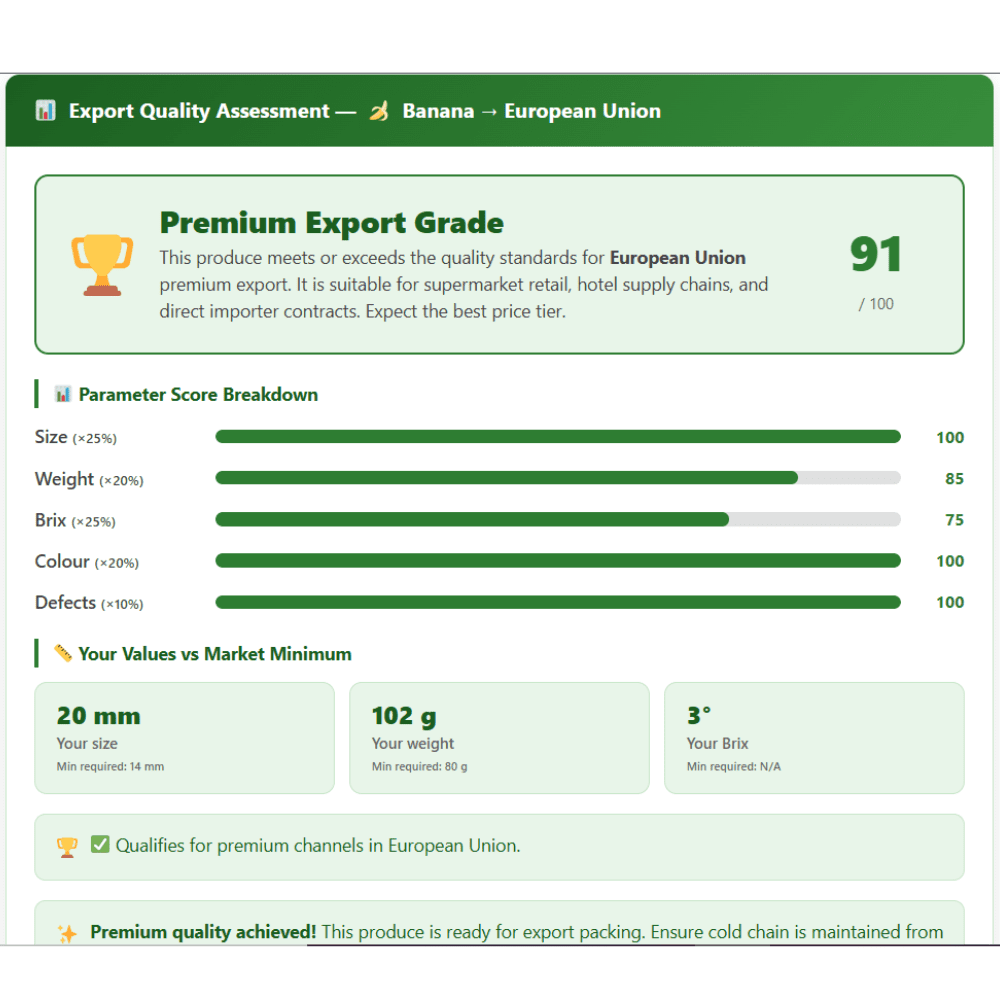
Grade Banner
A prominent colour-coded banner shows your final grade and total score out of 100.
Green banner with a trophy icon means Premium Export Grade (80 and above). Orange banner means Standard Export Grade (60 to 79). Blue banner means Domestic or Secondary Market (40 to 59). Red banner means Not Export Quality (below 40).
The description beneath the grade explains what the grade means for that specific market.
Parameter Score Bars
Five horizontal bars show your score for each parameter: size, weight, Brix, colour, and defects. Each bar is colour-coded: green for 70 and above, orange for 40 to 69, red for below 40.
The parameter weight percentage is shown next to each label, so you can immediately see which parameters are carrying the most grade weight for your selected market.
Your Values versus Market Minimum
Three cards show your actual size, weight, and Brix values alongside the market minimum for your selected produce and market. A card with an orange background signals that your value is below or close to the minimum.
Key Improvement Recommendation
For produce scoring below Premium, the tool identifies the single weakest parameter by weighted score and gives a specific improvement recommendation.
If size is the weakest parameter: the tip explains to allow more time on the tree or vine, increase potassium at fruit development stage, or adjust thinning. If Brix is weakest: delay harvest by 5 to 7 days, apply potassium sulphate foliar spray, and reduce irrigation 10 days before harvest to concentrate sugars.
These are not generic recommendations. They are crop-science-backed interventions for the specific limiting parameter.
Premium Produce Tip
When the grade is Premium, instead of an improvement recommendation, a green tip box advises on maintaining the quality through cold chain from the packing house and applying pre-harvest fungicide if required by the destination market.
The Produce Standards Reference Table (Tab 2)
The second tab is a complete produce standards reference for all 25 produce types.
The table shows EU and Middle East minimum size, weight, and Brix for each produce, plus the key colour and appearance requirement for each.
A search box filters the table by produce name. Type mango to see only mango. Type berry to see strawberry. This makes the table useful as a standalone reference guide even without running a grade calculation.
The note at the bottom of the table acknowledges that these are reference standards based on UNECE, USDA AMS, and Codex Alimentarius data, and that actual buyer specifications should always be confirmed before shipment.
What Makes This Grader More Useful Than a Simple Checklist
Market-Specific Scoring
Most produce quality guides give a single standard. This tool gives five different minimum standards and five different parameter weightings for five markets.
The practical implication is significant. A mango that grades Domestic for EU may grade Premium for Africa. Knowing this lets you make an informed market routing decision before packing rather than defaulting to the closest buyer.
Weighted Scoring System
The five parameters do not all carry equal weight. EU weights Brix at 25 percent because sweetness drives repeat purchase in EU retail. Africa weights defects at 20 percent because handling infrastructure creates more surface damage and buyers factor this in.
These weightings reflect real buyer priorities. A flat checklist that treats size equal to colour equal to Brix misses the nuance of what actually drives premiums in each market.
Weakest Parameter Identification
This feature alone is worth using the tool for before every harvest decision.
Instead of a general ‘your produce is sub-standard’ result, the tool tells you exactly which parameter is pulling your grade down and what to do about it agronomically. This turns the grade assessment into an actionable pre-harvest management recommendation.
25 Produce Types with Individual Standards
Each of the 25 produce types has individual minimum values for size, weight, and Brix across all five markets. That’s 375 individual data points drawn from published international trade standards.
The hint box for each produce adds the most commercially important buyer-specific guidance: Alphonso and Kesar variety preferences for EU mango buyers, Dry matter content rather than Brix for avocado maturity, Thompson Seedless and Red Globe as globally traded grape varieties.
Who Benefits Most from This Tool?
- Export-Oriented Farmers Making Harvest Timing Decisions: Use the tool 10 to 14 days before expected harvest to check whether current fruit size and Brix are approaching export standard. If not quite there, you know exactly how many more days on the tree and which inputs to apply.
- Farmers Evaluating New Export Markets: Before committing to a new buyer relationship with a specific market, run your typical produce quality against that market’s standards. Understand whether your current production system can meet the requirements without changes or whether agronomic or infrastructure investment is needed first.
- Packing House Managers and Quality Controllers: A quick grading tool for preliminary assessment of incoming produce from contract farmers. Identify out-of-specification lots before packing resources are committed.
- Agricultural Extension Workers and Export Development Officers: A field advisory tool for assessing farmer produce quality during on-farm visits and helping farmers understand the gap between their current quality and target market standards.
- Agri-Finance Officers Assessing Export Loans: Verify whether a borrower’s stated produce quality matches export grade standards before approving export working capital loans.
- New Exporters Building Buyer Relationships: Before approaching a new buyer, use the reference table to understand their market’s standard requirements and benchmark your produce against those requirements with confidence.
Step-by-Step: How to Use the Export Quality Grader
Here’s a complete example. You have Alphonso mangoes ready for potential EU export. You’ve measured: diameter 68 mm, weight 230 grams, Brix 15.5 degrees. Colour is excellent. No visible defects.
- Open the Advanced Export Quality Grader.
- Click the European Union market card.
- Select Mango from the produce dropdown.
- Select Premium/Export Variety (Alphonso counts as premium).
- Enter Size as 68 mm.
- Enter Weight as 230 g.
- Enter Brix as 15.5.
- Click Excellent for Colour Quality.
- Click Perfect Shape for Defects.
- Click Evaluate Export Quality.
Here’s what the results show:
- EU mango minimums: 60 mm, 200 g, 14 Brix.
- Size score: 68 mm is above 60 mm minimum and above 1.1x threshold (66 mm). Score = 85.
- Weight score: 230 g is above 200 g minimum and above 1.2x threshold (240 g) — not quite. Score approximately 70.
- Brix score: 15.5 is above 14 minimum and above 1.1x threshold (15.4). Score = 85.
- Colour score: Excellent = 100.
- Defect score: Perfect = 100.
- EU weights: Size 25%, Weight 20%, Brix 25%, Colour 20%, Defect 10%.
- Weighted score = (85×0.25) + (70×0.20) + (85×0.25) + (100×0.20) + (100×0.10) + 5 (premium bonus) = 21.25+14+21.25+20+10+5 = 91.5 rounded to 92.
- Grade: Premium Export Grade.
Your Alphonso mangoes qualify for EU premium export. The tip box confirms readiness and advises on cold chain management from the packing house.
If your weight had been 185 grams instead of 230 grams (below the 200 gram EU minimum), the weight score would drop to approximately 40, pulling the total down to around 73, which still grades Standard Export but not Premium. The improvement tip would identify weight as the weakest parameter and recommend ensuring adequate irrigation at fruit development stage and applying calcium and boron foliar sprays.
For official export standards documentation, refer to the UNECE Agricultural Quality Standards database, the USDA AMS Grades and Standards for fresh fruits and vegetables, and the Codex Alimentarius Commission standards for fresh produce. Always confirm specific buyer requirements directly with your importer before shipment as buyer specifications may be stricter than published minimum standards.
Related Tools
Use the Export Quality Grader alongside these tools for a complete post-harvest and export management program:
- Cold Storage Calculator — After grading for export, calculate your cold storage energy requirements and capacity to maintain quality during pre-shipment storage.
- Grains Storage Capacity Calculator — Plan your overall storage infrastructure for post-harvest management of bulk produce.
Frequently Asked Questions
What is Brix and how do I measure it?
Brix is the measurement of dissolved sugars in fruit juice, expressed as a percentage by weight. A reading of 14 degrees Brix means 14 grams of sugar per 100 grams of juice.
You measure Brix with a refractometer, which costs between 10 and 50 in most currencies and is available from agricultural suppliers. Squeeze a drop of juice from 3 to 5 representative fruits onto the prism of the refractometer, hold it to light, and read the scale where the light meets the dark region.
For accurate readings, sample from different parts of the fruit (equatorial zone is standard), ensure the refractometer is calibrated to zero with distilled water before use, and measure at the same time of day for consistency across samples.
My produce grades Standard Export but not Premium. Is it worth exporting?
Yes, in most cases. Standard Export grade produce can still achieve significantly better prices than domestic market, typically 1.5 to 2 times domestic price depending on the produce and market.
The key is to route Standard grade produce to markets where your quality achieves the best relative grade. Standard grade for EU may be Premium grade for Africa. The tool lets you check this by running the same measurements against multiple markets.
Also identify the weakest parameter from your result and address it agronomically for the next season. Consistent progression from Standard to Premium over 2 to 3 seasons is a realistic quality improvement trajectory for most producers.
The tool auto-filled my size and weight when I selected the produce. Why?
The tool pre-fills values that are slightly above the minimum standard for the selected market and produce. This gives you a starting point that represents average export-quality produce.
Override these values with your actual measured numbers. The auto-filled values are not your produce measurements. They’re just a convenience starting point to demonstrate how the tool works.
What is UNECE and why are its standards relevant to my farm?
UNECE stands for the United Nations Economic Commission for Europe. It publishes voluntary international standards for fresh fruit and vegetable quality that have been adopted as mandatory requirements by the European Union and are used as reference standards by many other markets worldwide.
If your produce will be exported to any EU country, UNECE standards are the binding legal requirement. If your produce goes to the Middle East, many buyers reference UNECE standards as their purchase specification even when it’s not a legal requirement.
Familiarizing yourself with the UNECE standard for your main produce is one of the most useful investments any export-oriented farmer can make. The standards are freely downloadable from the UNECE website.
Can I use this tool for spices, grains, or processed products?
The current tool covers fresh fruits and vegetables only. Spices, dried produce, grains, and processed products are governed by entirely different quality frameworks including moisture content, aflatoxin limits, pesticide residue standards, and microbiological requirements that are not captured in a size-weight-Brix-colour-defect assessment.
For fresh produce export, this tool provides a reliable pre-shipment quality check. For other agri-commodities, consult your exporter or the relevant national food safety and standards authority for the specific parameters required.
Conclusion
Export quality rejection is not random. It happens when specific measurable parameters fall below specific market standards.
The Advanced Export Quality Grader on Precision Agriculture Calculators makes those parameters visible and measurable before you pack a single carton. Select your market, enter your produce measurements, and get a grade with a weighted parameter breakdown and a specific improvement recommendation for the weakest link.
Use the reference table in Tab 2 to look up standards for any of the 25 produce types across five markets. Use the pre-harvest improvement tips to fix the limiting parameter this season before you commit to shipment. Export quality starts in the field, not at the packing house. This tool helps you measure it where it can still be changed.
Disclaimer
The Advanced Export Quality Grader on Precision Agriculture Calculators provides export quality assessments based on published UNECE, USDA AMS, and Codex Alimentarius international produce standards. Results are indicative estimates for planning and educational purposes only.
Actual export eligibility is determined by the specific buyer contract, destination country import regulations, phytosanitary requirements, pesticide residue limits, food safety certifications, and inspection results at port of entry, none of which are captured in this calculator.
Market minimum standards used in this tool are general reference values and may not reflect current buyer-specific requirements, which can be stricter or more flexible than published minimums. Brix, size, weight, colour, and defect assessments depend on accurate field measurement by the user.
The scoring and grade thresholds used in this tool are weighted estimates and may differ from formal grading decisions made by licensed produce inspectors. Always confirm specific buyer requirements directly with your importer and consult a qualified export development officer or agricultural extension service before committing to an export shipment. The author accept no liability for export rejections, financial losses, or trade disputes arising from quality decisions made based on this calculator.